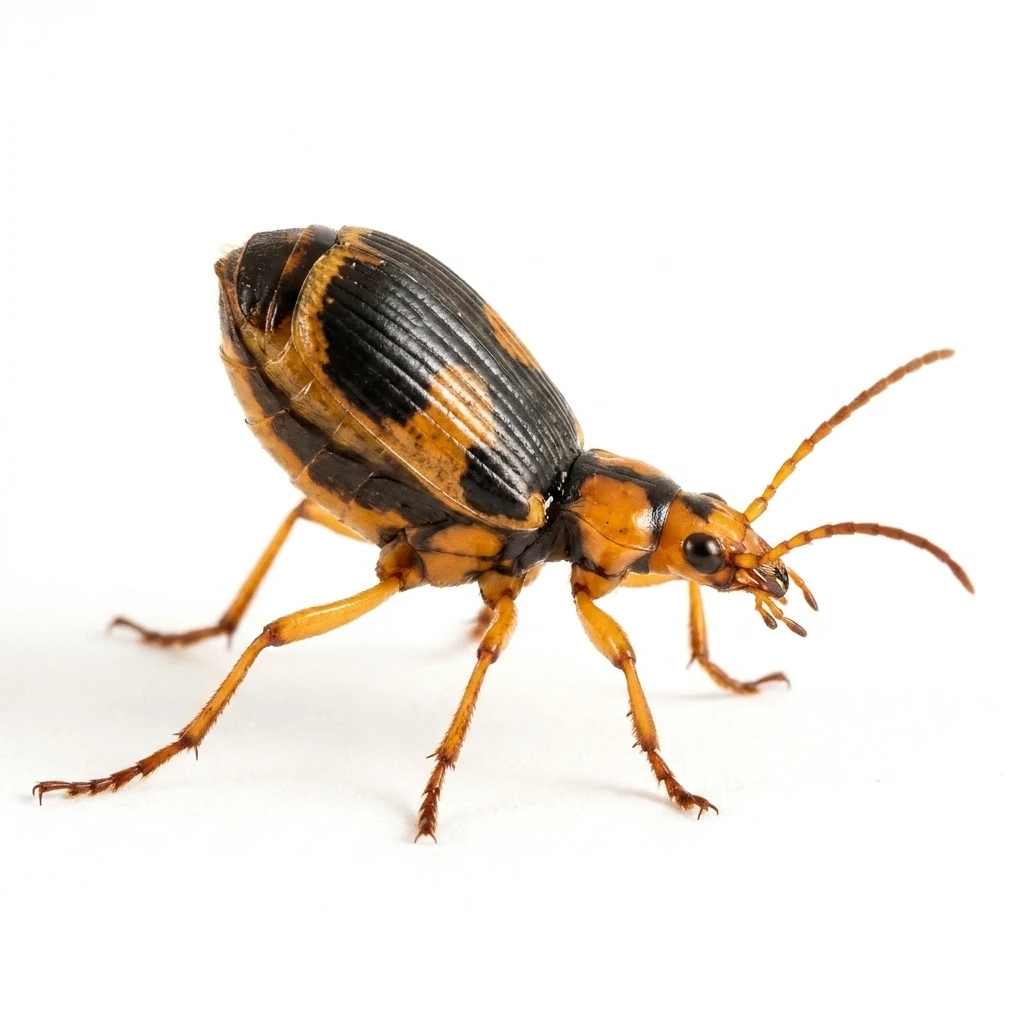
The bombardier beetle’s defensive system reads like a chemistry-lab accident that learned to walk. When threatened, the beetle fires a jet of boiling, corrosive liquid from a turret-like nozzle on the tip of its abdomen, aimed with surprising accuracy at the attacker. The temperature reaches around 100 °C (212 °F) — the boiling point of water — and the spray emerges not as a steady stream but as rapid pulses, roughly 500 per second.
It is, in effect, a microscopic pulse-jet engine running inside an insect.
Two chambers, one reaction
The beetle stores two chemicals separately inside its abdomen: hydroquinone and hydrogen peroxide. Both are reactive on their own, but together with a catalyst they undergo a fast, highly exothermic oxidation. The beetle keeps these reactants in a reservoir chamber, mixed but unreacted, because the necessary enzymes are absent there.
When the beetle is attacked, it contracts muscles that push a small amount of the reservoir mixture into a second, smaller chamber called the reaction chamber. This chamber is lined with cells that produce two enzymes: catalase and peroxidase. Within milliseconds, the catalase breaks down hydrogen peroxide into water and oxygen, while peroxidase oxidizes hydroquinone into the irritating compound para-benzoquinone.
The combined reactions release a huge amount of heat and produce a sudden burst of oxygen gas, raising the pressure inside the reaction chamber dramatically. The mixture flashes to near-boiling temperature and is forced out of the abdomen through a nozzle.
Why the spray pulses
Early biologists assumed the beetle simply sprayed a continuous stream. High-speed imaging by Eisner, Aneshansley, and colleagues in the 1990s and 2000s showed something far more elegant: the spray emerges in discrete pulses, around 300 to 1000 per second.
The mechanism resembles a valveless pulse-jet engine of the kind used in some experimental aircraft. As pressure builds in the reaction chamber, a one-way membrane opens and the hot mixture jets out. The resulting drop in pressure closes the membrane, allowing more reactants to flow in from the reservoir for the next burst. The cycle repeats automatically until the threat is gone or the reservoir is empty.
Pulsing has two practical advantages. First, it lets the beetle survive its own weapon. A continuous reaction would build pressure and heat faster than the beetle’s body could safely contain. By breaking the discharge into thousands of small bursts, each pulse can dissipate before the next one starts. Second, the pulsed jet has greater momentum and reach for a given amount of fuel than a continuous spray would.
Aiming the turret
The nozzle at the tip of the abdomen rotates on a flexible joint, giving the beetle roughly 270 degrees of horizontal aim and a wide vertical range. Experiments with restrained beetles show that they can direct the spray toward a stimulus on almost any part of their body, including straight forward over their own head. This swivel control means the beetle doesn’t have to turn to face its attacker — a useful trait when the attacker is faster than it is.
The accuracy is helped by a primitive form of feedback: tactile receptors along the abdomen feed positional information to the muscles controlling the nozzle.
The cost-benefit math
Producing the reactant chemicals is metabolically expensive, and the beetle has a limited supply. A typical adult can fire roughly 20 to 30 bursts before depleting its reservoirs, which then take time to refill. Because of this, the beetle does not spray reflexively at every disturbance. It tends to escalate: warning postures and slow leaks first, full discharge only when contact is imminent.
This frugality makes ecological sense. Most predators that have been sprayed once — frogs, ants, mice, birds — learn to avoid bombardier beetles entirely. The display only needs to work a few times in the beetle’s life to pay back its biochemical investment.
Escaping from inside: the Japanese toad
Most predators learn quickly to avoid bombardier beetles, but some encounters test the beetle’s chemistry against an unusual challenge. In 2018, biologist Shinji Sugiura published a study in Biology Letters documenting what happens when Japanese toads (Bufo japonicus) swallow bombardier beetles whole. The toads were forced to regurgitate the beetles — still alive — an average of 44 minutes later. The beetles had discharged their chemical jet inside the toad’s stomach, triggering vomiting and allowing escape. In laboratory trials, roughly 43 percent of swallowed beetles survived this way. It remains the only documented case of a prey animal actively escaping a vertebrate predator from inside its digestive system by chemical means alone.
What engineers learn from a beetle
The pulsed combustion mechanism has attracted attention from researchers in aerospace propulsion and drug delivery. A team at the University of Leeds, led by Andy McIntosh, published work modeling the bombardier beetle’s reaction chamber as a template for restartable pulsed-injection systems. The interest is not military or whimsical: the beetle solves a real engineering problem — generating short, repeatable pressure bursts at high temperature without external ignition or moving valves — that human-built combustors still struggle with.
Pharmaceutical researchers have looked at the same architecture for inhaler designs that need to deliver bursts of medication with precise droplet size and reach. The beetle’s nozzle geometry, in particular, produces a droplet spectrum that human-engineered atomizers find difficult to match.
Why it matters
The bombardier beetle is more than a curiosity. It is a working example of modular biochemistry under tight evolutionary constraints. Each component — the separation of reactants, the catalytic enzymes, the rigid reaction chamber, the directional nozzle, the metering valve — exists in many other beetles in some form. The bombardier beetle’s ancestors stitched these components into a functioning combustion engine over millions of years, in steps that are still partially traceable in related species.
Studying it tells us how complex biochemical machinery can arise from incremental modifications of pre-existing parts. It also tells us, more bluntly, that a half-inch insect figured out how to safely contain a 100 °C exothermic reaction long before any human engineer attempted it.
Sources and further reading
- Aneshansley DJ, Eisner T, Widom JM, Widom B. “Biochemistry at 100°C: explosive secretory discharge of bombardier beetles (Brachinus).” Science 165(3888):61–63. 1969.
- Dean J et al. “Defensive spray of the bombardier beetle: a biological pulse jet.” Science 248(4960):1219–1221. 1990.
- Eisner T, Aneshansley DJ. “Spray aim in the bombardier beetle: photographic evidence.” Proceedings of the National Academy of Sciences 96(17):9705–9709. 1999.