Educational disclaimer. This article is general biological reference. It is not medical advice, not a clinical guide, and does not describe the diagnosis or treatment of any human condition. All content is drawn from published scientific literature.
A lion succeeds on roughly 25 percent of hunting attempts. A great white shark closes on prey around 50 percent of the time. A dragonfly catches its target on more than 95 percent of attempts. This number, documented across multiple species and experimental settings, makes the dragonfly the most successful aerial predator ever quantified — and it achieves this while hunting insects that are themselves fast, erratic, and alert.
Dragonflies are ancient. Fossils of close relatives date back 325 million years, predating the dinosaurs by 100 million years. Their basic architecture — a cylindrical body, two pairs of independently controlled wings, enormous eyes — has changed relatively little in that time. When an engineering design persists for that long, it is worth examining closely.
Vision that leaves almost nothing blind
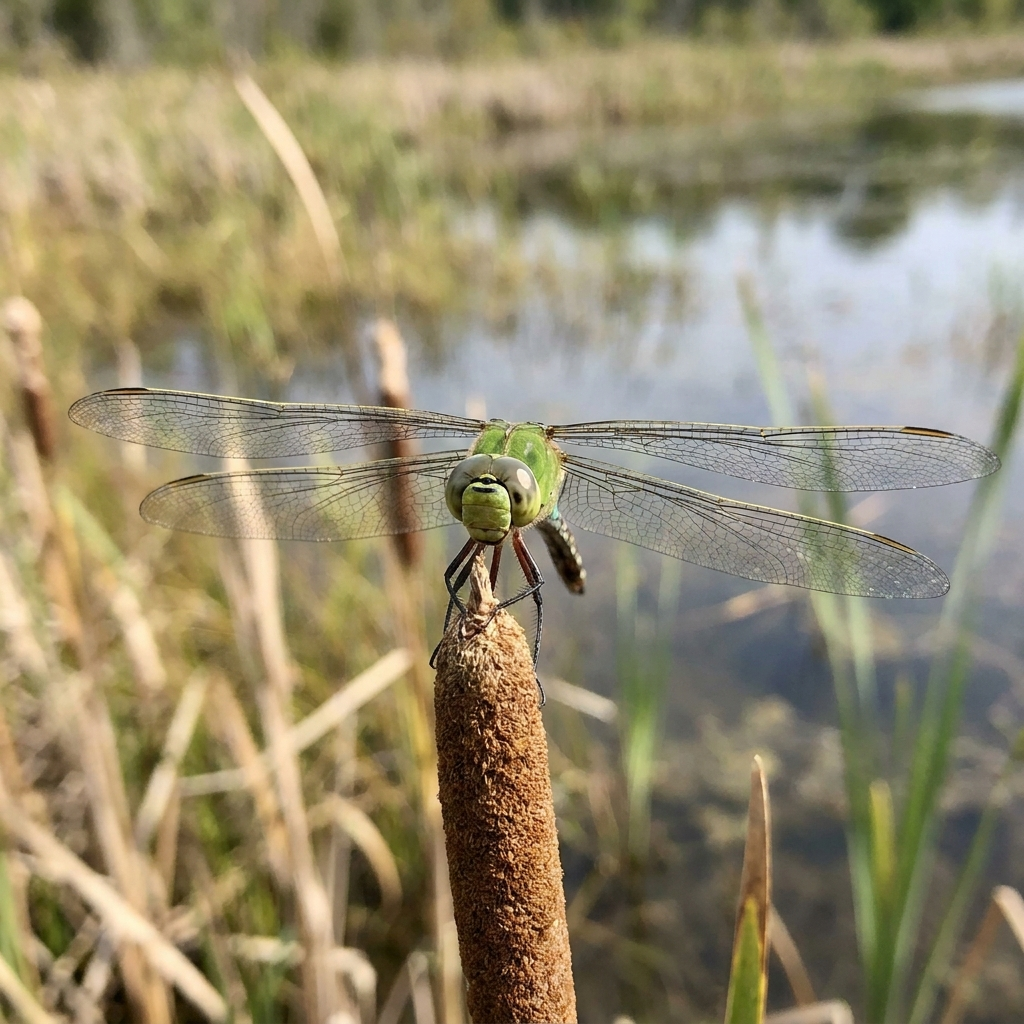
An adult dragonfly’s head is dominated by two enormous compound eyes that together cover approximately 80 percent of the head surface and provide nearly 360-degree visual coverage. Where the eyes meet at the top of the head, they provide overlapping binocular vision forward and upward — the zone where aerial prey is most often found.
Each compound eye contains up to 30,000 individual facets (ommatidia), each sampling a small portion of the visual field. In the dorsal zone of the eye, the facet density is unusually high — roughly 30 ommatidia per degree — giving the upper visual field a spatial resolution comparable, per unit angle, to parts of a vertebrate fovea. This dorsal acute zone is precisely aligned with the forward-and-upward direction a flying dragonfly presents to a target during an interception approach.
Dragonfly photoreceptors also contain multiple opsin types sensitive to different wavelengths, including ultraviolet. Some species have as many as 30 different spectral receptor types — far more than the three cone types in the human eye — potentially enabling extremely fine color discrimination, though how much of this spectral complexity is used in behavioral tasks is still being investigated.
Target-locking: the neuron that ignores everything else
In the dragonfly’s optic lobe lives a small cluster of neurons collectively called the CSTMD1 (Contralateral Small Target Motion Detector 1). These neurons respond selectively to small, dark objects moving against complex, patterned backgrounds — exactly the visual signature of a flying insect at hunting range.
What makes CSTMD1 neurons unusual is their behavior when multiple targets are present simultaneously. Instead of averaging the responses or activating proportionally to all targets, the neuron locks onto one target and suppresses its response to others. Once a target is selected, CSTMD1 actively inhibits responses to competing stimuli, maintaining a clean tracking signal even as the background changes and other insects move through the field.
This neural attentional mechanism — described in detail by Steven Wiederman and David O’Carroll’s group — functions as a selective filter optimized for aerial pursuit. It is functionally analogous to what happens in the primate visual cortex during selective attention, but implemented in a circuit with far fewer neurons.
Predictive flight: flying to where the prey will be
Most visual predators track their prey reactively — they steer toward where the prey is. Dragonflies do not. Instead, they compute an intercept trajectory: they calculate where the prey is going and fly to meet it, leaving the prey’s current position behind.
High-speed video analysis by Combes and colleagues showed that during successful hunts, the dragonfly’s flight path bears little resemblance to the prey’s flight path. The dragonfly holds its head and body at a fixed angle relative to the target — a behavior called fixation — while the body curves toward the intercept point. The prey often appears to disappear from the dragonfly’s forward visual field during the approach, because the dragonfly is not following it but ambushing it from below and behind.
This interception strategy requires computing the prey’s velocity and trajectory, predicting its future position, and executing a curved flight path — all in real time, with a nervous system containing roughly one million neurons (compared to roughly 86 billion in a human).
Four wings that operate independently
Most winged insects operate their two pairs of wings in a mechanically coupled fashion — the forewings and hindwings beat together or in a fixed phase relationship. Dragonflies can control each of their four wings independently, varying the stroke amplitude, frequency, pitch, and phase of each wing separately.
This independent control allows a range of flight maneuvers unavailable to coupled-wing insects. Dragonflies can hover precisely, fly backward, rotate in place, and make abrupt turns of up to 180 degrees without transitional deceleration. During prey capture, they often execute a rapid bank and roll sequence that positions their basket-shaped leg array directly in the prey’s path while their body remains minimally disturbed from the intercept angle.
The wings themselves are not simple rigid surfaces. They are corrugated, with a complex network of veins that creates a non-planar cross-section. Under aerodynamic loading, the corrugations produce delayed stall — the wing continues generating lift at angles of attack that would cause a flat plate to stop flying — and controlled deformation that passively adjusts the wing’s camber during the stroke. Engineers studying dragonfly wing geometry have found that the corrugated design is aerodynamically superior to smooth aerofoils of similar weight at the low Reynolds numbers (small scale, relatively low speed) where dragonflies operate.
A predator’s predator, not often
Despite their hunting efficiency, dragonflies are themselves prey. Birds — particularly aerial hunters like bee-eaters, hobbies, and kingfishers — catch them regularly. They are also taken by spiders in webs and, as nymphs in aquatic stages, by fish.
Dragonfly nymphs (the aquatic larval stage, which can last two to five years depending on species) are themselves effective predators of aquatic invertebrates, small fish, and tadpoles, using a hydraulic jaw called a labial mask that can extend forward at high speed to seize prey. A single dragonfly species therefore occupies a significant predator role at two completely different life stages, in two completely different environments.
The adult, flying stage lasts only a few weeks to a few months depending on species. In that time, the animal must hunt, avoid predators, find a mate, and reproduce. Its near-perfect hunting record is not incidental. It is the product of 325 million years of refinement applied to an animal with no margin for inefficiency.
Sources and further reading
- Mischiati M et al. “Internal models direct dragonfly interception steering.” Nature 517(7534):333–338. 2015.
- Olberg RM, Worthington AH, Venator KR. “Prey pursuit and interception in dragonflies.” Journal of Comparative Physiology A 186(2):155–162. 2000.
- Combes SA et al. “Linking biomechanics and ecology through predator–prey interactions: flight performance of dragonflies and their prey.” Journal of Experimental Biology 215(6):903–913. 2012.