Educational disclaimer. This article is general biological reference. It is not medical advice, not a clinical guide, and does not describe the diagnosis or treatment of any human condition. All content is drawn from published scientific literature.
In 1973, Austrian ethologist Karl von Frisch was awarded the Nobel Prize in Physiology or Medicine, in part for decoding a communication system used by honeybees. What he described was a behavioral display — a stereotyped sequence of movements performed on the vertical face of a honeycomb — that functions as a symbolic map. The dancer encodes the direction of a food source relative to the sun, the distance to it, and some measure of its quality, all through the geometry and intensity of a dance that lasts seconds.
The waggle dance is, as far as biologists have been able to determine, the only non-human communication system that uses arbitrary symbols to encode information about a location that is not physically present. Other animals can signal danger or signal food. The honeybee can tell nestmates where the food is, how far, and whether it’s worth the trip — without the recruits being able to see it.
The structure of the dance
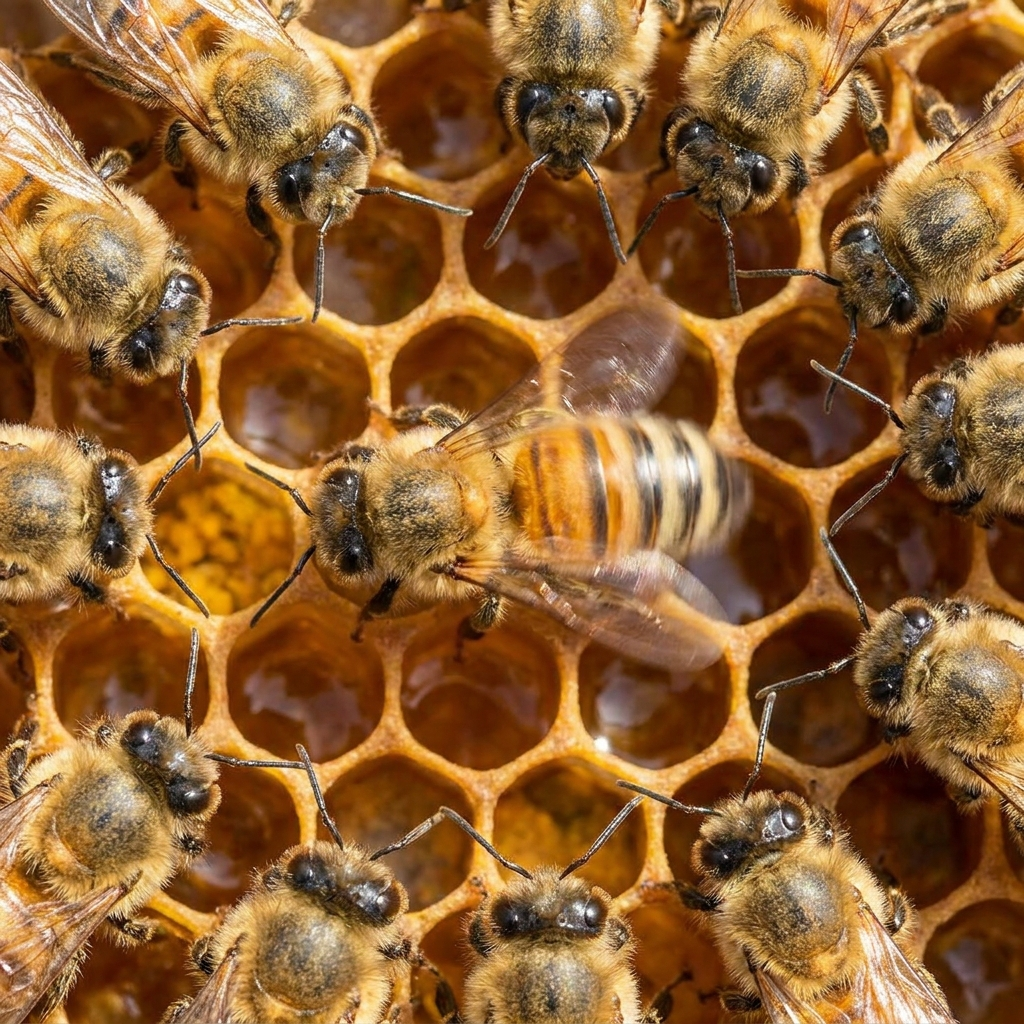
A waggle dance consists of a repeated figure-eight pattern. In the center of the figure eight, the dancer runs in a straight line while waggling its abdomen rapidly from side to side, producing a low-frequency vibration audible to nearby bees. After the waggle run, the bee turns and loops back to the starting point, alternating the direction of the return loop. The figure-eight is repeated continuously for as long as the dancer chooses.
Three parameters encode spatial information:
Direction. The angle of the waggle run relative to vertical on the comb encodes the angle between the sun and the food source, measured from the hive. If the dancer runs straight up, the food is in the direction of the sun. If the run is 30 degrees left of vertical, the food is 30 degrees to the left of the sun’s current position. The bees transfer the horizontal spatial angle — sun–hive–food — into a vertical dance angle, then reverse the translation to navigate.
Distance. The duration of the waggle run encodes the distance to the food. Longer runs mean greater distances. The relationship is roughly linear: a waggle run of about 1 second corresponds to roughly 1 kilometer, though the exact calibration varies by subspecies and geographic region. Forager bees adjust their distance encoding based on the energy cost of the flight, not pure meters — headwinds increase the dance duration for the same physical distance.
Quality. How many times the dance is repeated, and how vigorously (measured by waggling intensity and the duration of substrate vibrations), signals how profitable the food source is. A highly concentrated sugar solution close to the hive produces an energetic, extended dance. A dilute, distant source produces fewer, slower repetitions. Some foragers who have visited poor sources are actually “stopped” by nestmates before they can dance, a signal that some researchers interpret as active inhibition of low-value recruitment.
A short-range version: the round dance
For food sources very close to the hive — within roughly 50–100 meters — the waggle dance degenerates into a round dance: simple circular turns with no consistent waggle run. This provides directional information (scent cues from the dancer’s body and crop allow recruits to identify the flower type) but not bearing or precise distance. The transition from round dance to waggle dance as distance increases is gradual, and the threshold varies by subspecies.
How recruits decode the message
Recruits following a dancer orient their bodies to match the waggle run’s direction, actively tracking the dancer by maintaining antennal contact in the dark, vibrating interior of the hive. When they leave the hive, they convert the remembered dance angle relative to gravity back into a compass bearing relative to the sun, using the same time-compensated sun-compass mechanism seen in monarch butterflies.
Studies by James Gould in the 1970s and more rigorously by Riley and colleagues using harmonic radar in the 2000s tracked individually tagged recruits after they watched a dance. Recruits consistently flew in the direction encoded in the dance, corrected for sun position, and found food sources — even artificial ones set up by researchers — at the distances and directions specified by the dancers. The dance is decoded and executed by animals that have never seen the target location.
Collective decision-making: choosing a new home
The waggle dance is not used only for food. When a honeybee colony outgrows its hive and swarms, a portion of the population leaves with the old queen to find a new cavity. Scout bees explore the landscape, evaluate potential nest sites by several criteria (cavity volume, entrance height, entrance size, exposure), and return to the swarm cluster to dance for their preferred option.
Multiple scouts may dance simultaneously for different sites, each recruiting other scouts to visit and evaluate their candidate. Over hours to days, consensus emerges as the better sites accumulate more enthusiastic dancing and the poorer sites’ supporters are gradually won over or stop dancing. When roughly 15–30 scouts are simultaneously dancing for the same site — a threshold detected by the swarm through the pattern of vibrations at the cluster surface — the colony lifts off and flies to the new location.
Thomas Seeley’s decades of research on this process documented that swarms consistently choose the higher-quality cavity even when multiple options are available, and that the outcome is driven by a form of distributed information integration rather than any individual decision-maker. No bee has a view of all the available options simultaneously. The group decision emerges from local interactions governed by rules that each bee follows independently.
The limits of what dancing can say
The waggle dance is genuinely remarkable, but it is worth being precise about what it does and does not represent. It does not appear to be open-ended or generative in the way human language is — there is no evidence that bees use dance elements in novel combinations to describe new kinds of information. The encoded dimensions (direction, distance, quality) are fixed. A bee cannot invent a new waggle-dance component to communicate, say, that a water source is guarded by wasps.
What the waggle dance demonstrates is that symbolic, referential communication — using a signal to stand for a distant object rather than to express an immediate state — is not uniquely human and does not require a large brain or complex nervous system. It evolved in a social insect to solve a specific ecological problem: efficiently directing thousands of foragers toward the best available resources across a landscape too large for any individual to survey.
The dance is not language in the full human sense. But it is closer to language than almost anything else in the natural world.
Sources and further reading
- von Frisch K. The Dance Language and Orientation of Bees. Harvard University Press. 1967. (Karl von Frisch received the Nobel Prize in Physiology or Medicine, 1973, for this work.)
- Riley JR et al. “The flight paths of honeybees recruited by the waggle dance.” Nature 435(7039):205–207. 2005.
- Seeley TD. Honeybee Democracy. Princeton University Press. 2010.
- Dyer FC. “The biology of the dance language.” Annual Review of Entomology 47:917–949. 2002.