Educational disclaimer. This article is general biological reference. It is not medical advice, not a clinical guide, and does not describe the diagnosis or treatment of any human condition. All content is drawn from published scientific literature.
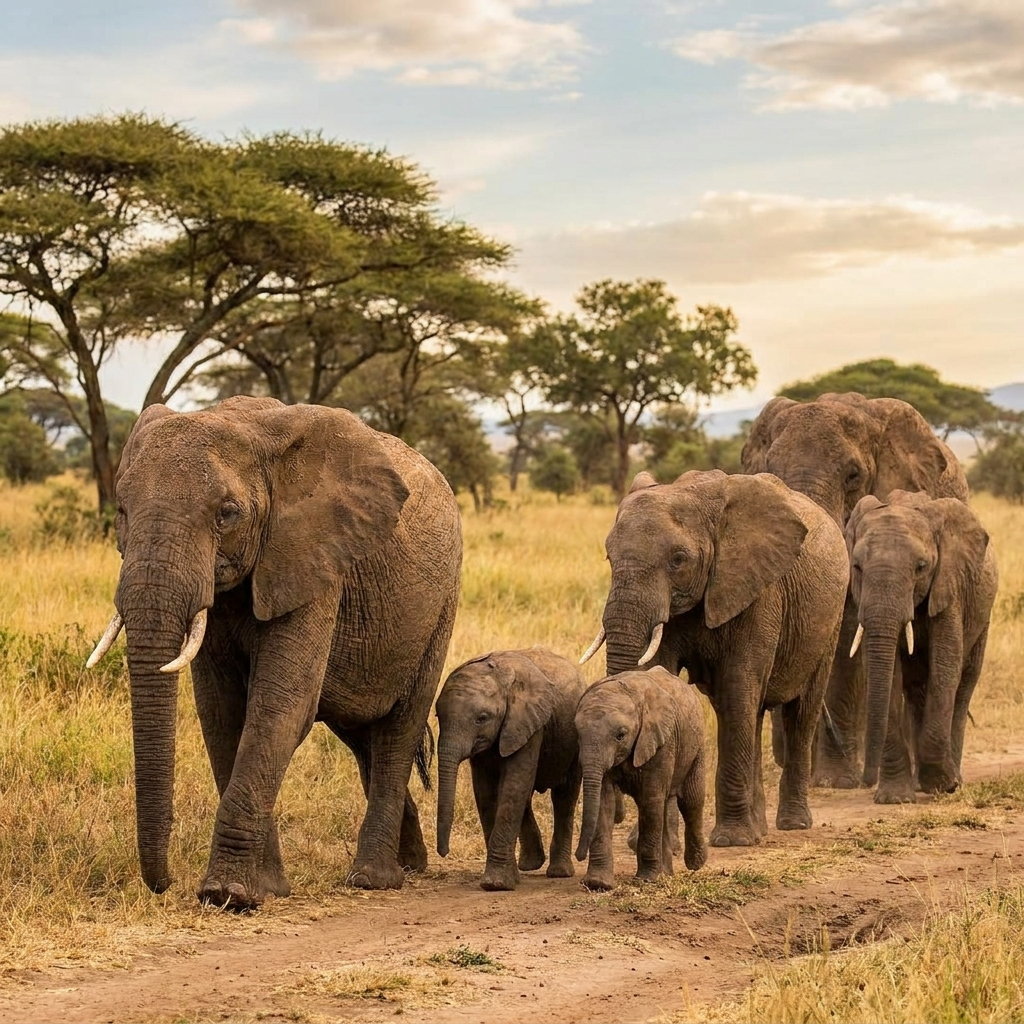
African elephants (Loxodonta africana) produce sounds that human ears cannot hear. Many of their most significant vocalizations — long-distance contact calls, mating announcements, alarm signals — fall at frequencies below 20 Hz, in the infrasound range that begins where human audition ends. These calls propagate through both air and ground, potentially covering distances of several kilometers, connecting individuals in a landscape where visual contact is impossible.
Elephants have the largest brain of any land animal, a rich and complex social structure anchored around matriarchal females, and documented behavioral responses to the deaths of conspecifics that have no straightforward explanation other than some form of emotional processing. They are not simply large herbivores. They are among the most cognitively sophisticated animals that have ever been studied.
The physics of infrasound communication
Infrasound — sound below 20 Hz — travels farther than high-frequency sound for a fundamental physical reason: lower frequencies lose less energy per meter of propagation, both in air and as surface waves through the ground. An elephant call at 14–15 Hz can travel several kilometers through open air with minimal attenuation. Under favorable atmospheric conditions (temperature inversions that trap sound near the ground), the same call can reach distances of up to 10 kilometers.
Katharine Payne, who first documented elephant infrasound in the 1980s, noticed a mysterious “rumbling” sensation at a zoo enclosure — not heard but felt as a slight vibration in the air. Subsequent analysis with sensitive microphones confirmed that elephants were producing calls well below the human hearing threshold continuously, particularly during social interactions. These calls had been occurring in plain sight at close range without anyone noticing.
Elephants also transmit infrasound seismically — as surface waves through the ground — and receive these ground vibrations through their feet. Specialized mechanoreceptors called Pacinian corpuscles, concentrated in the thick, fatty foot pads of elephants, are exquisitely sensitive to low-frequency vibrations. Elephants appear to “listen” through their feet, pressing them flat against the ground when receiving seismic signals, and may adopt a characteristic frozen posture — one foot slightly raised, trunk lowered — while interpreting what they feel.
Caitlin O’Connell-Rodwell’s field research in Namibia demonstrated that elephants respond behaviorally to recorded seismic playbacks of alarm calls, even when acoustic sound cues are blocked, confirming that ground-borne vibration alone can trigger coordinated group responses.
What the calls say
Elephant vocalizations form a rich repertoire. Beyond infrasound, they produce audible rumbles, roars, screams, and chirps covering a wide frequency range, often simultaneously. The infrasound component of a call can carry over long distances while the audible component provides information to nearby individuals.
African elephant social groups maintain cohesion over large home ranges using regular contact calls: low-frequency rumbles exchanged between separated family members or bond groups. When a returning group member approaches, the reunion is marked by a coordinated display of contact calls, rumbles, temporal gland secretions (a dark, oily fluid that runs down the sides of the face during periods of excitement or stress), and tactile contact. These reunions have been documented even between animals separated for years.
The matriarch — the oldest female in the family group — plays a specific role in filtering social information. Karen McComb and colleagues showed that family groups led by older matriarchs were better at correctly identifying the calls of unfamiliar elephants as potentially threatening and responding appropriately. The matriarch’s memory of which calls belong to which individuals, built over decades, functions as a living social database for the group.
Memory, individual recognition, and range
Elephants reliably recognize individual humans who have interacted with them, even after gaps of years. They recognize at least several hundred individual conspecifics by voice alone. They recall the locations of water sources, mineral deposits, and seasonal food resources across home ranges that can exceed 60 square kilometers — a spatial and temporal memory capacity that rivals primates.
The hippocampus of African elephants is proportionally large relative to brain volume, consistent with the demands of long-range spatial memory. Their temporal lobes, associated with complex social cognition and memory consolidation, are also particularly developed.
Responses to death
No topic in elephant biology generates more debate — or more field documentation — than their apparent responses to dead conspecifics. Elephants consistently approach and investigate the bones of deceased elephants, particularly skulls, touching them repeatedly with their trunks. This behavior is specific to elephant remains: the same individuals show no interest in bones of other large mammals placed nearby.
When a family group member dies, surviving individuals have been documented staying near the body for extended periods — sometimes days — engaging in tactile contact with the corpse, attempting to lift it, and producing low-frequency vocalizations. Calves whose mothers have died show prolonged behavioral changes that overlap significantly with descriptions of grief responses in primates.
Whether these behaviors constitute grief in a subjective sense that resembles human mourning is a question that science cannot yet fully resolve. What is documented beyond dispute is that the behaviors are species-specific, socially selective, and time-extended — three characteristics that distinguish them from simple curiosity about a novel stimulus.
Conservation and the cost of poaching
African elephants are classified as Vulnerable (savanna elephant) and Endangered (forest elephant) by the IUCN. Ivory poaching, which escalated dramatically in the early 2010s and continues at lower but significant levels, selectively kills older, larger-tusked individuals — disproportionately the matriarchs and eldest males whose social knowledge is hardest to replace.
Research in Amboseli by Cynthia Moss and colleagues has quantified what this loss means at the group level: family groups that lose their matriarch show disrupted ranging patterns, poorer performance on social recognition tasks, and elevated stress hormone levels for years afterward. Poaching does not just reduce population numbers. It removes the nodes of social memory that structurally hold elephant communities together.
This is one of the most consequential findings in conservation biology of the last two decades: killing the most experienced animals costs not just their lives but the learned knowledge stored in them, with compounding effects on group function that persist long after the killing stops.
Sources and further reading
- Payne KB, Langbauer WR, Thomas EM. “Infrasonic calls of the Asian elephant (Elephas maximus).” Behavioral Ecology and Sociobiology 18(4):297–301. 1986.
- McComb K et al. “Long-distance communication of acoustic cues to social identity in African elephants.” Animal Behaviour 65(2):317–329. 2003.
- Poole JH et al. “The social contexts of some very low frequency calls of African elephants.” Behavioral Ecology and Sociobiology 22:385–392. 1988.
- Elephant Voices Project. elephantvoices.org