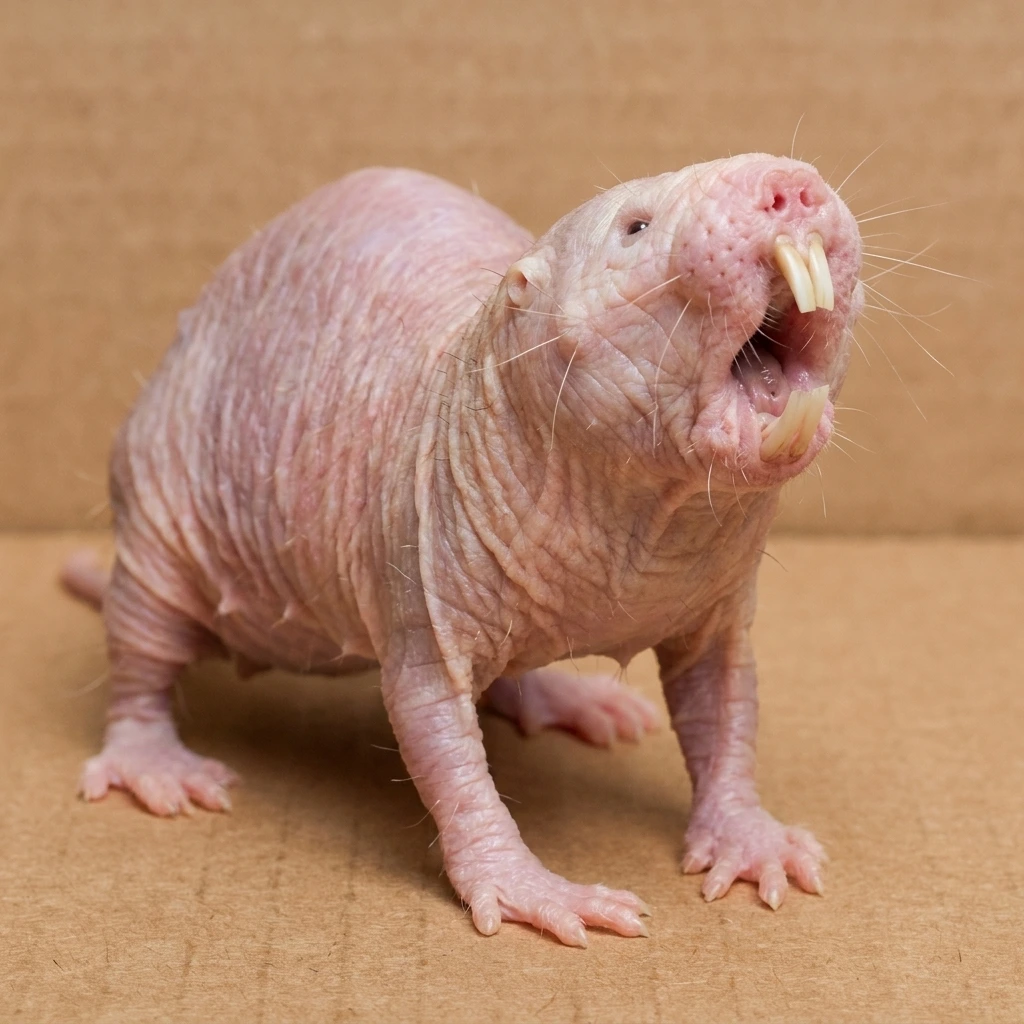
The naked mole rat (Heterocephalus glaber) is, by most aesthetic measures, an unimpressive animal. It is roughly the size of a small hamster, wrinkled, almost hairless, and lives its entire life in underground tunnels in the Horn of Africa. It is also one of the strangest mammals biologists have ever sequenced. Naked mole rats live for over 30 years — about ten times longer than a similarly sized mouse. They are essentially immune to spontaneous cancer. They feel no pain from certain types of acid. They can survive without oxygen for nearly twenty minutes. They are eusocial, like ants, with a single breeding queen and a colony of sterile workers.
Almost everything we thought “mammals can’t do,” naked mole rats appear to do anyway.
The cancer-resistance puzzle
In over four decades of laboratory observation, spontaneous tumors in naked mole rats have been documented only a handful of times. Compare that to mice, where roughly 70 to 80 percent develop cancer if they live long enough. What protects them?
Two mechanisms stand out. The first is early contact inhibition. Normal cells stop dividing when they touch their neighbors — a signal that tissue is full. In most mammals, this brake can fail (especially in pre-cancerous cells), allowing tumors to form. Naked mole rat cells halt growth at much lower densities than mouse or human cells, thanks to a hypersensitive contact-inhibition system mediated by a gene called p16INK4a working in concert with a related protein, p27. Both brakes have to fail for a cell to escape, which is a much higher bar.
The second mechanism is a strange polysaccharide called high-molecular-weight hyaluronic acid (HMW-HA). Naked mole rat tissue produces hyaluronic acid molecules far longer than the version found in mice or humans. This longer hyaluronic acid forms a dense, sticky matrix around cells that physically restricts their growth and influences cell signaling in ways that suppress tumor formation. Transferring the naked-mole-rat hyaluronic-acid system into mice in a 2023 study extended lifespan and reduced tumor incidence — direct experimental confirmation that this molecule alone has measurable anti-cancer effects.
A mammal that scarcely ages
A second extraordinary feature of naked mole rats is their near-flat mortality curve. In most mammals, the probability of dying in any given year goes up sharply as the animal gets older (a relationship known as Gompertz aging). In naked mole rats, mortality risk stays roughly constant for the entire adult lifespan. A 25-year-old naked mole rat is statistically about as likely to die in the next year as a 5-year-old. By the formal definitions used by gerontologists, the species shows negligible senescence.
Why? Naked mole rat cells appear to have unusually accurate protein synthesis (fewer translation errors per ribosome), more robust proteasomes (better cleanup of damaged proteins), and DNA repair mechanisms that stay efficient with age. Their mitochondria produce reactive oxygen species at high rates — paradoxically, they have more oxidative damage than mice — yet they tolerate it without obvious functional decline, likely because of compensatory antioxidant and repair systems.
The picture emerging is not that naked mole rats avoid the damage that drives aging. It is that they clean it up faster than they accumulate it, indefinitely.
Surviving without oxygen
Underground colonies of naked mole rats contain hundreds of animals breathing the same stagnant tunnel air. Carbon dioxide builds up, oxygen drops, and the animals are routinely exposed to conditions that would kill most mammals.
A 2017 study by Thomas Park and colleagues showed that naked mole rats can survive up to 18 minutes in pure nitrogen — essentially zero oxygen — and recover with no apparent brain damage. When oxygen runs low, their metabolism switches from burning glucose to burning fructose, the same sugar plants use for transport. Fructose metabolism does not require oxygen for several of its key steps, allowing the brain in particular to keep generating ATP under hypoxic conditions.
The closest parallel in mammals is the heart of a hibernating ground squirrel — and even that doesn’t match the duration. No other mammal known is capable of switching primary fuels under acute hypoxia.
No pain from acid
Another peculiarity: naked mole rats do not respond to certain chemical irritants the way other mammals do. Capsaicin (the burning compound in chili peppers) and acid (the kind that produces stinging sensations in our skin) elicit essentially no pain response in them.
The explanation lies in their nerve fibers. The pain-signaling neurons that respond to acid in other mammals fail to fire in naked mole rats because of a small genetic change in the sodium channel NaV1.7. The mutation is just a handful of amino-acid substitutions, but it’s enough to silence the acid-pain pathway entirely. The likely evolutionary driver is their high-CO₂ underground environment, where blood would otherwise turn slightly acidic and trigger constant pain in tissue not adapted for it.
A mammal that runs a colony
Behaviorally, naked mole rats are eusocial — meaning they organize their colonies the way honeybees or ants do. A single fertile queen produces all the young. Worker animals (mostly her offspring) divide labor: some dig tunnels, some forage for tubers, some defend the colony, some serve as living “blankets” to warm the queen and pups. Their colonies can contain hundreds of individuals across multiple generations.
This is essentially the only confirmed example of eusociality in mammals (a closely related species, the Damaraland mole rat, is the other). Why this social structure evolved in mole rats and basically nowhere else in mammals is still debated, but the underground, food-scarce environment is a leading hypothesis: digging tunnels to reach widely scattered tubers is so expensive that it pays off only for large, cooperative groups.
Why it matters
Each of these traits — extreme cancer resistance, near-absence of aging, fructose-fueled hypoxia tolerance, eusociality — would be remarkable in isolation. They all coexist in a single rodent species, suggesting that the constraints we normally associate with “being a mammal” are looser than biology textbooks imply.
The species is now a major research model for healthy aging and cancer prevention. Lab work on naked-mole-rat hyaluronic acid has already begun feeding into early-stage human research. Their hypoxia tolerance is studied for insights into stroke and cardiac arrest, where the brain’s intolerance of oxygen deprivation is the central problem. Their pain-channel biology has informed the design of newer analgesics that target NaV1.7 specifically.
A wrinkled, almost-blind rodent that lives in dirt is, in other words, one of the most informative mammals ever placed under a microscope — and quietly demonstrates that aging and cancer are not inevitable consequences of being a mammal, only the most common ones.
Sources and further reading
- Buffenstein R. “The naked mole-rat: a new long-living model for human aging research.” Journals of Gerontology: Biological Sciences 60(11):1369–1377. 2005.
- Ruby JG et al. “Naked mole-rat mortality rates defy Gompertzian laws by not increasing with age.” eLife 7:e31157. 2018.
- Kim EB et al. “Genome sequencing reveals insights into physiology and longevity of the naked mole rat.” Nature 479:223–227. 2011.
- Tian X et al. “High-molecular-mass hyaluronan mediates the cancer resistance of the naked mole rat.” Nature 499:346–349. 2013.