Educational disclaimer. This article is general biological reference. It is not medical advice, not a clinical guide, and does not describe the diagnosis or treatment of any human condition. All content is drawn from published scientific literature.
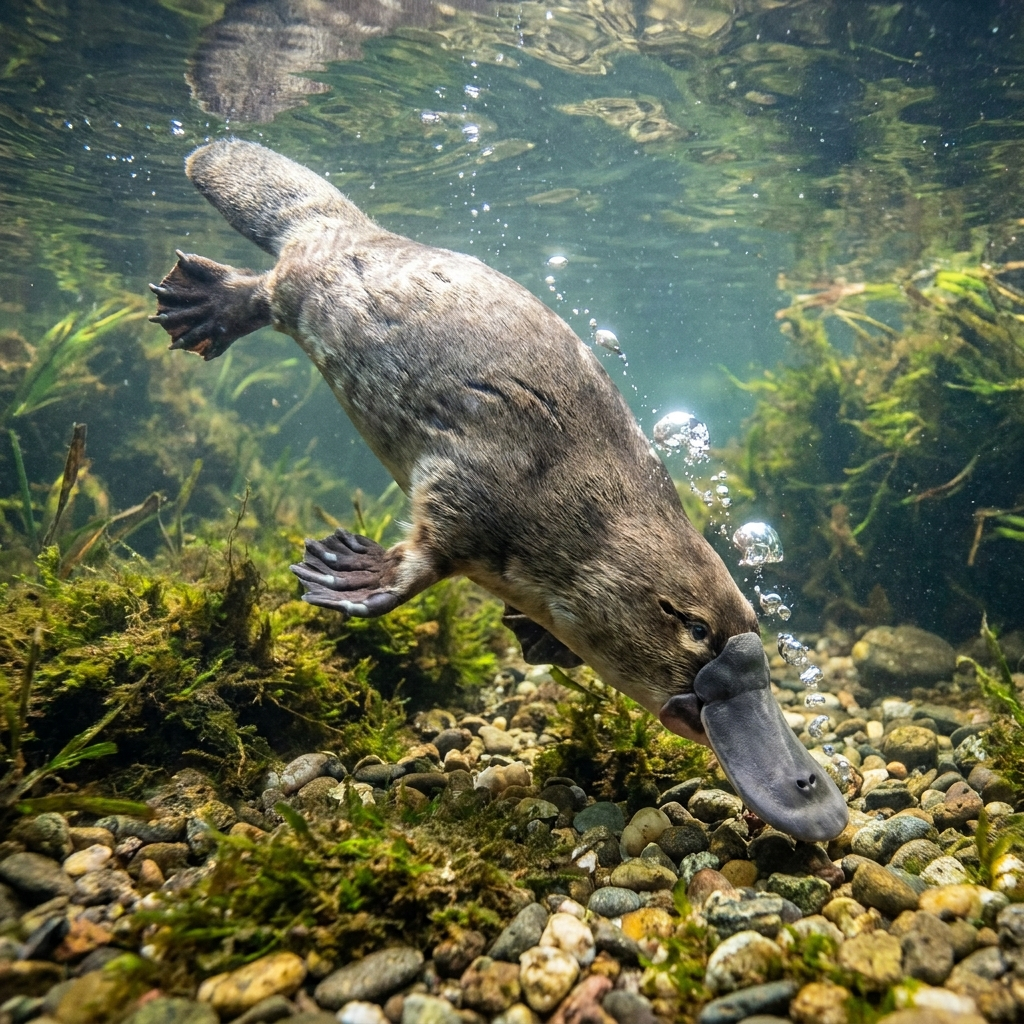
The platypus (Ornithorhynchus anatinus) is one of only five surviving monotremes — mammals that lay eggs instead of giving birth to live young. It has a bill resembling a duck’s, a beaver-like tail, webbed feet, waterproof fur, and, in the males, a venomous ankle spur capable of delivering excruciating pain to a human hand. It lays eggs and nurses its hatchlings with milk that seeps through patches of skin rather than nipples. And its bill is lined with one of the most sensitive electroreception systems of any mammal on Earth.
When biologists first received a platypus specimen in Europe in 1799, several naturalists assumed it was a taxidermy hoax — a duck’s bill sewn onto a beaver-like body. It was not. The platypus is genuinely that strange, and the strangeness runs deep into its genome and nervous system.
A bill built to detect electricity
Every living animal generates weak electrical fields through muscle contractions and nerve firing. In murky river water, where vision is nearly useless, detecting those fields can locate prey far more effectively than sight. The platypus exploits this with extraordinary precision.
Its soft, pliable bill is covered with approximately 40,000 electroreceptors distributed across around 60,000 total sensory organs, arranged in longitudinal rows along the upper and lower surfaces. These electroreceptors detect voltage gradients in the water as small as a few microvolts — roughly the field produced by the muscle twitch of a shrimp closing its claw. A second set of receptors in the same bill detects mechanical pressure, sensing disturbances in the water caused by movement.
When a platypus dives to hunt, it closes its eyes, ears, and nostrils and swims with its bill sweeping side to side. Navigation is entirely by bill. The two input streams — electrical and mechanical — arrive at the brain slightly out of phase, and the platypus uses the timing difference to triangulate the distance to prey, a mechanism analogous to binaural hearing in terrestrial animals. The brain region devoted to bill sensation is disproportionately large, the mammalian equivalent of what happens to the somatosensory cortex in animals that rely heavily on touch.
This kind of active electroreception in a mammal is exceptional. Among mammals, only the platypus and two species of echidna (the short-beaked and long-beaked) are known to use it.
Venom for male-to-male competition
Male platypuses carry a hollow spur on each hind ankle, connected by a duct to a crural gland in the thigh. During breeding season, the gland produces a venom containing at least 19 distinct peptides, including defensin-like proteins that have no close equivalent in any other venomous vertebrate. The venom is not lethal to humans or large animals, but it causes immediate, severe, and long-lasting pain that is reportedly resistant to standard opioid analgesics. Edema can persist for months.
What is the venom for? The spurs are not used in prey capture — platypuses eat invertebrates. The venom is used against other male platypuses during competition for mates in the breeding season. Females and juvenile males lose their vestigial spurs before adulthood, leaving only males with functional ones.
The genes encoding platypus venom peptides appear to have been recruited independently from genes with other functions, in a pattern that researchers have described as convergent venom evolution — the same mechanism seen across lizards, snakes, and shrews, each lineage assembling venomous secretions from different molecular starting points.
An egg-laying mammal: what that means biologically
Monotremes retained egg-laying from their reptilian ancestors when most other mammalian lineages evolved live birth. A platypus egg is leathery-shelled and roughly the size of a grape. The female lays one to three eggs, curls around them in a burrow, and incubates them for about ten days. Hatchlings emerge at a very early developmental stage — essentially fetal — and feed on milk that oozes from specialized patches of glandular skin on the mother’s abdomen, lapping it from fur tufts rather than suckling a nipple.
Milk in monotremes does not just deliver nutrition. It contains a protein called monotreme lactation protein (MLP), absent in other mammals, which appears to have strong antimicrobial properties. Because the eggs and nursing environment are not sterile, this milk-borne immune protection may have been an adaptation to compensate for the risks of egg-laying in potentially pathogen-rich soil.
A genome with ten sex chromosomes
Most mammals have two sex chromosomes. Female platypuses have ten: five pairs, designated X1X1X2X2X3X3X4X4X5X5. Males have five X chromosomes and five Y chromosomes: X1Y1X2Y2X3Y3X4Y4X5Y5. The platypus sex-determination system is therefore not the simple XX/XY arrangement of eutherian mammals but a complex chain that segregates during meiosis in a coordinated ring.
Intriguingly, some of the platypus X chromosomes share homology with the sex chromosomes of birds (the ZZ/ZW system), not with the sex chromosomes of other mammals. This suggests that the mammalian sex chromosome system evolved after the monotreme lineage diverged, and that platypuses retained an ancestral arrangement that other mammals discarded.
Why the platypus looks like a mashup of unrelated animals
The platypus’s anatomy violates the intuition that evolution builds toward coherence. The bill, the venom, the egg-laying, the electroreception, and the bizarre genome all exist simultaneously in one small river mammal that weighs under two kilograms. It is tempting to read this as disorganized, but evolutionary biologists now read it differently.
The platypus lineage diverged from the lineage leading to marsupials and placental mammals approximately 170 million years ago. Most of what looks like a mashup is simply extreme retention of ancestral features combined with specialized adaptations to a niche — freshwater invertebrate hunting in low-visibility water — that a highly derived mammal might not fill as efficiently.
The platypus doesn’t look like what a mammal “should” be. It looks like what a mammal actually could be, given enough time and a sufficiently unusual ecological problem to solve.
Sources and further reading
- Scheich H et al. “Electroreception and electrolocation in platypus.” Nature 319(6052):401–402. 1986.
- Pettigrew JD. “Electroreception in monotremes.” Journal of Experimental Biology 202(10):1447–1454. 1999.
- Warren WC et al. “Genome analysis of the platypus reveals unique signatures of evolution.” Nature 453:175–183. 2008.
- International Union for Conservation of Nature. Ornithorhynchus anatinus. IUCN Red List, 2016. iucnredlist.org