Educational disclaimer. This article is general biological reference. It is not medical advice, not a clinical guide, and does not describe the diagnosis or treatment of any human condition. All content is drawn from published scientific literature.
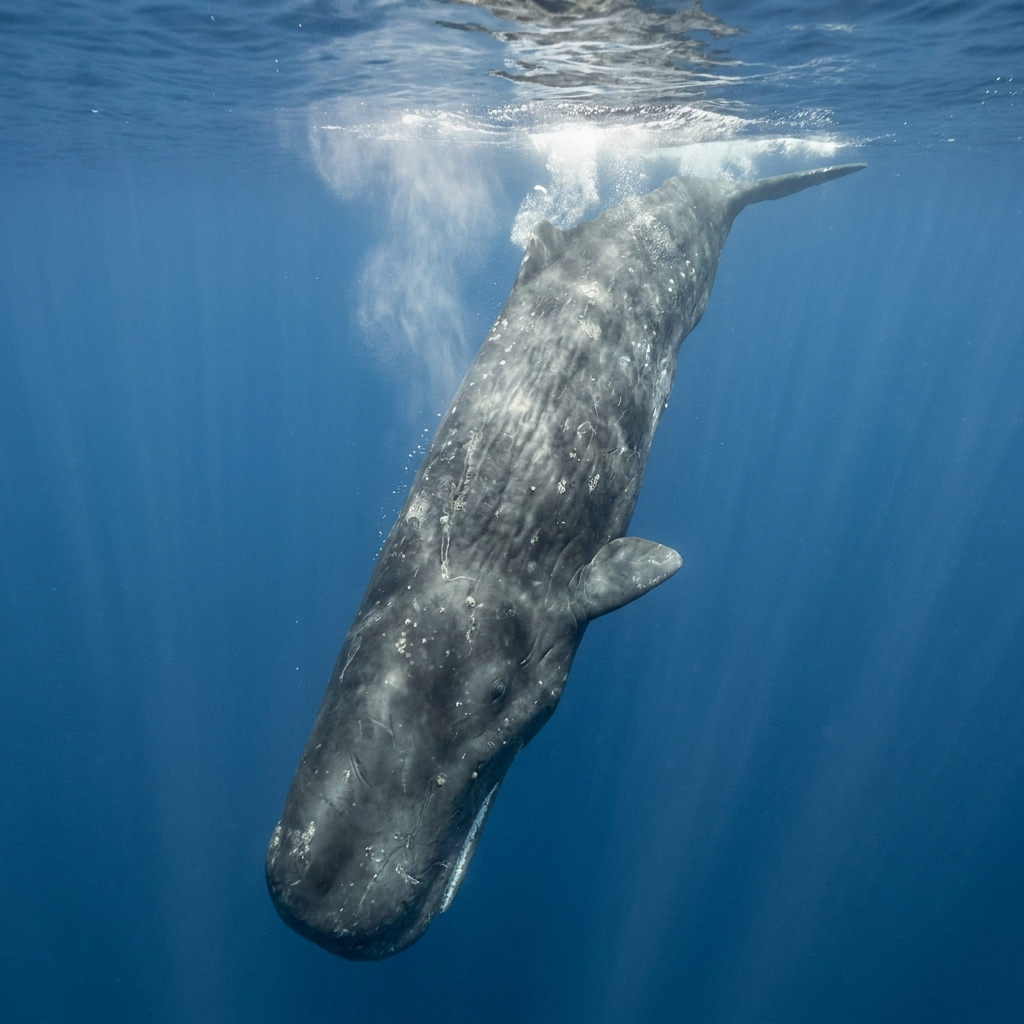
At two kilometers below the ocean surface, no light reaches. The pressure is over 200 atmospheres. The water temperature hovers just above freezing. In this environment, the sperm whale (Physeter macrocephalus) hunts. It is the largest toothed predator to have ever existed, capable of holding its breath for over an hour, and it navigates and captures prey — often giant squid — using clicks it produces itself.
The sperm whale carries the largest brain of any animal that has ever lived: an adult male’s brain can weigh approximately 8 kilograms, more than five times the mass of a human brain. Much of that neural tissue is devoted to processing sound. The animal sees poorly and hunts in an environment with no light at all. What it hears, and what it produces, is everything.
The spermaceti organ: a head full of wax
The most distinctive feature of a sperm whale is its enormous, blunt head, which can account for one-third of the animal’s total body length. Most of that head is occupied by the spermaceti organ — a massive structure filled with a liquid wax called spermaceti that solidifies at lower temperatures and was historically hunted to the brink of the whale’s extinction for use in lubricants and lamp oil.
The biological function of the spermaceti organ is acoustic. The whale generates clicks in the nasal passages, bounces them off an air sac at the front of the skull, passes the sound through the spermaceti organ (which acts as an acoustic lens, focusing the beam), and projects it forward. At the back of the head, a second air sac and a reflective structure called the junk — a laminated series of oil-filled lobes — further shape the outgoing beam. The result is one of the most directional sound emitters in the animal kingdom.
The clicks themselves are extraordinarily loud. At close range, sperm whale clicks reach approximately 230 decibels — the loudest sound produced by any biological organism. At 230 dB in water (equivalent to roughly 170 dB in air), the pulse is energetic enough that some researchers have hypothesized whales can stun prey at short range, though direct evidence for that specific behavior remains limited. What is well-documented is that the clicks are used for both biosonar (locating prey by echo timing) and social communication (in the form of patterned click sequences called codas).
Diving deeper than almost any air-breathing animal
Adult sperm whales routinely dive to depths of 1,000 to 2,000 meters in pursuit of squid. The confirmed depth record for a tagged individual, recorded using data loggers, is approximately 2,250 meters, with dive durations exceeding 90 minutes. How does an air-breathing mammal do this?
Several adaptations combine:
Oxygen storage. Sperm whale blood and muscle tissue contain unusually high concentrations of hemoglobin and myoglobin, the proteins that bind and store oxygen. Their muscle tissue is so richly packed with myoglobin that it appears nearly black in necropsy specimens. At depth, the whale’s lung capacity is compressed to near zero, but the oxygen already dissolved in blood and muscle continues to supply the brain and heart.
Cardiovascular routing. Deep divers selectively restrict blood flow to peripheral tissues during a dive, concentrating oxygen supply to the brain and vital organs. The heart rate drops dramatically — a phenomenon called diving bradycardia — and the spleen, which stores a significant reserve of oxygenated red blood cells, contracts and releases its contents into circulation at the start of the dive.
Flexible ribcage. At great depths, the lungs collapse entirely under pressure. The sperm whale’s ribcage and chest wall are structured to allow this collapse without tissue damage, unlike the rigid thorax of a human.
Codas: a communication system with regional dialects
Beyond echolocation, sperm whales produce a second class of clicks called codas — short, rhythmically patterned sequences that function in social contexts. Codas appear to carry identity information: different pods and populations in different ocean regions produce different, recognizable coda repertoires, maintained across generations by social learning.
Research by Shane Gero, Hal Whitehead, and colleagues over two decades of field work in the Eastern Caribbean documented that individual whales have consistent coda signatures, and that calves learn their group’s repertoire from adults — the closest thing to regional dialect transmission so far documented in a non-primate mammal. Whether codas carry specific propositional content (descriptions of things in the environment) remains an open and heavily investigated question.
A matrilineal society
Sperm whales live in two largely separate social worlds. Females and young form tight, stable groups of 10–20 individuals, often comprising related females and their offspring. These groups cooperate in calf-rearing — females collectively babysit calves at the surface while others dive — and appear to form lifelong social bonds.
Adult males are almost entirely solitary. They leave their birth groups around puberty and spend most of their adult lives alone or in loose bachelor aggregations, returning to mixed groups only to breed. This means nearly all the complex social communication documented in sperm whales — coda exchanges, babysitting networks, coordinated surfacing — is female behavior.
Why the sperm whale matters beyond biology
The species was hunted to near-extinction during the industrial whaling era of the 18th and 19th centuries. The spermaceti oil — extracted from the head — was the cleanest-burning oil available before petroleum, and sperm whales were the specific target of the American whaling industry. Herman Melville’s Moby-Dick was drawn from the experiences of actual sperm whale hunters and the terrifying reality that these animals sometimes fought back.
Current population estimates are uncertain, but the species is listed as Vulnerable by the IUCN. Populations have partially recovered since commercial whaling was banned in 1986, but ship strikes, entanglement in fishing gear, and acoustic disturbance from industrial sonar remain significant pressures.
The sperm whale is, in summary, an animal that evolved everything a terrestrial mammal discarded: lungs adapted to collapse, muscles that turn black with oxygen storage, a head built like a directional speaker array, and a social language with regional dialects. It is not a simplified version of a mammal. It is a highly derived one, shaped by sixty million years of solving the specific problem of surviving in the deep ocean.
Sources and further reading
- Møhl B et al. “The monopulsed nature of sperm whale clicks.” Journal of the Acoustical Society of America 114(2):1143–1154. 2003.
- Madsen PT et al. “Biosonar performance of foraging beaked whales (Mesoplodon densirostris).” Journal of Experimental Biology 208:181–194. 2005.
- National Oceanic and Atmospheric Administration (NOAA). Sperm Whale. fisheries.noaa.gov/species/sperm-whale
- International Union for Conservation of Nature. Physeter macrocephalus. IUCN Red List, 2008. iucnredlist.org