Educational disclaimer. This article is general biological reference. It is not medical advice, not a clinical guide, and does not describe the diagnosis or treatment of any human condition. Electric eels are capable of delivering shocks that can be dangerous to humans. Do not handle or approach them in the wild. All content is drawn from published scientific literature.
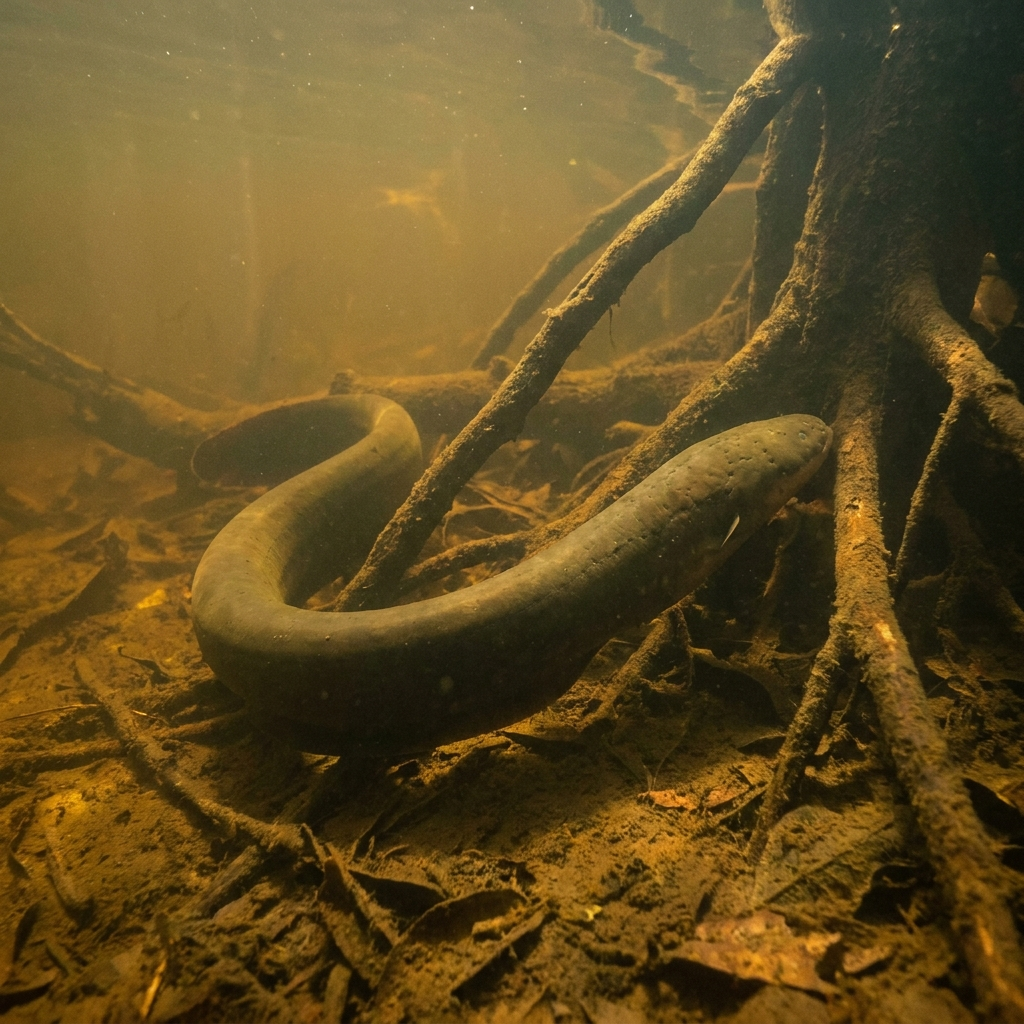
The electric eel (Electrophorus spp.) is not an eel. It is a knifefish — a South American freshwater fish more closely related to catfish and carp than to true eels. It breathes air, rising to the surface every 10–15 minutes to gulp atmospheric oxygen through a highly vascularized mouth, because the murky, low-oxygen rivers of the Amazon and Orinoco basins cannot supply enough dissolved oxygen for a fish of its metabolic demands.
Its most remarkable feature is its ability to generate electricity at a level and in a manner found nowhere else in the vertebrate world. Electrophorus voltai, the species confirmed in 2019 by Carvalho and colleagues as the highest-voltage species within the genus, produces discharges of up to 860 volts — the highest recorded from any living animal. But the voltage alone does not explain what makes the electric eel remarkable. What matters is how it uses the electricity.
Three electric organs, two functions
Approximately 80% of an electric eel’s body volume consists of three distinct electric organs: the Main Organ, Hunter’s Organ, and Sach’s Organ. Each is composed of thousands of modified muscle cells called electrocytes, which have been evolutionarily repurposed from their original contractile function to become biological batteries.
Electrocytes are flattened, disc-shaped cells, each generating a small voltage difference across their membranes through ion pump activity. Stacked in series (like cells in a battery), thousands of them produce a cumulative voltage. The organs differ in their function:
Sach’s Organ generates low-voltage, high-frequency pulses (less than 1 volt) used for electrolocation — detecting distortions in the animal’s self-generated electric field caused by objects or other animals in the vicinity. This is analogous to sonar, using electric fields instead of sound.
The Main Organ and Hunter’s Organ together generate the high-voltage discharges used for prey capture and defense. These pulses reach 860 V in peak bursts and are delivered as extremely brief (less than 2 milliseconds) biphasic pulses, typically in volleys of 400–600 Hz during an attack.
Remote control via doublet pulses
In 2014, neurobiologist Kenneth Catania at Vanderbilt University published a study in Current Biology that revealed an unexpected sophistication in how electric eels hunt.
During a hunt, eels produce a characteristic doublet pulse — two high-voltage discharges fired in rapid succession — before the main immobilizing volley. When these doublets are delivered to a prey fish, they directly activate the prey’s motor neurons, causing involuntary, uncontrollable muscle contractions (twitch responses) throughout the prey’s body. If the prey is hiding under leaf litter, buried in substrate, or otherwise concealed, the involuntary twitch movement reveals its location.
The eel detects this movement using its electrolocation system, adjusts its position, and then delivers the full immobilizing volley. The full volley drives the prey’s motor neurons at 400+ Hz, causing sustained tetanic muscle contraction — the prey is locked rigid, unable to flee, by its own motor system being driven at a frequency too high for voluntary control.
Catania confirmed the mechanism by recording motor neuron activity in prey fish during eel attacks with electrodes, directly observing the neuromuscular response to eel-generated pulses. The eel is not simply shocking the fish; it is remotely activating the prey’s motor nervous system with a precision targeted to a specific physiological response.
A shock that curves around conductors
Electric eels do not discharge toward a single point. The voltage difference is generated between the head (positive) and tail (negative), and the current flows through the water around the eel in all directions. This means the electric field extends outward in a roughly cylindrical pattern, and a prey fish anywhere within the field — not just directly in front of the eel — experiences the discharge.
During attacks on larger prey, eels have been observed curling their body around the prey, with the head and tail in close proximity on opposite sides of the target. This curled posture increases the current through the target by reducing the conductive path length through water between the poles. Catania observed eels spontaneously adopting this posture and showed that it approximately doubled the effective current through the prey animal.
Adult eels also leap partially out of the water when disturbed at the surface — a behavior Catania characterized in a 2016 paper. The high-voltage organ can deliver its discharge through direct skin contact with a wet (conductive) threat that contacts the eel’s dorsal surface. When a large animal or limb touches the eel while it is partially above water, the eel presses upward, increasing contact conductance and routing more current through the threat than would be possible in open water.
Life history in low-oxygen water
Beyond electricity, electric eels are unusual in their respiratory physiology. Their mouth lining contains dense capillary beds that absorb oxygen directly from air, allowing them to survive in water with near-zero dissolved oxygen — conditions lethal to most fish. This air-breathing adaptation allows them to inhabit stagnant Amazon backwaters, flooded forest floors, and hypoxic river bends where competition and predation pressure from oxygen-dependent fish is low.
They are obligate air-breathers in the sense that, even in well-oxygenated water, they must still surface periodically because their gill area is insufficient for full aerobic metabolism through gill respiration alone.
Genus revision and three species
For most of the 20th century, Electrophorus electricus was treated as a single species. A 2019 study by de Santana and colleagues revised the genus and identified three separate species: E. electricus (lower voltage, up to ~480 V), E. varii (intermediate), and E. voltai (highest voltage, up to 860 V), based on morphological, genetic, and bioelectric differences. The three species occupy partially overlapping ranges in northern and central South America but show habitat preferences that broadly correspond to elevation and river system.
This revision matters not just taxonomically. It documents that the extreme voltage generation in E. voltai is a derived state within the genus — a further elaboration of an already extreme trait, suggesting ongoing evolutionary refinement of the bioelectric system rather than a stable evolutionary endpoint.
Engineering relevance
The electrocyte stacking arrangement in electric eel organs has been studied as a model for soft, biocompatible power generation — relevant to medical implants that require electrical power without metal or rigid components. A 2017 paper in Nature by Schroeder and colleagues reported artificial “electric organ” hydrogels modeled on electrocyte geometry that generated voltages sufficient to power small electronic devices.
The same ion pump mechanisms that power electric eel discharge are variants of the sodium-potassium ATPase found in all vertebrate cells. The eel essentially took the ordinary ion transport machinery of a muscle cell, scaled up its output, and wired thousands of cells in series. Understanding how that scaling works in a biological system is directly applicable to designing biologically compatible power sources.
Sources and further reading
- Catania KC. “The shocking predatory strike of the electric eel.” Science 346(6214):1231–1234. 2014.
- Catania KC. “Electric eels use high-voltage to track fast-moving prey.” Nature Communications 6:8638. 2015.
- Schroeder TBH et al. “An electric-eel-inspired soft power source from stacked hydrogels.” Nature 552:214–218. 2017.