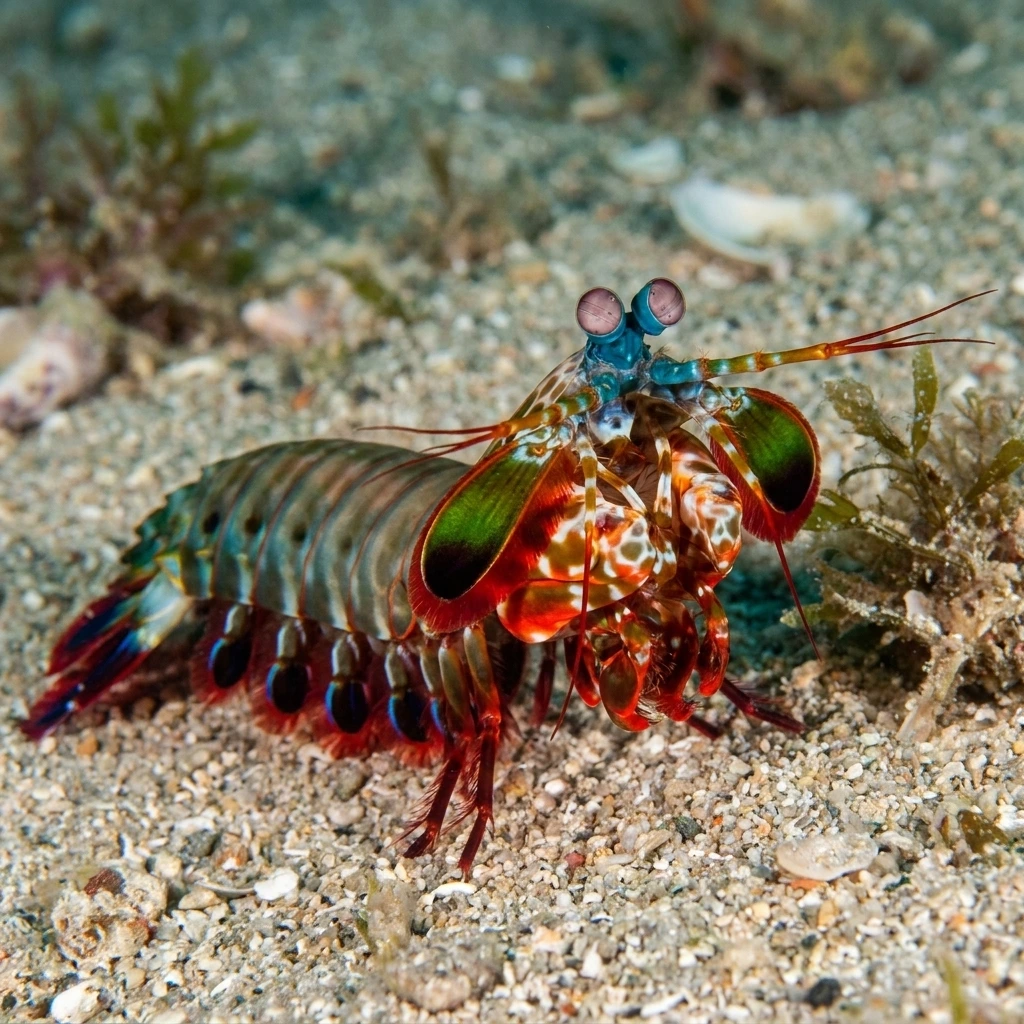
The peacock mantis shrimp (Odontodactylus scyllarus) is famous for two superpowers. First, its hammer-like front limb strikes prey at roughly the acceleration of a .22 caliber bullet, producing flashes of light and shockwave-induced cavitation bubbles. Second, and stranger, its eyes contain sixteen distinct photoreceptor types. Humans, by comparison, have three.
For decades, that 16-channel eye made the mantis shrimp a textbook example of “the best color vision on Earth.” Then a 2014 study upended the story. The animal’s color vision is not better than ours — it is just completely different, and it solves a different problem.
What lives in a mantis shrimp eye
A mantis shrimp’s compound eyes sit on the ends of independently moving stalks. Each eye is divided into three regions: a top hemisphere, a bottom hemisphere, and a narrow band across the middle called the midband. Almost all the exotic photoreceptors live in the midband, which is only about six rows of ommatidia wide.
Inside the midband, biologists have identified at least:
- 12 distinct color receptors, each tuned to a narrow slice of the visible spectrum from deep ultraviolet (around 300 nm) up into red.
- Four polarization receptors, including two that detect circularly polarized light — the only animal eye on Earth known to do this.
That polarization sensitivity is a major hint that this is not a color eye in the human sense. Polarization is a channel humans cannot perceive at all, and the mantis shrimp uses it for communication, prey detection, and mate signaling with patterns invisible to almost every other animal.
Why more receptors does not mean better color discrimination
Humans see millions of colors with only three receptor types (red, green, blue) by comparing the relative outputs of those three channels in the brain. A red apple stimulates the long-wavelength cone more than the medium-wavelength cone, and the visual cortex computes “red” from that ratio. This comparison-based system is extraordinarily efficient and accurate at distinguishing nearby hues.
A 2014 behavioral study by Hanne Thoen and colleagues tested whether mantis shrimp can distinguish closely spaced wavelengths the same way. They cannot. The animals could easily tell apart colors that were far apart on the spectrum (say, 500 nm versus 600 nm) but failed when the wavelengths were within about 25 nm of each other. By the comparison-based metric, our three cones beat their twelve.
So what are all those receptors for?
A different strategy: pattern recognition over comparison
The leading interpretation is that mantis shrimp use their twelve color channels to recognize colors directly, without the brain having to do a comparison computation. Each receptor is essentially a yes/no detector for a specific narrow band of the spectrum. A given object stimulates a specific subset of receptors, and that pattern is the “color label.”
The trade-off is that fine discrimination between similar colors is lost — but speed and simplicity are gained. A mantis shrimp can identify whether it is looking at a rival’s blue spot, a mate’s red signal, or a prey item’s shell color in a single neural step. Given that the animal needs to make life-or-death decisions in milliseconds during a strike, that efficiency may matter more than perceptual nuance.
Circularly polarized light: a private channel
The midband also contains receptors for circular polarization, a property of light in which the electric field rotates clockwise or counterclockwise as the wave propagates. Mantis shrimp produce circularly polarized signals on parts of their shell, particularly during courtship displays. Because almost no other marine animal can detect circular polarization, this acts as a private communication channel — visible to other mantis shrimp but invisible to predators and competitors.
The mechanism that makes this possible is a built-in quarter-wave retarder in the eye, a microscopic structure that converts circular polarization into linear polarization that the rest of the eye can process. Engineers studying biomimetic optics have used this finding to design new types of optical filters and circular-polarization-sensitive sensors for cameras and medical imaging.
Eye movements that map the world
Each eye also moves independently in three rotational axes — yaw, pitch, and roll. Because the midband is so narrow, the mantis shrimp builds up a high-resolution image of its surroundings by scanning, the way some satellites scan the Earth one strip at a time. The two eyes can also focus on the same object from different angles, giving each eye independent depth perception (rather than needing two eyes to triangulate).
Individual recognition and social memory
Mantis shrimp of several species recognize individual neighbors — a behavior confirmed by experiments in which resident stomatopods responded differently to familiar versus unfamiliar rivals placed in adjacent burrows. Familiarity de-escalates encounters: established neighbors exchange shorter displays and are less likely to strike than strangers are. This saves both animals from the risk of a high-speed limb exchange that could injure either party. The animals use both color patterns and polarization signals during these assessments. Social memory of this kind has been documented in Gonodactylus smithii and Neogonodactylus bredini, and it implies that the information the mantis shrimp eye encodes is not just used for identifying food and threats, but for maintaining a map of local social relationships.
Why it matters
The mantis shrimp eye was the first hard evidence that the relationship between “more photoreceptors” and “better color vision” is more complicated than it sounds. It is now used as a benchmark case in sensory ecology, computational neuroscience, and biomimetic engineering. Cancer-detection cameras inspired by mantis-shrimp polarization sensitivity are already in clinical research — some types of tumor tissue alter polarized light in ways the human eye cannot see but a mantis-shrimp-style sensor can.
More broadly, the mantis shrimp is a reminder that evolution does not optimize for what humans find impressive. It optimizes for what the animal needs to do. A 16-channel eye that loses to a 3-channel eye on hue discrimination is still the right eye for a fast-striking, polarization-signaling predator that lives in a world we cannot even perceive. The shrimp does not see what we see, better or worse — it sees a different world entirely.
Sources and further reading
- Cronin TW, Marshall NJ. “A retina with at least ten spectral types of photoreceptors in a stomatopod crustacean.” Nature 339(6220):137–140. 1989.
- Thoen HH et al. “A different form of color vision in mantis shrimp.” Science 343(6169):411–413. 2014.
- Chiou TH et al. “Circular polarization vision in a stomatopod crustacean.” Current Biology 18(6):429–434. 2008.
- Marshall NJ, Oberwinkler J. “The colourful world of the mantis shrimp.” Nature 401(6755):873–874. 1999.