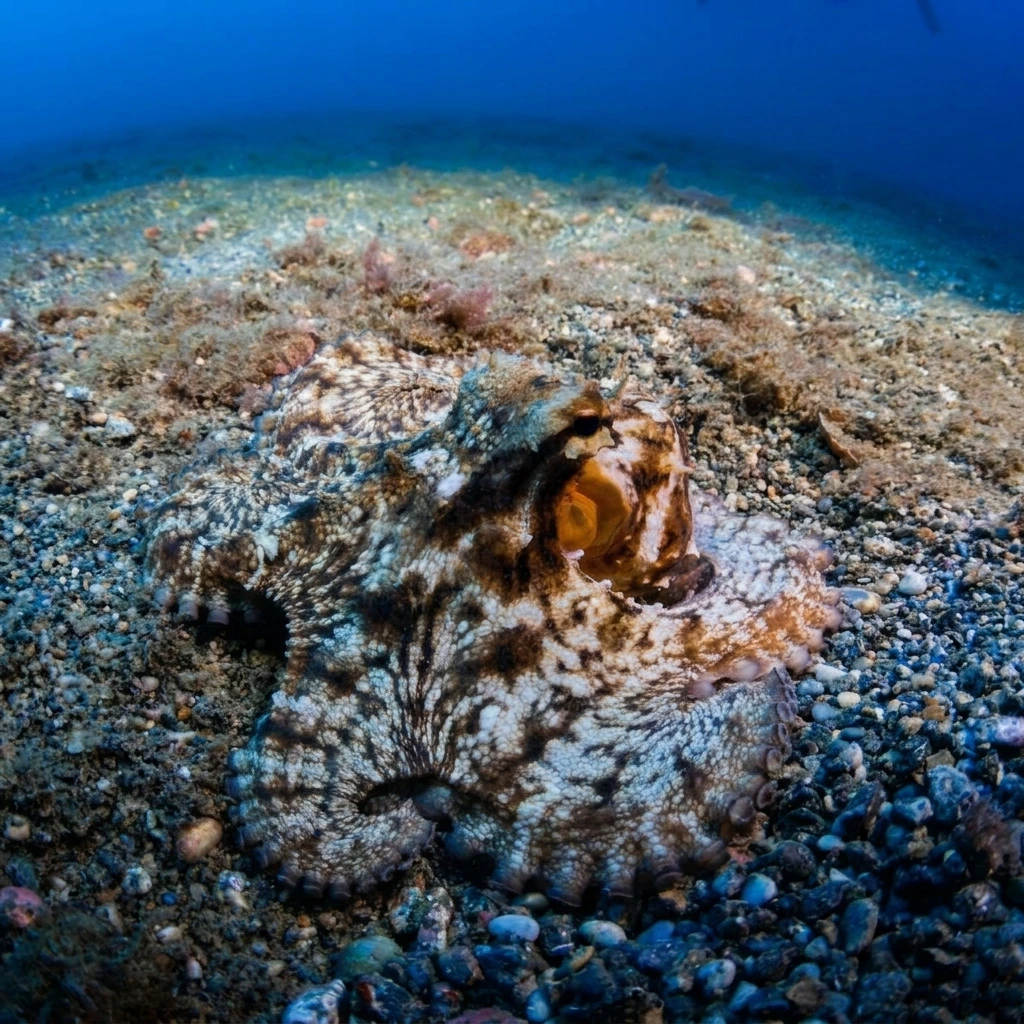
If you swim past an octopus and never notice it, the octopus has done its job. In less than a second, the animal can match the color of a sponge, the speckled texture of sand, or the jagged silhouette of a rock. What makes the trick even stranger is that, by every test biologists have run, octopuses appear to be colorblind. So how does a colorblind animal produce the most sophisticated camouflage on the planet?
A skin made of pixels
An octopus skin is essentially a living display. Just beneath its surface sit tiny pigment-filled sacs called chromatophores. Each chromatophore is surrounded by a ring of muscle. When the muscle contracts, the sac stretches into a wide disc and its color shows through; when the muscle relaxes, the sac shrinks to a pinpoint and effectively disappears. A common octopus has millions of these “pixels” distributed across its body, each one wired to the brain through its own nerve.
Below the chromatophores lie two more reflective layers. Iridophores act like microscopic mirrors that can be tuned to reflect different wavelengths, producing greens, blues, and metallic sheens that pigments alone cannot generate. Deeper still are leucophores, broadband white reflectors that bounce back whatever ambient light is present, giving the octopus a built-in neutral baseline.
The combination is essentially a three-layer screen: pigments, tunable mirrors, and a white background, all under direct nervous-system control. No other animal in the ocean comes close.
Seeing without seeing color
Here is the paradox. Octopus eyes contain only one photoreceptor type, sensitive to a narrow band of light around 470–500 nanometers. Behaviorally, octopuses fail every test of color discrimination researchers have devised. Yet they routinely produce skin patterns that match the colors of their surroundings.
Several lines of evidence suggest octopuses get color information through a different channel: their skin itself. The same opsin proteins that detect light in the eye have been found in chromatophore-rich skin tissue. Because octopus pupils are shaped like a horizontal slit, they likely produce strong chromatic aberration — different wavelengths focus at slightly different depths. By rapidly changing the focus of the lens, an octopus may sample the spectrum sequentially and reconstruct color information indirectly. It is not “seeing” the way we do, but the animal may still gather enough wavelength data to match the scene.
Texture changes are part of the disguise
Color alone is not enough to defeat a predator that can see contrast or shape. Octopuses also alter the texture of their skin using muscle-controlled bumps called papillae. In half a second, a smooth-skinned animal can sprout coral-like spikes, leaf-shaped flaps, or pebbly ridges. Combined with chromatophore patterning, the result is a three-dimensional disguise that breaks up the animal’s outline against the background — a strategy biologists call disruptive coloration.
In the mimic octopus (Thaumoctopus mimicus) of Indonesian waters, this goes a step further. The species has been observed impersonating flatfish, lionfish, and sea snakes by combining patterning with specific arm postures. It is essentially live theater, performed without rehearsal, by an invertebrate.
A distributed nervous system
Roughly two-thirds of an octopus’s 500 million neurons live not in its central brain but in its arms. Each arm contains its own ganglion and can react to local stimuli almost autonomously. This is why an octopus can pattern-match different parts of its body to different parts of the substrate simultaneously — one arm draped over a green sponge can flush green while another arm on bare sand stays pale.
Researchers studying this distributed cognition often describe octopuses as the closest thing on Earth to encountering an alien intelligence. The animals are not centralized in the way mammals are; they are colonies of partially independent limbs, coordinated by a small brain that delegates aggressively.
Camouflage beyond defense
Camouflage serves the octopus as much for hunting as for hiding. When stalking prey — crab, shrimp, small fish — the animal holds a near-perfect match with the substrate until it is close enough to strike. The switch from camouflaged to attacking posture takes less than 100 milliseconds, meaning prey rarely has time to react once the octopus commits.
A striking observation involves octopus sleep. In 2021, researchers at the Brain Institute of the Federal University of Rio Grande do Norte in Brazil filmed Octopus insularis at night and recorded rapid, large-scale color changes during periods of apparent rest. Textures and patterns flashed across the skin over several seconds, similar in complexity to active camouflage displays, suggesting the animals may experience something functionally analogous to REM sleep. Whether these changes reflect memory consolidation, sensory replay, or simple neural activity during rest remains under active investigation, but the footage sparked renewed scientific debate about the cognitive life of cephalopods.
Camouflage also has limits. Some fish predators, including the bluefin trevally, see into the ultraviolet range. Under UV illumination, an octopus that appears perfectly blended to human eyes can stand out sharply against its background. In shallow coastal waters, bioluminescent plankton — disturbed by the animal’s movement — can also outline a camouflaged octopus with flashes of light visible to any predator watching from below. Evolution rarely produces perfect solutions, and the octopus is no exception.
Why it matters
The octopus camouflage system has direct applications outside marine biology. Engineers studying soft robotics have designed elastomer skins that mimic chromatophore expansion to give robots dynamic color and texture. Materials scientists working on adaptive optics look at iridophores as a natural model for tunable reflective coatings. And neuroscientists interested in distributed control architectures study how an octopus can issue eight independent motor plans without a central traffic controller.
The takeaway is bigger than a clever trick. Evolution produced a colorblind, soft-bodied invertebrate that solves a problem (real-time, full-surface camouflage) that human engineering still cannot match. Every time we figure out a little more of how octopuses do it, we get a glimpse of what nervous systems and biological materials are truly capable of — and how much of that we have barely begun to copy.
Sources and further reading
- Hanlon RT, Messenger JB. Cephalopod Behaviour. 2nd ed. Cambridge University Press. 2018.
- Mäthger LM et al. “Evidence for colour discrimination using a single visual pigment in a mantis shrimp and a cephalopod.” Journal of Experimental Biology 213(11):1825–1830. 2010.
- Stubbs AL, Stubbs CW. “Spectral discrimination in colour blind animals via chromatic aberration and pupil shape.” Proceedings of the National Academy of Sciences 113(29):8206–8211. 2016.
- Medeiros SL et al. “Cyclic alternation of quiet and active sleep states in the octopus.” iScience 24(4):102223. 2021.