Educational disclaimer. This article is general biological reference. It is not medical advice, not a clinical guide, and does not describe the diagnosis or treatment of any human condition. All content is drawn from published scientific literature.
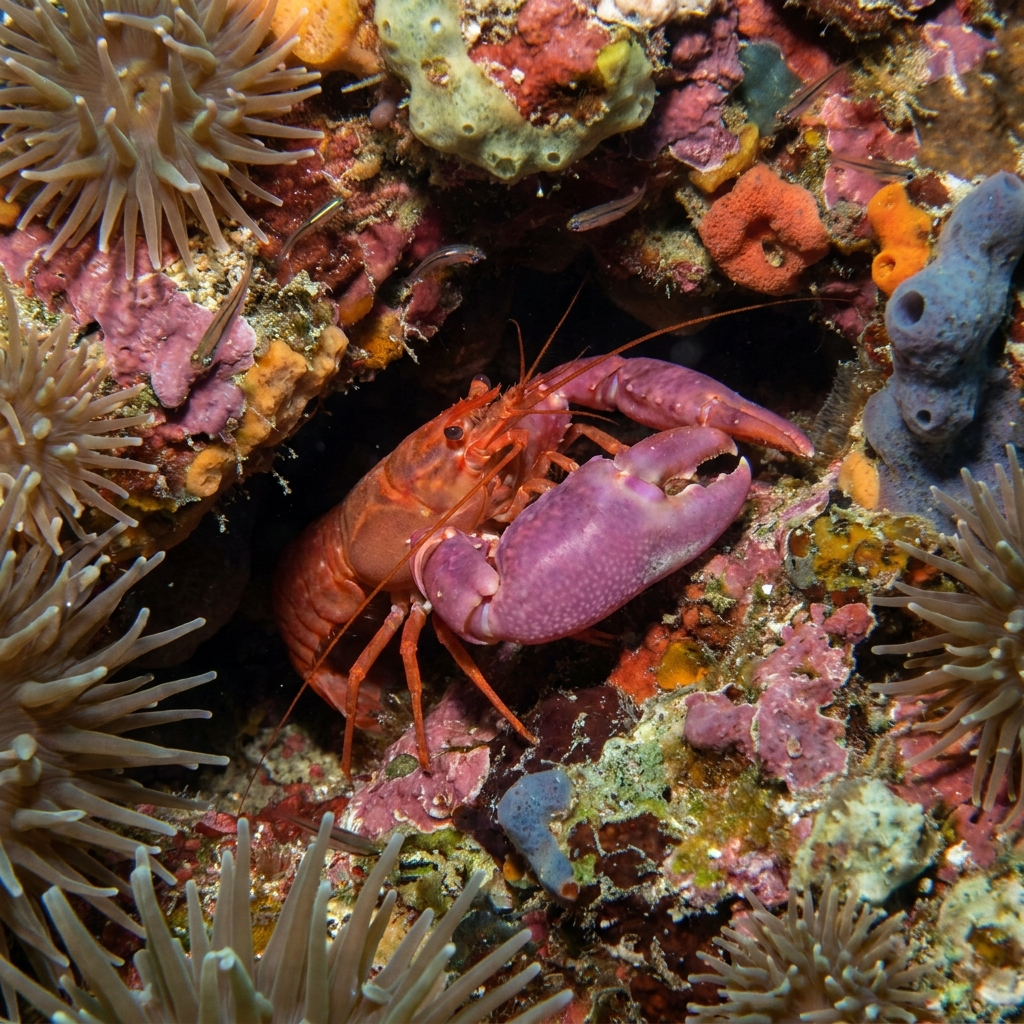
The pistol shrimp (Alpheus spp. and related genera) is a small crustacean, typically 3–5 centimeters long, found in tropical and subtropical marine environments worldwide. One of its two claws is substantially enlarged — sometimes larger than the shrimp’s entire body — with a distinctive trigger-and-hammer mechanism that allows it to snap closed at extraordinary speed.
When that claw closes, it creates one of the most extreme physical events occurring regularly in the shallow ocean. The snap does not kill prey by impact. It works by generating a cavitation bubble: a near-vacuum pocket in the water that collapses almost immediately under the surrounding pressure. During that collapse, temperatures inside the bubble briefly reach approximately 5,000 Kelvin — comparable to the surface temperature of the sun — and the implosion generates a pressure wave that stuns, injures, or kills nearby prey.
This happens in a fraction of a millisecond, in a claw not much larger than a thumbnail.
The mechanics of the snap
The enlarged claw has a plunger-shaped extension on the lower finger (dactyl) that fits into a socket on the upper jaw (propodus). When the claw is cocked open, the dactyl is held under muscular tension. On release, the dactyl slams into the socket at approximately 98 kilometers per hour, faster than any documented muscle-powered motion relative to body size in any crustacean.
The impact itself is not what kills prey. What matters is the water jet the closing gap produces just before full closure. As the dactyl approaches the socket, it rapidly displaces a volume of water in a focused, high-velocity jet. The jet velocity exceeds the cavitation threshold for seawater — roughly 10 meters per second — and a low-pressure region (cavitation bubble) forms behind the jet’s leading edge.
The bubble contains water vapor, and its interior pressure is far below ambient. It exists for less than a millisecond before the surrounding water pressure forces it to collapse. During collapse, the interior temperature spikes to around 5,000 K. At this temperature, sonoluminescence — emission of light — occurs, producing a brief flash detectable with sensitive photomultipliers in laboratory settings.
Sound as the primary weapon
The collapsing bubble generates a pressure wave with a peak sound level measured at approximately 210 decibels at close range (in water). This makes the pistol shrimp snap one of the loudest biological sounds in the ocean, with peak intensities exceeding those of sperm whale clicks on a per-event basis, though with a far shorter duration and smaller source.
For the shrimp’s typical prey — small fish, invertebrates — at distances of a few centimeters, the pressure wave is physically damaging. Prey animals caught within the shockwave’s effective radius are stunned or killed by mechanical disruption of tissue, not by the bubble’s heat (the bubble is too brief and small to transfer significant thermal energy to surrounding water). The shrimp then retrieves the incapacitated prey before it can recover or escape.
The shrimp uses its non-enlarged claw for manipulation and feeding; the snapping claw is a specialized weapon rather than a feeding appendage.
Population noise and naval implications
Pistol shrimp colonies in shallow tropical reefs are dense enough that their collective snapping creates continuous broadband noise in the 2–200 kHz range, audible to hydrophones as a crackling or sizzling background. In some reef environments, particularly in the Indo-Pacific, this shrimp noise dominates the acoustic background, masking other biological signals and interfering with submarine sonar detection.
During World War II, American submarine commanders discovered that hiding under reef zones where pistol shrimp were abundant could confuse enemy hydrophone operators. The biological noise floor was mistaken for acoustic interference rather than vessel noise. This was not a deliberate strategy developed from biological knowledge — it was a practical observation that preceded the formal scientific characterization of shrimp-generated noise.
Partnership with goby fish
Many pistol shrimp species form mutualistic partnerships with small goby fish (Amblyeleotris and Cryptocentrus genera). The shrimp excavates and maintains a burrow in sandy substrate, which it shares with the goby. The shrimp, which has relatively poor eyesight, keeps one antenna in contact with the goby’s body whenever both are outside the burrow. The goby maintains visual vigilance for predators. When the goby detects a threat, it performs a rapid tail flick or body movement that the shrimp detects through the contact, and both retreat into the burrow.
This cooperative arrangement — defense-for-housing — is one of the most-studied examples of interspecies mutualism in marine environments. The two animals co-evolve in some species pairs to the point where neither is commonly found without the other in the wild.
The claw can regenerate — and switch sides
If a pistol shrimp loses its snapping claw, the opposite (smaller) claw grows to take its place as the snapping claw, and the stump regenerates as a smaller claw. This is a known feature of crustacean regeneration: the positional specification of the claw type can be reversed depending on which limb is present. A shrimp that started life right-handed can become effectively left-handed after injury and regeneration, with the functional snapping claw switching from one side to the other.
Why this matters
The pistol shrimp snap is a demonstration of mechanical energy storage and rapid release at a scale and efficiency that engineers working on impact mechanisms still find instructive. The shrimp’s latch mechanism — holding the dactyl under muscular tension and releasing it in a controlled, near-instantaneous motion — is a biological analogue of spring-loaded actuators. Robotics and biomechanics researchers have used the shrimp claw as a model for designing miniature actuators that require extremely high acceleration from small energy stores.
More broadly, the pistol shrimp is a reminder that extreme physical phenomena — temperatures comparable to the sun’s surface, pressure waves loud enough to stun vertebrates — are not exclusive to large or powerful organisms. They emerge, in this case, from a crustacean that fits in a hand, through mechanics precise enough that evolution arrived at them and has maintained them across hundreds of species.
Sources and further reading
- Versluis M et al. “How snapping shrimp snap: through cavitating bubbles.” Science 289(5487):2114–2117. 2000.
- Lohse D et al. “Snapping shrimp make flashing bubbles.” Nature 413:477–478. 2001.
- Hess D et al. “Flow field of a snapping shrimp.” Physics of Fluids 25(9):091108. 2013.