Educational disclaimer. This article is general biological reference. It is not medical advice, not a clinical guide, and does not describe the diagnosis or treatment of any human condition. All content is drawn from published scientific literature.
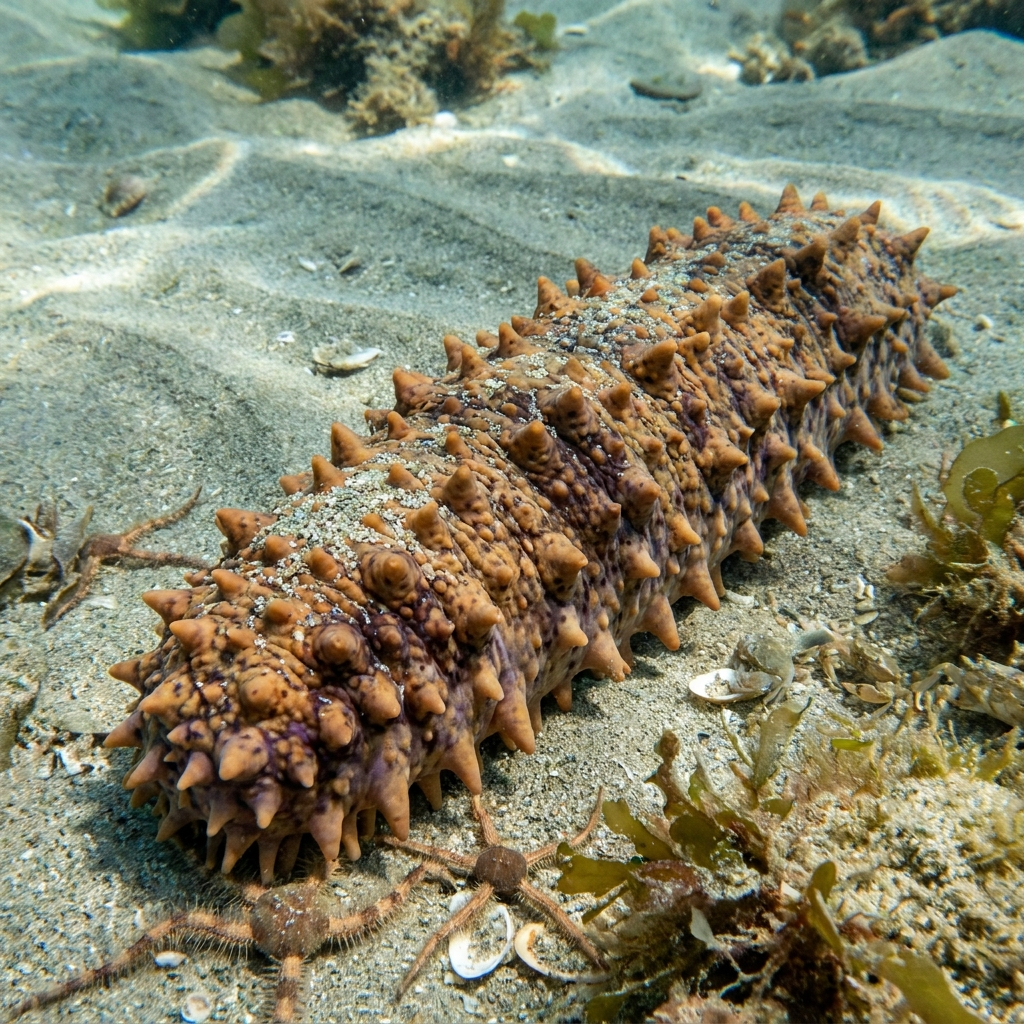
Sea cucumbers are echinoderms — relatives of starfish and sea urchins — found in marine environments worldwide, from shallow coral reefs to abyssal depths exceeding 5,000 meters. Most species are soft-bodied, slow-moving animals that feed by processing sediment or filtering organic particles from the water. Their primary defense against predation is chemically mediated: they produce toxic saponin compounds (holothurins) in their body wall that make them unpalatable to most fish and invertebrate predators.
When chemical deterrence is insufficient, some sea cucumbers resort to a backup strategy that biologists call evisceration: the animal ruptures its own body wall and expels some or all of its internal organs at the threatening animal. The expelled organs can be toxic, sticky, or both. The sea cucumber then regenerates the lost organs over a period of days to weeks.
This is not an accident or a trauma response in the way that prey animals sometimes lose limbs to predator bites. Evisceration in sea cucumbers is a controlled, directed defensive behavior that the animal actively initiates, and which it is capable of performing repeatedly throughout its lifetime.
What gets expelled and how
Different sea cucumber species eject different organ systems in different ways. The two primary mechanisms are:
Cuvierian tubules, present in certain species of the genus Holothuria and relatives, are thin, elongated structures attached to the base of the respiratory tree (a branching respiratory organ unique to sea cucumbers). When threatened, the animal directs these tubules toward the threat, ruptures a section of the body wall, and forcibly expels the tubules by hydraulic contraction of the body musculature. In water, the expelled tubules rapidly elongate — sometimes expanding to many times their resting length — and become extraordinarily sticky, adhering to whatever they contact: crab claws, fish mouths, net threads, or researcher’s fingers. The stickiness is mediated by collagen-like proteins that undergo rapid cross-linking on contact with seawater.
The entangled predator is typically immobilized or severely hampered. Laboratory experiments have shown that crabs that grab a Cuvierian-tubule-armed sea cucumber become entangled within seconds and spend extended periods cleaning their appendages. If the predator cannot disengage and is in open water, the tubules may cause drowning by blocking gill surfaces.
Evisceration of digestive and respiratory organs occurs in species lacking Cuvierian tubules, and also in some species as a secondary response after tubule discharge. The animal ruptures its own body wall — often at the posterior end — and expels its digestive tract, gonads, and/or respiratory trees. The expelled material may contain holothurins (saponin toxins) that deter consumption.
The connective tissue that makes it possible
Sea cucumbers belong to a group of echinoderms that have mutable connective tissue — a unique biological material called catch connective tissue (or mutable catch connective tissue) that can shift between rigid and liquid-like states within seconds under neural control.
When the animal is calm, its body wall connective tissue is relatively stiff and rigid. Under threat, neural signals cause the connective tissue matrix to rapidly soften and partially liquify in specific regions. This targeted liquification allows the body wall to rupture at controlled points while remaining intact elsewhere — the animal, in effect, opens a precisely located hole in itself rather than rupturing randomly.
The same mechanism allows sea cucumbers to pass through crevices far smaller than their resting body diameter. By softening their connective tissue, they flow semi-liquid into narrow gaps, then re-stiffen to anchor themselves inside. This ability to become temporarily semi-liquid is not a passive deformation; it is an active neurally mediated state change, and it enables both the defensive evisceration behavior and the physical flexibility required for life in complex reef environments.
Regeneration: growing new organs in weeks
After evisceration, the sea cucumber seals the body wall rupture and begins regenerating the lost structures. Regeneration timelines vary by species and organ system:
- Respiratory trees typically regenerate in 5–20 days.
- Digestive organs, including portions of the gut, regenerate in 8–40 days depending on species and extent of evisceration.
- Gonads regenerate more slowly, often over weeks to months.
The regeneration process involves dedifferentiation of local cells and proliferation of cells derived from the coelomic epithelium (the lining of the body cavity), which reconstitute the organ structures with reasonable fidelity to the originals. Full restoration of digestive function allows the animal to resume feeding within the regeneration period.
This regenerative capacity is the reason evisceration is a viable long-term strategy rather than a suicidal defense. A sea cucumber that eviscerated and could not regenerate would face slow death from the loss of its digestive system. One that regenerates completely within a month has sustained a recoverable cost in exchange for escaping a predation event.
Holothurins: the chemical foundation
Underlying all of these defenses is the suite of saponin glycosides — holothurins — present in the body wall and, in some species, in high concentrations in the Cuvierian tubules. These compounds disrupt cell membranes by interacting with cholesterol, producing cytotoxic effects in most animals that ingest them in meaningful quantities.
Most marine predators that encounter sea cucumbers at least once learn to avoid them. Fish that do eat sea cucumbers tend to do so by targeting very young individuals, species with lower holothurin loads, or by consuming only the gonads (which have lower toxin concentrations than the body wall).
Holothurins have attracted pharmaceutical research interest as potential anticancer and antifungal agents, since their membrane-disrupting activity is not entirely cell-type-specific and some derivatives show activity against tumor cell lines in laboratory assays. Clinical development of holothurin-derived drugs remains in early research stages, but the structural diversity of saponins across sea cucumber species has made the group a sustained focus of marine natural-products chemistry.
Ecological function: the ocean’s sand filters
Beyond their defensive biology, sea cucumbers play a functional role in marine ecosystem health. Many species are deposit feeders, ingesting sand and sediment and digesting the organic content (bacteria, microalgae, detrital particles) before excreting the processed sand. A single sea cucumber can process several kilograms of sediment per day, cycling organic matter and nutrients through the seafloor in ways that affect oxygen availability and nutrient distribution in benthic communities.
Sea cucumber populations have declined severely in many regions due to commercial harvesting for the dried-seafood trade (trepang or bêche-de-mer), which is particularly intensive in the Indo-Pacific. The ecological consequences of removing large numbers of deposit feeders from reef ecosystems are still being assessed, but preliminary studies suggest measurable changes in sediment chemistry and microbial community structure in areas where populations have collapsed.
An animal that expels its own guts as a weapon, then regrows them, turns out to also be quietly essential to the basic housekeeping of the ocean floor.
Sources and further reading
- Flammang P, Ribesse J, Jangoux M. “Biomechanics of adhesion in sea cucumber Cuvierian tubules.” Integrative and Comparative Biology 42(6):1107–1115. 2002.
- Hyman LH. The Invertebrates: Echinodermata, vol. IV. McGraw-Hill. 1955.
- Uthicke S, Benzie JAH. “Effect of bêche-de-mer fishing on densities and size structure of Holothuria nobilis populations.” Canadian Journal of Fisheries and Aquatic Sciences 60(8):935–945. 2003.