Educational disclaimer. This article is general biological reference only. It is not medical advice, not a clinical guide, and does not describe diagnosis or treatment of human disease. If you suspect any eye or neurological condition, seek qualified medical attention promptly.
Balamuthia mandrillaris is almost certainly present in the soil where you garden, in dust kicked up along a dry road, in the sediment of stagnant ponds, and in agricultural fields. It is a creature of dirt and standing water rather than the plumbing biofilm and chlorinated pools where its better-known relative Acanthamoeba thrives. Yet for all its environmental obscurity, Balamuthia commands attention for one reason: when it does reach the human central nervous system, it produces an infection that is fatal in roughly nine out of ten recognized cases.
It is one of only a handful of free-living amoebae — alongside Naegleria fowleri and Acanthamoeba — capable of crossing from a harmless soil organism into a lethal human pathogen.
What kind of organism is Balamuthia?
Balamuthia mandrillaris belongs to the class Discosea, order Centramoebida — the same broad neighborhood of the Amoebozoa that houses Acanthamoeba. That grouping is not accidental: when the amoeba was first studied it was filed away as a leptomyxid soil amoeba, but ribosomal RNA sequencing later revealed it sits much closer to Acanthamoeba on the evolutionary tree. In 1993 it was formally recognized as a distinct genus and species.
The organism is named for its origins. It was first isolated in 1986 from the brain of a pregnant mandrill baboon that died of encephalitis at a San Diego wildlife park, and the genus honors the protozoologist William Balamuth. To date, B. mandrillaris remains the only known pathogenic species in the genus.
Like Acanthamoeba, Balamuthia is not a parasite in the traditional sense. It needs no host to reproduce. In the wild it feeds on other microbes and organic matter, and it survives long stretches of hostile conditions by retreating into a hardy resting form. The disease it causes in humans is, from the amoeba’s perspective, an evolutionary dead end — an accident, not a strategy.
Two life stages, one resilient form
Balamuthia has only two stages in its life cycle, and notably — unlike Naegleria fowleri — it never develops a swimming flagellated form:
Trophozoite
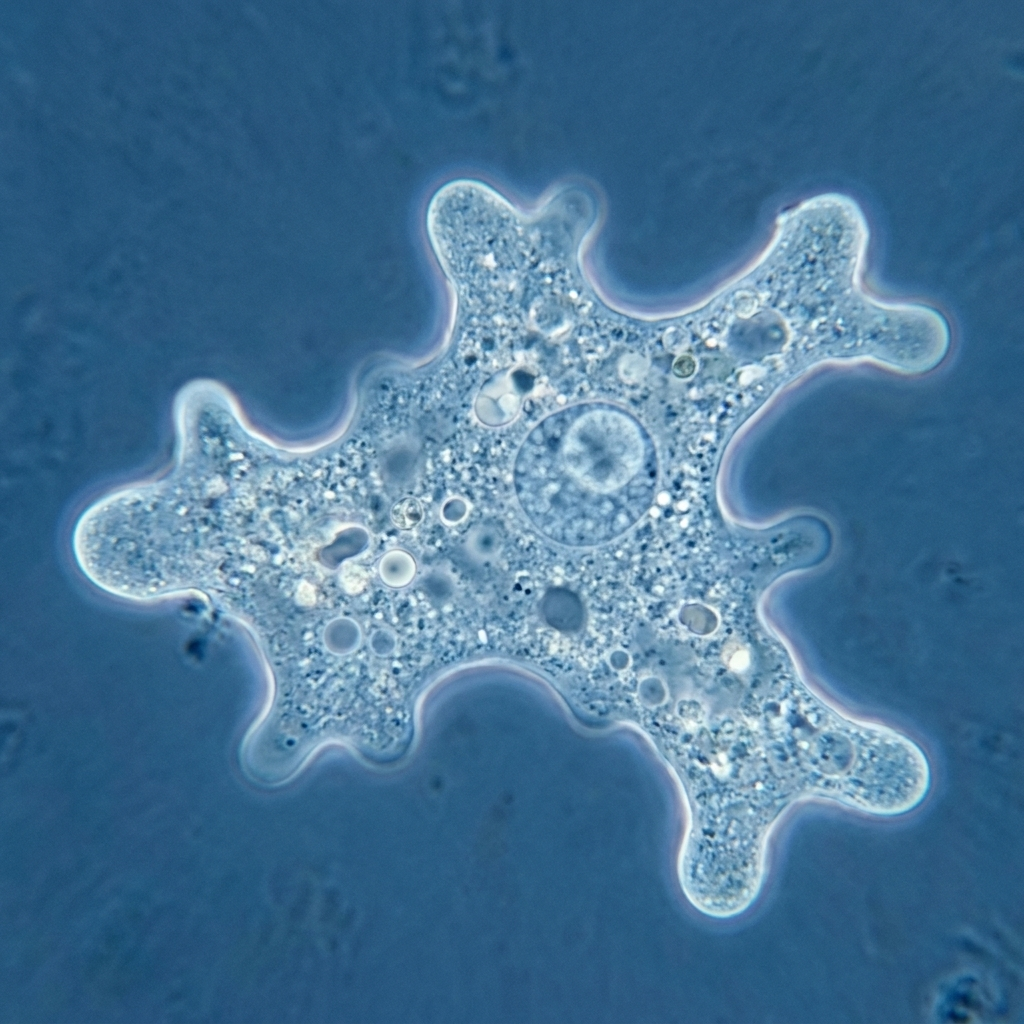
The active, feeding, dividing stage. Balamuthia trophozoites are roughly 15 to 60 micrometers across, with most measuring around 30 micrometers. They are irregular in outline, often described as having a branching, ragged shape. Each trophozoite carries a single nucleus, though cells with two nuclei are occasionally seen, and the nucleus typically contains one dense, centrally placed nucleolus. That prominent nucleolus is one of the few features that lets microscopists tell Balamuthia apart from Acanthamoeba in tissue, where the two look frustratingly alike. The trophozoite reproduces by mitotic division.
Cyst
When the environment turns hostile — no food, swings in temperature or pH, crowding, or accumulated waste — the trophozoite encysts. The cyst is roughly spherical and smaller than the active form, around 10 to 30 micrometers. Under an ordinary light microscope it appears to have a double wall, but electron microscopy reveals a more elaborate three-layered architecture: a wrinkled outer wall (ectocyst), an inner wall (endocyst), and between them a thick, amorphous, fibrous middle layer (the mesocyst) that distinguishes Balamuthia from its relatives.
This layered cyst is what allows the amoeba to persist through adverse conditions and survive in dry soil and dust. Crucially for medicine, the cyst’s toughness is also a clinical obstacle: an amoeba that converts to its cyst form inside the body becomes far harder to eliminate, because cysts resist many of the chemical agents that can affect the active trophozoite. When favorable conditions return, the trophozoites emerge again and the cycle closes.
A relative among bacterial carriers
Free-living amoebae have a well-documented reputation in water microbiology as “Trojan horses” — single cells that engulf bacteria but fail to digest some of them, instead giving those bacteria a protected place to multiply. Acanthamoeba is the classic example, sheltering Legionella pneumophila and various mycobacteria inside a cell that itself shrugs off disinfection.
Balamuthia mandrillaris is far less studied in this role, and it does not have the documented water-system track record of Acanthamoeba. But the genus as a whole carries the same potential: an environmental relative, Balamuthia spinosa, has been flagged as a possible vehicle for Legionella pneumophila. The broader lesson holds — amoebae that graze on bacteria in soil and water can inadvertently become reservoirs that concentrate and protect microbes resistant to digestion. With B. mandrillaris specifically, the dominant human concern is not bacterial transport but the amoeba’s own ability, in rare circumstances, to invade tissue.
How Balamuthia reaches human tissue
Balamuthia is not built to infect people. It has no specialized machinery for breaching healthy skin or mucous membranes, and the overwhelming majority of human contact with it produces nothing at all. The disease, when it occurs, takes a slow and indirect path — and unlike Acanthamoeba, Balamuthia strikes both immunocompromised and otherwise healthy people.
Route 1: The skin and lungs as entry points
The body’s first contact with Balamuthia is thought to come through one of two doorways. The amoeba can enter through a break in the skin that is contaminated by amoeba-bearing soil or stagnant water, or it can be inhaled as dust or aerosolized droplets into the lower respiratory tract. From either site it can establish a quiet, local foothold.
This is why the skin is so often the first organ affected. Balamuthia skin disease frequently shows up as a single lesion, often on the central face, and this cutaneous stage can precede neurological symptoms by months — sometimes longer. The slow tempo is one of the most dangerous features of the infection, because the early signs are easy to mistake for something else.
Route 2: The brain (Granulomatous Amoebic Encephalitis)
The feared destination is the central nervous system. Balamuthia causes granulomatous amoebic encephalitis (GAE), the same broad category of disease Acanthamoeba produces in immunosuppressed patients — but Balamuthia GAE can strike people with perfectly normal immune systems as well.
The route to the brain is believed to be hematogenous: from its primary site in the skin or lungs, the amoeba reaches the bloodstream and is carried to the brain, where it crosses the blood-brain barrier. Supporting this, pathologists examining infected brain tissue typically find amoebae clustered around blood vessels, and autopsies often reveal multiple infected organs. This is a different mechanism from Naegleria fowleri, which travels directly up the olfactory nerve from the nasal cavity; Balamuthia cases do not show the olfactory-lobe pattern characteristic of Naegleria. Like Acanthamoeba GAE, and unlike the lightning-fast Naegleria infection, Balamuthia disease is subacute to chronic — it unfolds over weeks to months rather than days, though once the brain is involved, deterioration can be swift.
A rarer route: organ transplantation
A small but well-documented number of Balamuthia infections have been transmitted through solid organ transplantation, when organs from an unknowingly infected donor were given to recipients. These clusters are rare and tragic, and they underscore how easily the infection can hide: in several cases the donors had died of what looked like a stroke or undiagnosed neurological illness.
Environmental presence and what it means
Balamuthia has been recovered from soil, dust, and water across a wide range of climates, from warm regions to cooler northern soils and even hot springs. Because it is so widely distributed in dirt, meaningful exposure is far more common than disease.
Serologic surveys make this concrete. When researchers tested blood from landscapers and ordinary blood donors in southern Arizona — a region with documented cases — they found measurable Balamuthia antibodies in a small percentage of both groups, with no significant difference between them. In other words, a portion of the general population has been exposed to the amoeba and cleared it silently, never developing symptoms. Exposure, it turns out, is meaningfully more common than illness.
That gap between exposure and disease is the central epidemiological fact about Balamuthia. The organism is around us; the catastrophe is rare.
Who is affected, and where
Worldwide, only a few hundred cases have ever been reported, and the true number is likely higher because the infection is easily misdiagnosed. In the United States, the largest case review covering 1974 to 2016 documented just over a hundred cases. Several patterns stand out:
- The disease appears at any age, from infants to the elderly, and affects more males than females.
- California reported the most cases, followed by other southwestern states such as Arizona and Texas — a geographic skew toward warm, dry, soil-rich regions.
- Hispanic patients were disproportionately represented, making up roughly half of cases. The reasons are not settled and may involve a mix of environmental, occupational, genetic, and socioeconomic factors rather than any single cause.
- Soil exposure — gardening, landscaping, farming, yard work, and similar dirt contact — was the most commonly reported risk activity, with recreational water exposure also frequently noted.
Among patients with a known outcome, roughly 90% died, a fatality rate that places Balamuthia GAE among the deadliest infections recognized in medicine. A handful of survivors have been reported following aggressive, prolonged combination drug therapy, but recovery remains the exception, and early recognition is widely regarded as the single most important factor.
Practical, general precautions
Because Balamuthia lives in soil and dust, complete avoidance is impossible, and there are no official, validated prevention guidelines specific to this amoeba. What follows are general, common-sense hygiene behaviors that follow logically from how the organism is understood to enter the body — not medical recommendations:
- Clean any wound that has been in contact with soil or standing water promptly and thoroughly with soap and clean water, and keep it covered.
- Wear gloves and protective clothing during heavy gardening, landscaping, or agricultural work, particularly with broken skin on the hands.
- Be mindful of inhaling large amounts of dust during digging, excavation, or work in very dry, dusty conditions.
- Use only sterile or properly treated water — never untreated tap or environmental water — for any practice that introduces water into the nasal passages, such as nasal rinsing.
These are behavioral precautions drawn from the biology of the organism. They are not medical advice, and anyone with a specific health concern, a non-healing skin lesion, or unexplained neurological symptoms should consult a qualified healthcare professional without delay.
Why it matters
Balamuthia mandrillaris occupies an uneasy place in microbiology — an organism of profound ecological modesty and disproportionate clinical menace. Understanding it means holding several ideas at once:
- Environmental microbiology — how a soil-and-dust amoeba with a triple-walled, disinfection-resistant cyst persists invisibly across continents and climates.
- Microbial ecology — how free-living amoebae as a group can act as reservoirs and carriers in the environment, even where, as with Balamuthia, the dominant danger is the amoeba’s own rare capacity to invade.
- Host–pathogen biology — how an organism with no evolutionary stake in infecting humans can, through slow opportunistic spread from skin or lung into the bloodstream and brain, cause a disease that kills the great majority of the people it reaches, regardless of whether their immune systems are intact.
The takeaway is not panic about touching dirt. It is the same biologically humbling point that Acanthamoeba teaches, sharpened by Balamuthia’s lethality: the abundance of an organism in the environment and the danger it poses to any individual are not the same measure. Balamuthia is widespread and almost never causes illness. The rare cases that do occur arise from an unlucky collision of circumstance — a contaminated wound, an inhaled lungful of dust, an unsuspected donor organ — that carries a soil amoeba somewhere it was never meant to go.
In a microbial world of staggering diversity, most of which never brushes against human health, Balamuthia mandrillaris stands as a sobering reminder of how narrow, and how consequential, the line between harmless environmental microbe and deadly pathogen can be.
Sources and further reading
- Centers for Disease Control and Prevention. Balamuthia mandrillaris. cdc.gov/parasites/balamuthia
- Cope JR et al. “Balamuthia mandrillaris — United States, 1974–2016.” MMWR Morbidity and Mortality Weekly Report 68(50):1133–1138. 2019.
- Visvesvara GS, Moura H, Schuster FL. “Pathogenic and opportunistic free-living amoebae.” FEMS Immunology and Medical Microbiology 50(1):1–26. 2007.
- Schuster FL, Visvesvara GS. “Free-living amoebae as opportunistic and non-opportunistic pathogens of humans and animals.” International Journal for Parasitology 34(9):1001–1027. 2004.