Educational disclaimer. This article is general biological reference only. It is not medical advice, not a clinical guide, and does not describe diagnosis or treatment of human disease. If you suspect any lung or other medical condition, seek qualified medical attention promptly.
Coccidioides immitis lives in the dry, dusty soil of the American Southwest — in the San Joaquin Valley of California, in desert washes, in farmland and construction sites and the dirt churned up by a passing truck. It is not an organism that needs water systems, hosts, or warm bodies to thrive. It is a soil fungus, content to grow as a thread-like mold a few inches beneath the surface of arid land, waiting for the wind. And every time that soil is disturbed — by a plow, a dust storm, a digging dog, a child kicking up dirt — it can launch microscopic spores into the air that humans then breathe.
Most of the time, nothing serious happens. But Coccidioides immitis is also the cause of Valley fever (coccidioidomycosis), a disease that ranges from a mild cough to a slow, dangerous infection that can spread far beyond the lungs.
What kind of organism is Coccidioides?
Coccidioides immitis is a fungus, not a parasite or an amoeba. It belongs to the phylum Ascomycota, class Eurotiomycetes, order Onygenales — a group that includes several dimorphic fungi capable of causing serious infection in otherwise healthy people. For a long time after its discovery in the 1890s it was mistaken for a protozoan, and only at the turn of the twentieth century was it correctly classified as a fungus.
There are two nearly indistinguishable species in the genus: Coccidioides immitis and Coccidioides posadasii. They are genetically distinct but look identical under the microscope and cause the same disease. The practical split is geographic: C. immitis is the form typically found in California, while C. posadasii dominates elsewhere — Arizona, the rest of the southwestern United States, northern Mexico, and parts of Central and South America. For most purposes the two are discussed together, and what is true of one is broadly true of the other.
Unlike a true parasite, Coccidioides does not depend on infecting a host to complete its life cycle. It lives perfectly well in soil. When it does end up inside a lung, the infection is — from the fungus’s point of view — a detour, not a destination.
Two phases, one dramatic transformation
Coccidioides is a dimorphic fungus: it takes one form in the environment and a completely different one inside the body. This shape-shifting is the heart of its biology.
The mold (saprobic phase)
In the soil, Coccidioides grows as a mold — a mesh of branching, segmented filaments called hyphae. As the colony matures, alternating cells along these filaments dry out and develop into tough, barrel-shaped reproductive units called arthroconidia, usually only a few micrometers across. When the soil is disturbed, these arthroconidia fracture loose and become airborne, where they can drift on even gentle air currents and travel considerable distances on the wind. They are the infectious propagules — the form that reaches human lungs.
The spherule (parasitic phase)
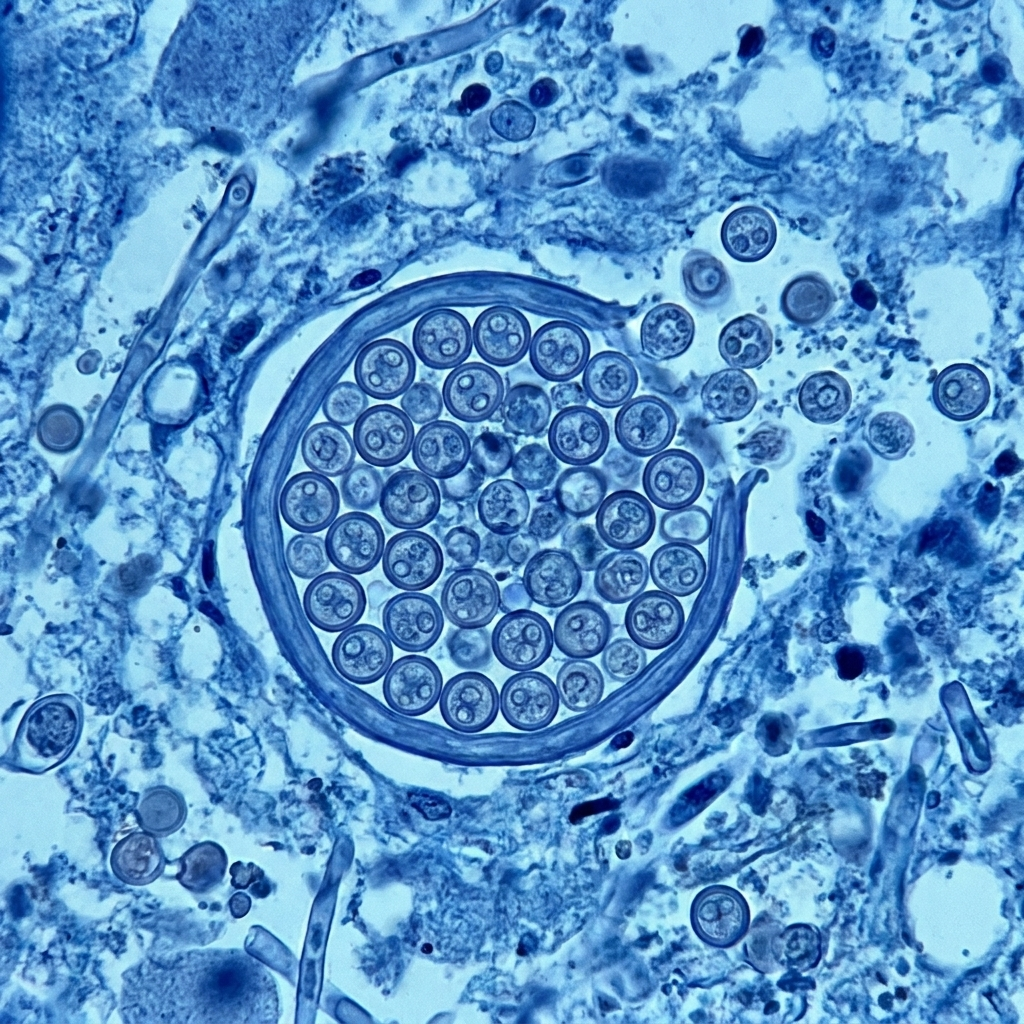
When an arthroconidium is inhaled deep into the lung, the warmth and conditions of the body trigger a remarkable transformation. Instead of growing into more mold, the spore rounds up and swells into a thick-walled sphere called a spherule. Inside, the spherule undergoes internal division, partitioning its interior into as many as several hundred tiny single-celled units called endospores. When the mature spherule ruptures, it releases this cloud of endospores into the surrounding tissue — and each one can grow into a new spherule, repeating the cycle.
This spherule-and-endospore form is unique to Coccidioides and is the classic finding pathologists look for in infected tissue. It is also part of what makes the fungus dangerous: a single inhaled spore can, through this self-amplifying cycle, multiply enormously inside the lung. Notably, the infectious dose is thought to be very small — possibly as little as a single arthroconidium.
Not a “Trojan horse,” but a master of disguise
The free-living amoebae are famous as “Trojan horses” of water microbiology — cells that swallow bacteria and unwittingly shelter them. Coccidioides plays a different game entirely. It carries no bacterial passengers; its trick is transformation.
The shift from mold to spherule is, in effect, a disguise. The spherule’s thick wall and its strategy of bursting into hundreds of new endospores help the fungus resist and evade the immune defenses that would normally contain an inhaled microbe. Where an amoeba hides bacteria inside itself, Coccidioides hides itself inside a form the body is poorly equipped to recognize and clear. The result is the same kind of biological lesson from a different angle: survival inside a hostile environment depends not on brute toughness alone, but on changing shape at exactly the right moment.
How Coccidioides reaches human tissue
Coccidioides has no interest in infecting people and no specialized machinery for invading healthy skin. There is essentially one route into the body, and a much rarer secondary path.
Route 1: The lungs (inhalation)
Nearly all infections begin the same way: a person breathes in airborne arthroconidia stirred up from contaminated soil. The spores are small enough to bypass the upper airway’s defenses and settle deep in the lungs, where they convert into spherules and begin the endospore cycle.
What happens next varies enormously. Many infected people have no symptoms at all and never know they were exposed. Others develop a flu-like or pneumonia-like illness — fatigue, cough, fever, shortness of breath, night sweats, sometimes a distinctive rash — that often resolves on its own over weeks. A smaller number develop chronic lung disease. Importantly, Coccidioides can cause illness in both immunocompetent and immunocompromised people; a normal immune system is no guarantee against infection, though it strongly influences the outcome.
A crucial point for public understanding: Valley fever is not contagious. It does not spread from person to person or between animals and people. Every case comes from the environment.
Route 2: Dissemination beyond the lungs
In roughly 1% of cases, the infection escapes the lungs and spreads through the bloodstream to other parts of the body — a serious condition called disseminated coccidioidomycosis. When this happens, the fungus most commonly settles in the skin, the bones and joints, or the membranes around the brain and spinal cord, where it can cause meningitis. Disseminated disease is the dangerous face of Valley fever and the form most likely to be life-threatening.
Certain groups face a higher risk of this severe spread. Documented risk factors for dissemination and serious disease include advanced age, pregnancy (especially the later stages), diabetes, immunosuppression from conditions such as HIV/AIDS or from medications, and — for reasons not fully understood and likely involving a mix of factors — certain ethnic and racial backgrounds. These associations describe populations, not individual destinies, and the great majority of infections in every group remain mild.
A rarer route: direct skin inoculation
Very occasionally, Coccidioides enters through a break in the skin contaminated with soil or spores, producing a localized skin infection rather than a lung infection. This is uncommon compared with the inhalation route but is well documented.
Environmental presence and what it means
Coccidioides is firmly rooted in geography. It thrives in hot, dry, low-elevation regions with alkaline soil, sparse rainfall, and few hard winter freezes. In the United States it is endemic across Arizona, California, Nevada, Utah, New Mexico, and western Texas, with the fungus more recently confirmed in parts of eastern Washington state. It also occurs in northern Mexico and parts of Central and South America. Climate patterns appear to be shifting and possibly expanding where the fungus can establish itself.
Because the fungus lives in soil that millions of people walk, dig, and drive across, exposure in endemic areas is extremely common, while serious disease is not. In some parts of the endemic zone, Valley fever accounts for a substantial share of community-acquired pneumonia — by some estimates a notable fraction of such cases — which tells us that quiet, often unrecognized exposure is a routine background fact of life in these regions. Many people who have lived in the Southwest carry immune evidence of past infection without ever having been knowingly ill.
That gap between exposure and serious illness is the central epidemiological truth about Coccidioides: the organism is common, the dangerous outcome is rare.
Who is affected, and where
Valley fever is a reportable disease in the United States, and case numbers have risen in recent years, particularly in Arizona, for reasons that are still being studied. Several patterns recur:
- The disease appears at any age, but older adults tend to fare worse, and incidence has been notably high in older age groups.
- Outdoor and dust-exposed occupations carry elevated risk — construction, agriculture, ranching, road work, archaeological excavation, and military training in the desert have all been linked to infections and outbreaks.
- Travelers and newcomers to endemic regions can be infected and may carry the disease home to areas where physicians rarely think to test for it, leading to delayed diagnosis.
- Activities that disturb soil — gardening, off-road driving, digging, building — increase the chance of inhaling spores.
Most infections are mild or self-limiting and resolve without specific treatment; serious and disseminated cases require medical antifungal therapy under professional care. Coccidioides immitis is taken seriously enough at the laboratory level that it is among the very few fungi classified as a regulated select agent in the United States, reflecting how readily its spores can cause infection.
Practical, general precautions
Because Coccidioides lives in soil across large, populated regions, complete avoidance is impossible. The following are general, common-sense behaviors that follow from how the fungus reaches people — not medical recommendations:
- In endemic, dusty areas, try to limit time spent in heavy outdoor dust, and stay indoors with windows closed during dust storms when practical.
- When work requires disturbing soil in endemic regions — digging, construction, agriculture — appropriate respiratory protection such as a well-fitted N95 respirator may reduce inhaled spores.
- Wet down soil before digging or disturbing it to cut down on airborne dust.
- Clean and cover any wound contaminated with soil promptly, since direct skin inoculation, though rare, is possible.
- If you live in or have traveled to an endemic area and develop a persistent cough, fever, fatigue, or pneumonia-like illness, mention your exposure to a healthcare provider, since Valley fever is easily mistaken for ordinary pneumonia.
These are behavioral precautions drawn from the biology of the organism. They are not medical advice, and anyone with a specific health concern or persistent respiratory symptoms should consult a qualified healthcare professional.
Why it matters
Coccidioides immitis sits at the meeting point of mycology, environmental science, and public health, and understanding it means thinking on several levels at once:
- Environmental microbiology — how a soil fungus tuned to arid land turns the simple act of disturbing dry dirt into an aerosol of infectious spores capable of traveling on the wind.
- Developmental biology — how a single organism carries two utterly different body plans, switching from soil-dwelling mold to self-replicating spherule under the cue of the host’s internal environment.
- Host–pathogen biology — how a fungus with no evolutionary stake in infecting humans can, through inhalation and a self-amplifying tissue cycle, produce anything from a silent exposure to a life-threatening infection that spreads to bone and brain.
The takeaway is not fear of the desert. It is the same biologically humbling point that the free-living amoebae teach, applied to a fungus: how common an organism is in the environment and how dangerous it is to any one person are different measurements. Coccidioides is widespread across the Southwest and most encounters with it pass without incident. The serious cases arise from an unlucky combination — a deep breath of spore-laden dust, a vulnerable host, an infection that slips past containment — that carries a soil fungus somewhere it was never adapted to go.
In a world of vast and mostly harmless microbial life, Coccidioides immitis is a vivid reminder that the line between an ordinary handful of desert soil and a serious human disease can be as thin as a single inhaled breath.
Sources and further reading
- Centers for Disease Control and Prevention. Valley Fever (Coccidioidomycosis). cdc.gov/fungal/diseases/coccidioidomycosis
- Galgiani JN et al. “Coccidioidomycosis.” New England Journal of Medicine 353(22):2369–2379. 2005.
- Ampel NM. “New perspectives on coccidioidomycosis.” Proceedings of the American Thoracic Society 7(3):181–185. 2010.
- Morgan J et al. “Coccidioidomycosis hospitalization, United States, 2011–2017.” Emerging Infectious Diseases 26(4):716–723. 2020.