Educational disclaimer. This article is general biological reference only. It is not medical advice, not a clinical guide, and does not describe diagnosis or treatment of human disease. If you suspect any lung or neurological condition, seek qualified medical attention promptly.
Cryptococcus neoformans is almost certainly present somewhere near you — in soil, in dust, in the weathered droppings that accumulate beneath pigeon roosts and around old buildings, barns, and park ledges. It is one of the most widespread environmental yeasts in the world, recovered from every inhabited continent, thriving especially in places where birds gather. Most people inhale it at some point in their lives and never know it.
And yet Cryptococcus neoformans is also responsible for cryptococcal meningitis, one of the deadliest fungal infections of the human brain. The World Health Organization lists it among its highest-priority fungal threats, and globally it still accounts for a startling share of AIDS-related deaths each year. It is a vivid example of an organism that is almost harmless to most and devastating to a vulnerable few.
What kind of organism is Cryptococcus?
Cryptococcus neoformans is a yeast — a single-celled fungus. It belongs to the phylum Basidiomycota, class Tremellomycetes, which makes it, surprisingly, a closer evolutionary relative of gilled mushrooms than of the more familiar medical yeasts like Candida. It was first identified as a human pathogen in the 1890s, but it did not become medically prominent until the 1970s, and its profile rose sharply with the arrival of the HIV/AIDS epidemic in the 1980s.
The genus contains roughly thirty species, but the overwhelming majority of human disease comes from two closely related members: Cryptococcus neoformans and Cryptococcus gattii. The practical distinction is ecological. C. neoformans is found worldwide and is strongly associated with bird droppings — especially aged pigeon excreta — and soil contaminated by them. C. gattii, by contrast, is more often tied to certain trees in tropical and subtropical regions and is more likely to infect people with healthy immune systems. The two are usually discussed together as the cryptococcal species complex.
Like other environmental fungi, Cryptococcus does not need a human host to survive. It lives perfectly well as a free-living organism in the environment, feeding on organic matter. When it ends up in a human lung, the infection is — from the yeast’s perspective — an accident of inhalation, not a goal.
One yeast, one extraordinary coat
Cryptococcus spends most of its life as a round-to-oval budding yeast cell, typically only a handful of micrometers across. It can, under particular conditions such as mating, form filaments (hyphae) and produce tiny spores called basidiospores, but in infected human tissue it is essentially always found in the yeast form. Its defining feature, however, is not its shape — it is its armor.
The capsule
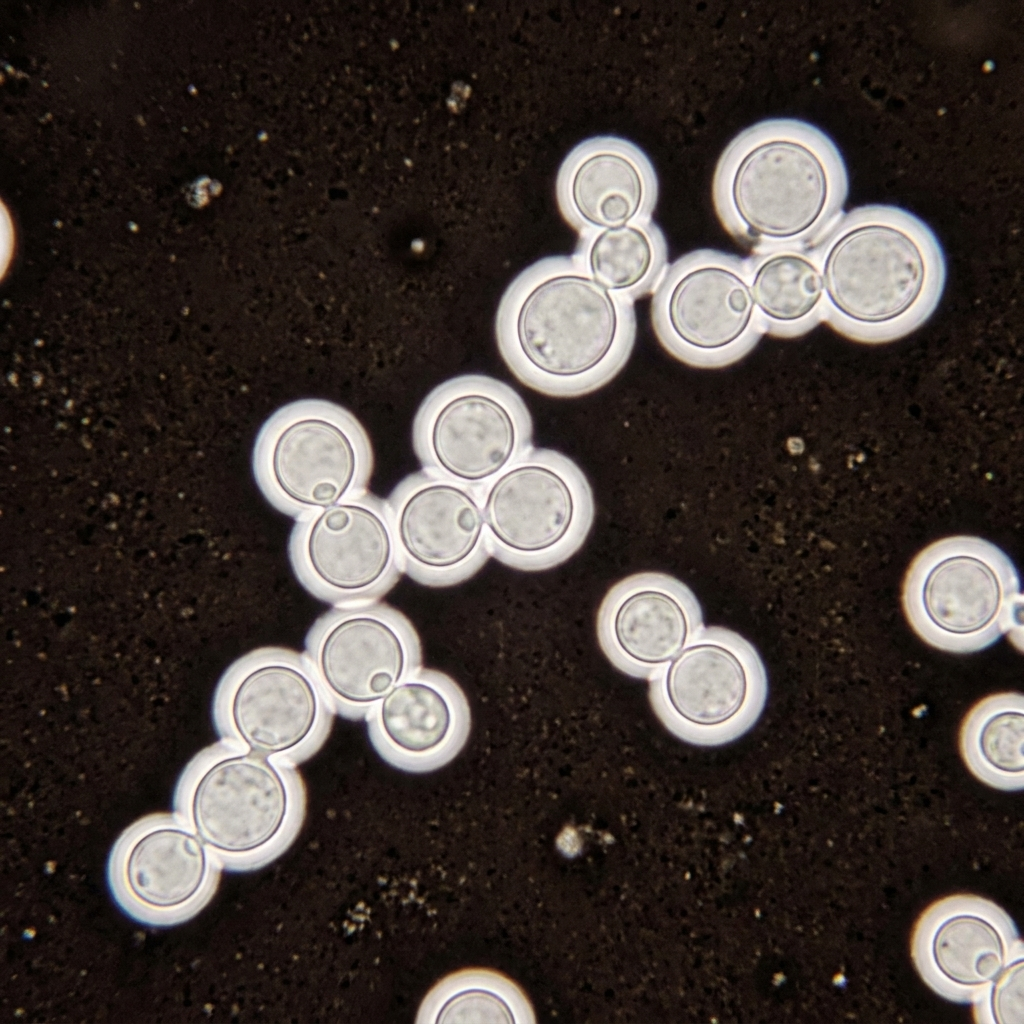
What sets Cryptococcus neoformans apart from nearly every other yeast is a thick, gelatinous polysaccharide capsule that surrounds each cell. This capsule can swell to several times the diameter of the cell itself, and it is the single most important reason the organism is dangerous. Made largely of a sugar polymer called glucuronoxylomannan (GXM), the capsule:
- Hides the yeast from the immune system, masking the cell wall components the body would normally recognize and attack.
- Suppresses and confuses the immune response, with shed capsule material actively dampening inflammation.
- Helps the cell resist drying out and survive harsh environmental conditions.
The capsule is so distinctive that a simple laboratory technique — mixing a sample with India ink — reveals it instantly: the ink particles cannot penetrate the capsule, so each yeast cell appears surrounded by a bright, clear halo.
Other weapons
Beyond the capsule, Cryptococcus produces melanin, a dark pigment that protects it against oxidative attack and ultraviolet light, and urease, an enzyme that helps it cross into the brain. It also grows happily at human body temperature — a capability many environmental fungi lack, and a prerequisite for infecting a warm-blooded host. Together, these traits make an otherwise unremarkable soil yeast into a formidable pathogen.
Not a “Trojan horse” — but a passenger inside one
The free-living amoebae are the classic “Trojan horses” of microbiology, swallowing bacteria that then survive inside them. Cryptococcus turns this relationship inside out in a fascinating way. In the environment, soil amoebae prey on yeast cells — and Cryptococcus has evolved to survive being engulfed, persisting and even replicating inside the amoeba rather than being digested.
Many researchers believe this is no coincidence. The same tricks that let Cryptococcus survive inside a soil amoeba — resisting the hostile interior of a predatory cell, withstanding being eaten — are strikingly similar to the tricks it uses to survive inside human immune cells called macrophages, the very cells meant to destroy it. In this view, Cryptococcus’s ability to cause human disease is an accidental byproduct of millions of years spent defending itself against amoebae in the dirt. Its virulence in us was never aimed at us at all.
How Cryptococcus reaches human tissue
Cryptococcus has no interest in infecting people and no machinery for breaking through healthy skin. There is essentially one main route into the body, leading to two very different outcomes depending on the host.
Route 1: The lungs (inhalation)
Infection almost always begins when a person inhales desiccated yeast cells or tiny basidiospores stirred up from contaminated soil or dried bird droppings. The particles are small and light enough to reach deep into the lungs. There, the body’s immune cells attempt to contain them.
In a person with a healthy immune system, this usually works. The infection is typically cleared or walled off, often producing no symptoms at all — or at most a mild, self-limiting respiratory illness. Crucially, the yeast can also enter a latent (dormant) state, sitting quietly contained within the lungs or lymph nodes for months or years, held in check by the immune system without ever causing disease.
It is worth stressing that cryptococcosis is not contagious. It does not pass from person to person or from birds to people directly; the pigeons that enrich the soil with the yeast are not themselves infected and carry it harmlessly. Every human case traces back to the environment.
Route 2: The brain (cryptococcal meningitis)
The danger emerges when the immune system can no longer keep the yeast contained — typically because of immunosuppression. The contained infection reactivates, the yeast multiplies, and it spreads through the bloodstream. Cryptococcus has a striking affinity for the central nervous system: it crosses the blood-brain barrier and settles in the membranes surrounding the brain and spinal cord, causing cryptococcal meningitis (more precisely, meningoencephalitis).
This is the lethal face of the organism. Cryptococcal meningitis develops slowly, with headache, fever, neck stiffness, nausea, light sensitivity, and progressive changes in mental state, and without proper care it is frequently fatal. Even with treatment, mortality remains high in many parts of the world. The urease and capsule that seemed like mere survival tools in the soil become, in this setting, the instruments of a devastating brain infection.
A rarer route: the skin and other organs
Although the lungs and brain dominate, Cryptococcus can disseminate to almost any organ once it enters the bloodstream, producing skin nodules and ulcers, bone lesions, or involvement of organs such as the prostate. Skin disease sometimes appears as an early visible sign of a deeper, disseminated infection.
Who is affected, and where
The defining epidemiological fact about Cryptococcus neoformans is that it is overwhelmingly an opportunist of the immunocompromised. The single largest risk group, by far, is people with advanced HIV/AIDS, in whom the collapse of cell-mediated immunity removes the defense that normally keeps the yeast dormant. Cryptococcus neoformans is the leading cause of meningitis in adults in sub-Saharan Africa, driven by the regional burden of advanced HIV disease.
The scale is sobering. Global modeling estimates place cryptococcal meningitis in the range of well over a hundred thousand cases each year, with a very high fatality rate, and the disease still accounts for roughly one in five AIDS-related deaths worldwide — even though expanded HIV treatment has reduced the absolute burden compared with a decade earlier. These figures are part of why the WHO designated C. neoformans a “critical priority” fungal pathogen in 2022.
Other risk groups have grown in importance as HIV treatment has improved. Documented risk factors beyond HIV include:
- Organ transplantation and the immunosuppressive drugs that follow it.
- Cancer, especially blood cancers, and chemotherapy.
- Long-term corticosteroid use and other immune-suppressing treatments.
- Conditions such as advanced liver disease, kidney disease, diabetes, and certain autoimmune disorders.
Although disease in fully healthy people is uncommon for C. neoformans (its relative C. gattii does this more readily), it is not impossible, and cases in apparently normal hosts are documented.
Practical, general precautions
Because Cryptococcus is so widespread in the environment, complete avoidance is impossible and not necessary for most people. There are no formal prevention guidelines aimed at the general population. The following are general, common-sense behaviors that follow from how the yeast reaches people — and they matter far more for those with weakened immune systems — and are not medical recommendations:
- Avoid stirring up large amounts of dust from areas heavily soiled with bird droppings, such as old pigeon roosts, attics, barns, or window ledges thick with accumulated excreta.
- If cleaning such areas is unavoidable, dampening the material first reduces airborne dust, and appropriate respiratory protection may reduce inhaled particles.
- People with significantly weakened immune systems may wish to be especially cautious around heavy bird-dropping accumulations and should follow any guidance from their own healthcare providers.
- Because early cryptococcal meningitis can be mistaken for other illnesses, anyone with a compromised immune system who develops a persistent headache, fever, or neck stiffness should seek medical attention promptly.
These are behavioral precautions drawn from the biology of the organism. They are not medical advice, and anyone with a specific health concern — particularly anyone immunocompromised — should consult a qualified healthcare professional.
Why it matters
Cryptococcus neoformans sits at the crossroads of environmental mycology, evolutionary biology, and global public health, and understanding it means holding several ideas together at once:
- Environmental microbiology — how a hardy, encapsulated yeast flourishes in soil and aged bird droppings across the entire inhabited world, drying out and riding the air into human lungs.
- Evolutionary biology — how the very weapons that make this yeast deadly in a human brain appear to have evolved not to attack us at all, but to survive being eaten by amoebae in the dirt.
- Host–pathogen biology — how an organism almost completely controlled by a healthy immune system becomes one of the world’s great killers of people whose immune defenses have failed.
The takeaway is not fear of pigeons or soil. It is the same biologically humbling lesson the free-living amoebae and the desert fungi teach, here written in especially stark terms: how common an organism is in the environment and how dangerous it is to a given person are entirely different measurements, and the gap between them is bridged almost entirely by the state of the immune system. Cryptococcus neoformans is everywhere, and for most people it is nothing. For those whose immune defenses have collapsed, the same ubiquitous yeast becomes a lethal threat.
In a microbial world of staggering diversity, most of which never harms anyone, Cryptococcus neoformans is a sobering reminder that the boundary between a harmless environmental yeast and a deadly pathogen can rest not in the organism, but in the vulnerability of the person who breathes it in.
Sources and further reading
- World Health Organization. WHO Fungal Priority Pathogens List. WHO, 2022. who.int
- Centers for Disease Control and Prevention. Cryptococcosis. cdc.gov/fungal/diseases/cryptococcosis-neoformans
- Rajasingham R et al. “Global burden of disease of HIV-associated cryptococcal meningitis: a systematic review and meta-analysis.” The Lancet Infectious Diseases 17(8):873–881. 2017.
- Idnurm A et al. “Deciphering the model pathogenic fungus Cryptococcus neoformans.” Nature Reviews Microbiology 3(10):753–764. 2005.