Educational disclaimer. This article is general biological reference only. It is not medical advice, not a clinical guide, and does not describe diagnosis or treatment of human disease. If you suspect any parasitic condition, seek qualified medical attention promptly.
Of all the parasitic worms that infect human beings, Enterobius vermicularis — the pinworm — is at once the most common and the least dangerous in the temperate, industrialized world. It does not lurk in tropical rivers like a blood fluke, nor migrate across the eye like the African eye worm, nor invade the brain. Instead, it lives quietly and entirely inside the human intestine, and its single most famous feature is almost mundane by comparison: at night, the female crawls out of the anus to lay her eggs on the surrounding skin, producing the maddening itch that has made pinworm a familiar visitor in households, daycares, and schools the world over.
The pinworm is a parasite stripped down to its essentials. It needs no intermediate host, no insect vector, no patch of contaminated soil. Its entire existence unfolds within and immediately around a single human being, and it spreads from person to person with remarkable efficiency — which is exactly why it remains, by a wide margin, the most prevalent roundworm infection in much of the developed world.
What kind of organism is Enterobius vermicularis?
Enterobius vermicularis is a nematode — a roundworm — belonging to the family Oxyuridae. It was once known by the name Oxyuris vermicularis, and it is the cause of the infection called enterobiasis (sometimes oxyuriasis). It is small, white, and threadlike, which is the origin of its common names: pinworm, threadworm, and seatworm.
The worm is sexually dimorphic and modest in size. Adult females measure roughly 8 to 13 millimeters in length, with a long, sharply pointed tail; adult males are much smaller, around 2 to 5 millimeters, with a curved rear end. A closely related species, Enterobius gregorii, has been described in parts of Europe, Africa, and Asia, but for all practical purposes its biology, behavior, and significance are identical to those of E. vermicularis.
One of the most important biological facts about the pinworm is its host range: humans are essentially its only host. Unlike Toxoplasma, which infects nearly every warm-blooded animal, or Schistosoma, which depends on a snail, the pinworm has tied its entire fate to people. It is a true obligate parasite, and its complete life cycle takes place within the human gastrointestinal tract — there is no developmental phase in soil, water, or any other animal. This intimacy with its single host shapes everything about how it lives and spreads.
A life cycle that never leaves the human body
The pinworm’s life cycle is among the simplest of all parasitic worms, precisely because it has dispensed with intermediate hosts. The whole journey, from swallowed egg to egg-laying adult, takes place in and around one person and lasts roughly one month.
The egg (the infective form)
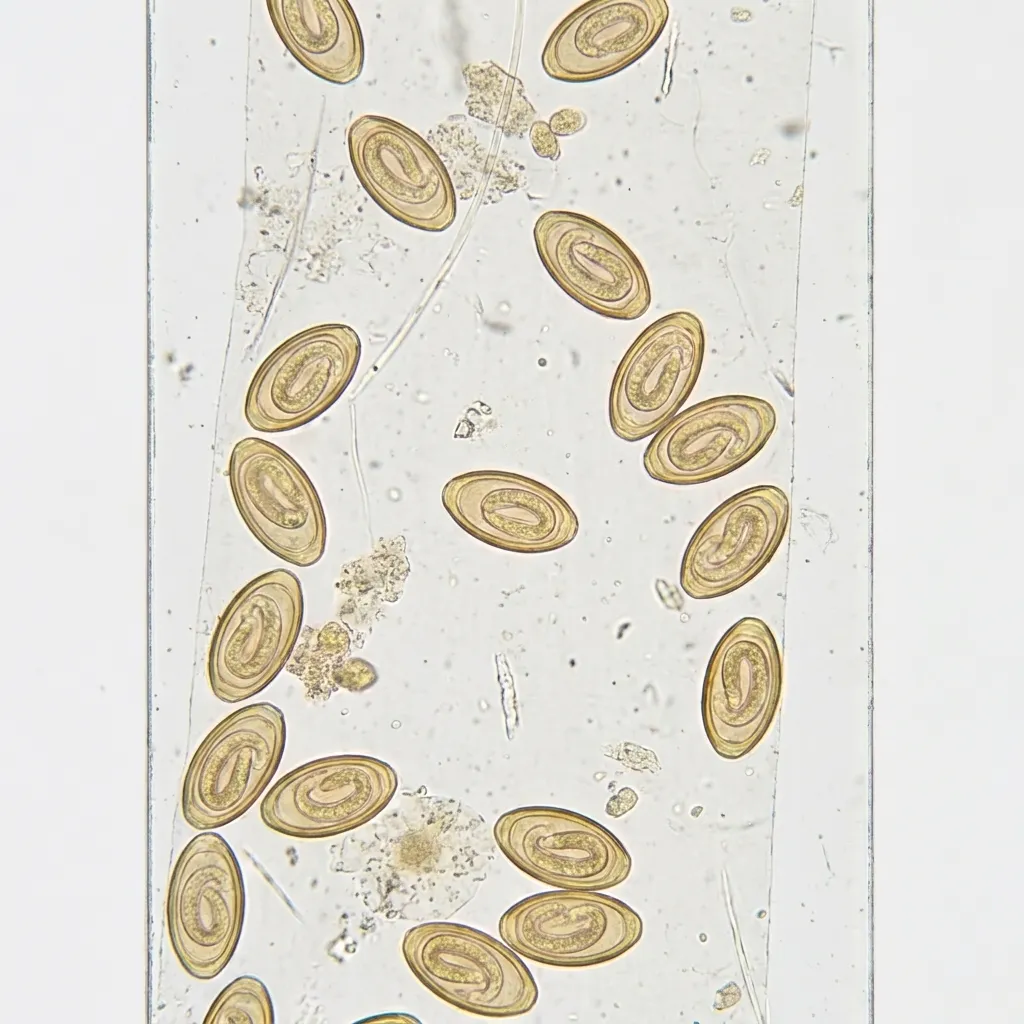
Infection begins when a person swallows pinworm eggs. The eggs are microscopic — about 50 to 60 micrometers long — oval, and distinctively flattened on one side, with a fully formed embryo inside. They reach the mouth on contaminated fingers, food, or objects. Critically, freshly laid pinworm eggs become infectious within only a few hours, which gives the parasite a fast and efficient route back into a host.
Hatching and maturation (in the intestine)
Once swallowed, the eggs hatch in the small intestine, releasing larvae. These larvae travel down the digestive tract toward the large intestine, settling in the region of the cecum, appendix, and adjacent colon. There they molt and mature into adult worms over the following weeks. The adults attach loosely to the intestinal lining and feed on the gut contents, bacteria, and surface cells. Males and females mate; the males generally die soon afterward and pass out of the body.
The nightly migration (egg-laying)
Here lies the pinworm’s signature behavior. The fertilized female fills with eggs — a single female may carry on the order of ten to fifteen thousand eggs in her body. Rather than releasing them inside the gut, she undertakes a nocturnal journey: at night, while the host sleeps, the gravid female migrates down through the colon, out of the anus, and onto the perianal skin — the skin surrounding the anal opening — where she deposits her eggs before dying. The movement of the worm and the eggs across this sensitive skin provokes intense itching, the hallmark symptom of the infection.
The cycle renews: autoinfection and beyond
This egg-laying strategy sets up the pinworm’s clever, and troublesome, modes of spreading:
- Autoinfection. The perianal itch prompts scratching, especially in sleeping children. Eggs lodge under the fingernails and on the fingers, and are then carried back to the mouth, restarting the cycle in the very same person. This self-reinfection is why pinworm can persist for long periods and is so difficult to clear without breaking the cycle.
- Person-to-person and environmental spread. Eggs shed onto skin, fingers, bedding, underclothing, towels, and surfaces are easily transferred to other people. The eggs are light and can become dislodged into household dust, contaminating furniture, carpets, and linens, and even, by some accounts, drifting in the air to be inhaled and swallowed. This is why pinworm so readily passes through entire households, classrooms, and institutions.
- Retroinfection. In a less common variation, eggs laid on the perianal skin hatch there, and the emerging larvae crawl back in through the anus and re-establish themselves in the colon.
Because the eggs are immediately infective and the routes of transmission are so ordinary, pinworm thrives wherever people live in close contact — and it has no need for warmth, water, or wilderness.
Not a “Trojan horse” — but a master of the household
The free-living amoebae are the classic “Trojan horses” of microbiology, sheltering bacteria inside themselves. The pinworm plays no such role; its distinction is entirely different. It is, in a sense, the consummate domestic parasite — an organism that has succeeded not through exotic biology but through exploiting the ordinary intimacies of human life.
Where other parasites have evolved elaborate machinery to cross between species or survive harsh environments, the pinworm has done the opposite: it has streamlined itself to depend wholly on human behavior. Its transmission rides on the things people do every day — sleeping in shared beds, scratching an itch, handling laundry, touching surfaces, gathering children together in schools and daycares. Its nocturnal egg-laying is exquisitely timed to the host’s sleep, when scratching is unconscious and hand-washing is hours away. In this light, the pinworm is less a creature of nature than a creature of the household, and its persistence is a reflection of how easily microscopic eggs move through the close quarters of human communities. Where an amoeba smuggles bacteria through water systems, the pinworm smuggles its eggs through the everyday fabric of family and institutional life.
How Enterobius vermicularis affects people
The pinworm is, mercifully, one of the most benign of human parasites. The great majority of infected people have few or no symptoms at all, and many carry the worm without ever realizing it.
When symptoms do occur, the dominant one is perianal itching (pruritus ani), characteristically worse at night when the females are active. This itching can disturb sleep and produce restlessness and irritability, particularly in children, who are the most frequently infected. Other reported effects include loss of appetite, difficulty sleeping, and general agitation. Notably, pinworm infection does not cause anemia and does not typically produce the elevated eosinophil counts seen with many other worm infections, reflecting how superficial and non-invasive it is.
Complications are uncommon but do exist. Persistent scratching can lead to irritated, broken, or secondarily infected skin around the anus. In girls and women, a wandering female worm can occasionally migrate to the genital region, causing irritation of the vulva or vagina; rarely, worms have been found in more distant sites. There has also been longstanding discussion about whether pinworms can contribute to appendicitis when they lodge in the appendix, though the relationship remains debated. For the overwhelming majority, however, enterobiasis is a nuisance rather than a threat — uncomfortable and socially unwelcome, but not dangerous.
The infection is not a marker of poor hygiene or dirtiness, a point worth emphasizing because of the stigma that sometimes attaches to it. Because the eggs spread so readily among people in close contact, pinworm appears across all social and economic groups, and infection says nothing about a household’s cleanliness.
Who is affected, and where
Enterobius vermicularis has a worldwide distribution but is especially common in temperate regions, and it is the most frequent roundworm infection in many developed countries — a striking contrast to the soil-transmitted and tropical worms that dominate elsewhere. Several patterns define who is at risk:
- Children, particularly those of preschool and school age, are by far the most commonly infected. Their close play, shared spaces, developing hygiene habits, and tendency to put hands in mouths make them efficient spreaders. Reported infection rates in children vary widely, and in some institutional or crowded settings can be very high.
- Family members of infected children, especially parents and caregivers, frequently become infected in turn, which is why pinworm is so often described as a household infection rather than an individual one.
- People in institutional or crowded living situations — daycares, schools, residential facilities — where close contact and shared surfaces accelerate transmission.
Because reinfection within a household is so common, controlling pinworm usually means addressing the whole family or group at once rather than a single person, and pairing any treatment with hygiene measures that interrupt the egg-to-mouth cycle.
Practical, general prevention
Because the pinworm spreads through eggs carried from the perianal skin to the mouth and onto surfaces, prevention centers on hygiene and breaking that cycle. The following are general, common-sense behaviors that follow from the parasite’s biology — not medical recommendations:
- Frequent, thorough hand-washing, especially after using the toilet, after scratching, before eating, and before preparing food, is the single most effective measure.
- Keeping fingernails short and clean and discouraging nail-biting and scratching reduces the eggs carried under the nails.
- Morning bathing or showering helps remove eggs deposited overnight, and washing the perianal area in the morning is more effective than at night.
- Laundering underclothing, pajamas, bedsheets, and towels regularly in hot water — and avoiding shaking them, which can disperse eggs into the air — helps clear environmental contamination.
- In households where infection is found, treating and applying hygiene measures to everyone at once helps prevent the cycle of reinfection that keeps pinworm circulating.
- Anyone concerned about a possible pinworm infection should consult a qualified healthcare professional, who can confirm it simply and advise on safe, effective treatment — the infection is readily curable.
These are general, educational points drawn from the biology of the organism. They are not medical advice, and anyone with a specific health concern should consult a qualified healthcare professional.
Why it matters
Enterobius vermicularis sits at an unexpectedly interesting intersection of parasitology, human behavior, and public health, and understanding it means thinking on several levels at once:
- Parasite biology — how a worm can complete its entire life cycle within and around a single human host, dispensing entirely with the intermediate hosts, vectors, and environmental stages that most parasites depend on, in one of the most streamlined life cycles in all of parasitology.
- Behavioral ecology — how the pinworm’s success rests not on exotic adaptations but on exploiting ordinary human routines, timing its egg-laying to sleep and riding its transmission on scratching, shared bedding, and the close contact of family and community life.
- Public health and perception — how an infection that is extraordinarily common and almost entirely harmless still carries social stigma, and how its control depends less on medicine alone than on understanding the simple hygiene that interrupts the egg-to-mouth cycle.
The takeaway is not alarm about a worm in the gut. It is a gentler and more human lesson than the ones taught by the more dangerous organisms: with Enterobius vermicularis, a parasite can be ubiquitous, persistent, and socially fraught while being medically trivial — its real impact measured in lost sleep and household frustration rather than in serious disease. The pinworm is a reminder that the most common parasite many people will ever encounter is also one of the most benign, and that its remarkable success comes simply from having learned, over countless generations, to live in the quiet spaces of human life.
In a world of parasites capable of blindness, organ damage, and death, Enterobius vermicularis stands almost as a counterpoint — proof that a hugely successful parasite need not be a dangerous one, and that abundance and harm are, once again, entirely separate measures.
Sources and further reading
- Centers for Disease Control and Prevention. Enterobiasis (Pinworm Infection) — Biology and Prevention & Control. cdc.gov/parasites/pinworm
- StatPearls. “Enterobius Vermicularis.” StatPearls Publishing / National Library of Medicine. 2023.
- Medscape. “Pinworm (Enterobiasis): Practice Essentials, Etiology, Transmission.” emedicine.medscape.com
- Rajamanickam A, Nutman TB. “Pinworm and other intestinal nematodes.” In Tropical Infectious Diseases. Elsevier.
- World Health Organization. Soil-transmitted helminth and intestinal nematode infection resources. who.int