Educational disclaimer. This article is general biological reference only. It is not medical advice, not a clinical guide, and does not describe diagnosis or treatment of human disease. If you suspect any eye or parasitic condition, seek qualified medical attention promptly.
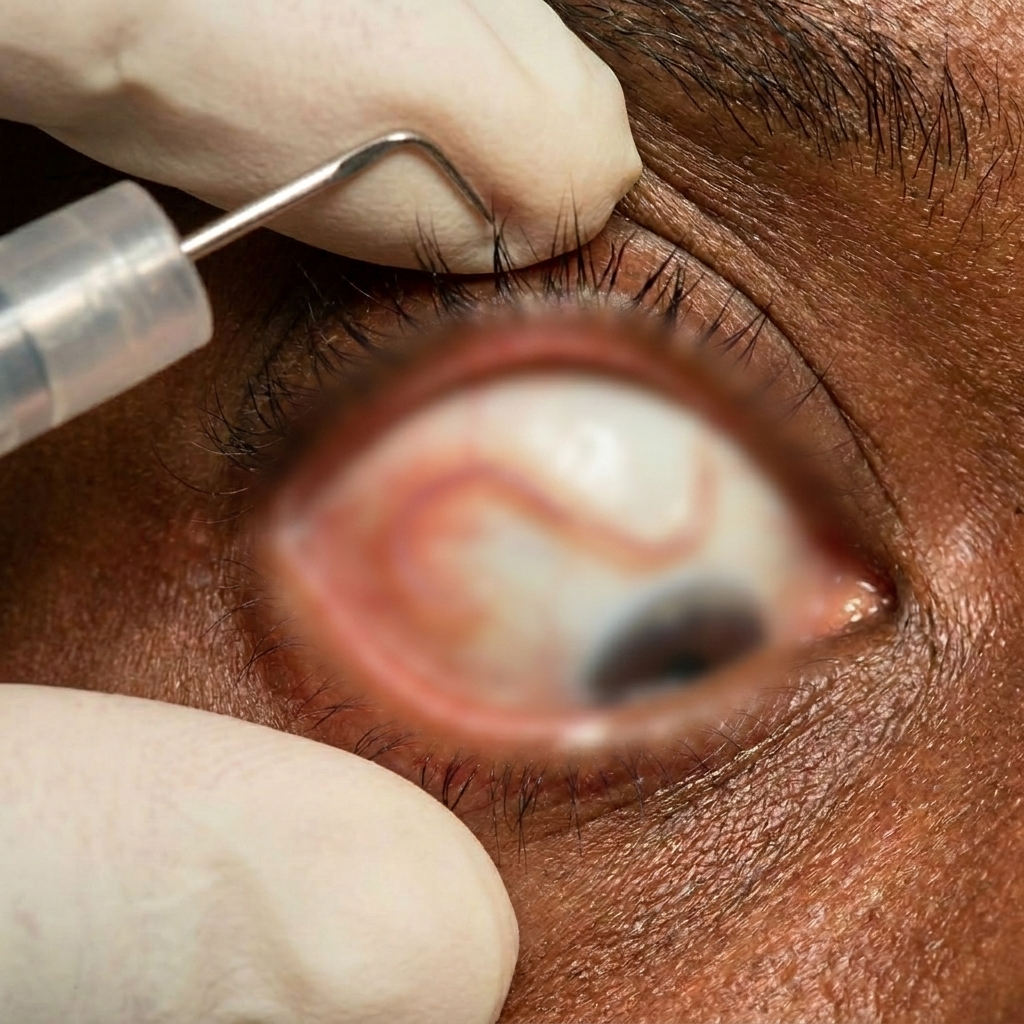
Of all the organisms that live inside the human body, few are as viscerally unsettling as Loa loa — for the simple reason that you can sometimes watch it move. An adult Loa loa worm, several centimeters long, migrates freely through the tissue just beneath the skin, and now and then it slides across the surface of the eye, visible as a living thread wriggling beneath the conjunctiva. This single dramatic image has earned it its common name: the African eye worm.
Unlike the microscopic bacteria, fungi, and amoebae that cause disease invisibly, Loa loa is a large, multicellular animal — a parasitic roundworm that can live inside a person for well over a decade. It is endemic to the rainforests of Central and West Africa, where it infects millions of people, and it carries a peculiar modern significance: it is one of the great obstacles to eliminating two other devastating tropical diseases.
What kind of organism is Loa loa?
Loa loa is not a microbe at all. It is a nematode — a roundworm — belonging to a group of thread-like parasites called the filarial worms, the same broad family that causes river blindness and lymphatic filariasis (elephantiasis). It is a genuine animal, with a head, a body, a tail, and the organ systems of a complex multicellular creature, and the disease it causes is called loiasis.
The adult worms are strikingly large for something living loose in human tissue. Adult females measure roughly 40 to 70 millimeters in length — up to about 7 centimeters — though only about half a millimeter thick, giving them the proportions of a long, fine thread. Males are smaller, around 30 to 34 millimeters. These adults can survive inside a human host for an extraordinarily long time, with lifespans estimated at well over a decade and sometimes approaching twenty years.
Unlike the free-living amoebae and fungi covered elsewhere, Loa loa is a true obligate parasite. It cannot complete its life cycle without two hosts: a human (the definitive host, where the worms mature and reproduce) and a fly (the intermediate host, which carries the parasite from person to person). Humans are essentially the only natural reservoir.
Two hosts, two stages, one journey
The life of Loa loa is a relay race between a human and a fly, and it hinges on a remarkable piece of biological timing.
The adult worm and the microfilariae (in humans)
After infection, the larvae mature over roughly a year into adult worms that live and wander in the subcutaneous tissue — the layer of fat and connective tissue just under the skin. There the males and females mate, and the females release enormous numbers of tiny larvae called microfilariae, sheathed, thread-like forms only about a quarter of a millimeter long. A single female can produce many thousands of these per day, and they circulate in the bloodstream.
What is extraordinary is their timing. Loa loa microfilariae display a strict diurnal periodicity: during the daytime they circulate in the peripheral blood, but at night they retreat and concentrate in the small vessels of the lungs. This rhythm is no accident — it is precisely synchronized with the feeding habits of the parasite’s carrier.
The infective larva (in the fly)
The carrier is a day-biting fly of the genus Chrysops, known as the deerfly or mango fly, most active in the middle of the day. When such a fly bites an infected person during daylight hours — exactly when the microfilariae are crowding the bloodstream — it swallows them with its blood meal. Inside the fly over the next week and a half or so, the microfilariae develop through successive larval stages into the infective third-stage larvae, which migrate to the fly’s mouthparts. When the fly bites its next human victim, those larvae slip into the new host through the bite wound, and the cycle begins again. The worm’s daytime blood rhythm and the fly’s daytime biting are locked together — a textbook example of a parasite tuning its biology to its vector.
Not a “Trojan horse” — but a passenger and an obstacle
The free-living amoebae are the classic “Trojan horses” of microbiology, smuggling bacteria inside themselves. Loa loa has no such role, but it occupies a position in tropical medicine that is, in its own way, just as consequential — it is a dangerous obstacle standing in the way of eliminating other diseases.
Across large parts of Central Africa, loiasis overlaps geographically with onchocerciasis (river blindness) and lymphatic filariasis, two filarial diseases targeted for elimination through enormous mass drug administration campaigns using the drug ivermectin. The problem is that the medicines used to fight those diseases also kill Loa loa microfilariae — and in a person carrying a very heavy Loa loa burden, the sudden mass death of microfilariae can trigger a severe, potentially fatal brain inflammation (see below). As a result, the mere presence of Loa loa in a community forces public-health programs to proceed with great caution, complicating and sometimes stalling efforts to wipe out river blindness across whole regions. A worm that was long dismissed as a minor nuisance turned out to be a major roadblock for global health.
How Loa loa affects the human body
Once inside a person, Loa loa produces disease through the migration of its adult worms and the body’s reactions to the parasite. Most of its effects are dramatic to witness but, in themselves, relatively mild; the gravest dangers are indirect.
The eye worm
The signature manifestation is the subconjunctival migration of an adult worm — the moment the parasite travels across the surface of the eye, beneath the thin transparent membrane covering the white of the eye. It is alarming and uncomfortable, often causing intense irritation, watering, and swelling, but the worm typically passes across without penetrating the eyeball itself, and the episode usually resolves. This visible crossing is frequently how the infection is recognized.
Calabar swellings
The other hallmark sign is the Calabar swelling — a localized, transient area of soft-tissue swelling (angioedema), often appearing around the wrists, forearms, or near joints. These swellings come and go as the worms migrate and are thought to be an immune reaction to the parasite or to material it releases. They can itch and be uncomfortable but are generally not dangerous on their own.
The serious danger: a treatment complication
Here lies the most important and counterintuitive fact about loiasis. The disease itself is often comparatively benign, but treatment can be hazardous in people who carry very large numbers of microfilariae in their blood. When microfilaria-killing drugs are given to such heavily infected individuals, the simultaneous death of vast numbers of larvae can provoke a severe reaction — including a potentially fatal encephalopathy (brain inflammation) that can appear a few days after treatment. This is why loiasis treatment is genuinely complex and why, in regions where it overlaps with river blindness, people may need to be screened for their Loa loa burden before being given certain medications. This is also precisely why decisions about treatment must be made only by qualified medical professionals, ideally specialists — never self-directed.
Loiasis is not contagious from person to person. It can only spread through the bite of an infected Chrysops fly. A traveler who acquires it in Africa cannot pass it to family members back home.
Who is affected, and where
Loiasis is firmly tied to one part of the world: the rainforest and swamp-forest regions of Central and West Africa. The most heavily affected countries include Cameroon, the Democratic Republic of the Congo, the Republic of the Congo, Gabon, Nigeria, and neighboring areas — the equatorial forest belt where the Chrysops flies breed. An estimated tens of millions of people are infected, with figures often cited around 20 million.
Several patterns define who is at risk:
- Residents of endemic forest regions, where long worm lifespans combined with constant exposure to infected fly bites mean a person may carry the parasite for much of their life.
- Occupations and activities that increase exposure to the day-biting flies, which breed in muddy, shaded forest environments and are drawn to wood smoke and movement.
- Travelers and expatriates to endemic regions, in whom the infection may be diagnosed later, sometimes after returning home, when a worm is seen crossing the eye or when characteristic swellings appear.
For a long time loiasis was regarded as a benign curiosity of remote rural communities, which is part of why it was neglected by health systems. More recent research has challenged that view, linking the infection to broader ill health and even excess mortality in heavily affected populations — evidence that the African eye worm carries a heavier burden than its reputation long suggested.
Practical, general prevention
Because Loa loa spreads only through the bite of day-biting Chrysops flies, prevention centers on avoiding those bites in endemic areas. The following are general, common-sense behaviors that follow from the parasite’s biology — not medical recommendations:
- In endemic forest regions, reduce skin exposure to day-biting flies by wearing long-sleeved shirts and long trousers during daylight hours, when these flies feed.
- Use insect repellents on exposed skin during the day, following label directions.
- Be aware that ordinary bed nets, so effective against night-biting malaria mosquitoes, offer little protection against Chrysops, which bite during the day.
- Anyone who has lived in or traveled to an endemic region and notices a worm crossing the eye, recurrent localized swellings, or other unexplained symptoms should seek evaluation from a qualified healthcare professional with experience in tropical disease — and should never attempt to self-treat, given the real risk of severe treatment complications.
These are general, educational points drawn from the biology of the organism. They are not medical advice, and anyone with a specific health concern should consult a qualified healthcare professional, ideally one experienced in tropical and parasitic diseases.
Why it matters
Loa loa sits at an intriguing intersection of parasitology, evolutionary timing, and global public health, and understanding it means thinking on several levels at once:
- Parasite biology — how a large, long-lived animal can live for years wandering through human tissue, releasing offspring whose daily rhythm is exquisitely synchronized with the biting schedule of the fly that carries them onward.
- Evolutionary timing — how the worm’s diurnal blood periodicity and the Chrysops fly’s daytime feeding have co-evolved into a tightly coordinated handoff, a striking example of a parasite shaping its own biology around its vector.
- Public-health complexity — how an infection once dismissed as mild became one of the central obstacles to eliminating river blindness, because the very drugs that fight related diseases can turn dangerous in people heavily burdened with this particular worm.
The takeaway is not horror at the idea of a worm in the eye. It is a more layered lesson than the ones taught by the environmental microbes: with Loa loa, the most visible and frightening feature of an infection is not always the most dangerous one, and an organism’s true significance can lie in its tangled relationship with other diseases and their treatments. The eye worm crossing the conjunctiva is unforgettable, but the deeper story is about timing, ecology, and the genuine difficulty of fighting tropical disease in the real world.
In a world of parasites still under-studied and under-treated, Loa loa is a vivid reminder that even a well-known, centuries-old worm can hold complications that make it far more consequential than its dramatic party trick of swimming across a human eye.
Sources and further reading
- Centers for Disease Control and Prevention. Loiasis. cdc.gov/parasites/loiasis
- Nutman TB. “Loiasis and Mansonella Infections.” Infectious Disease Clinics of North America 33(1):101–115. 2019.
- Pion SD et al. “Excess mortality associated with Loa loa infection in a sub-Saharan African community.” Annals of Internal Medicine 166(8):592–600. 2017.
- World Health Organization. Loiasis Fact Sheet. who.int/news-room/fact-sheets/detail/loiasis