Educational disclaimer. This article is general biological reference only. It is not medical advice, not a clinical guide, and does not describe diagnosis or treatment of human disease. If you suspect any skin or nerve condition, seek qualified medical attention promptly.
Mycobacterium leprae is one of the most famous bacteria in human history and, paradoxically, one of the least understood. It is the cause of leprosy — now usually called Hansen’s disease — a condition that has shadowed humanity for thousands of years, woven through ancient texts, and burdened with a stigma so heavy that its very name became a metaphor for exclusion. And yet the organism itself is biologically strange almost to the point of being broken: it grows more slowly than any other known bacterium, it cannot be grown in a laboratory dish at all, and roughly half of its genome has decayed into useless genetic rubble.
For all its fearsome reputation, Mycobacterium leprae is hard to catch, the great majority of people are naturally resistant to it, and the disease it causes is completely curable. It is a case study in how a microbe’s biological reality can diverge wildly from the dread that surrounds it.
What kind of organism is Mycobacterium leprae?
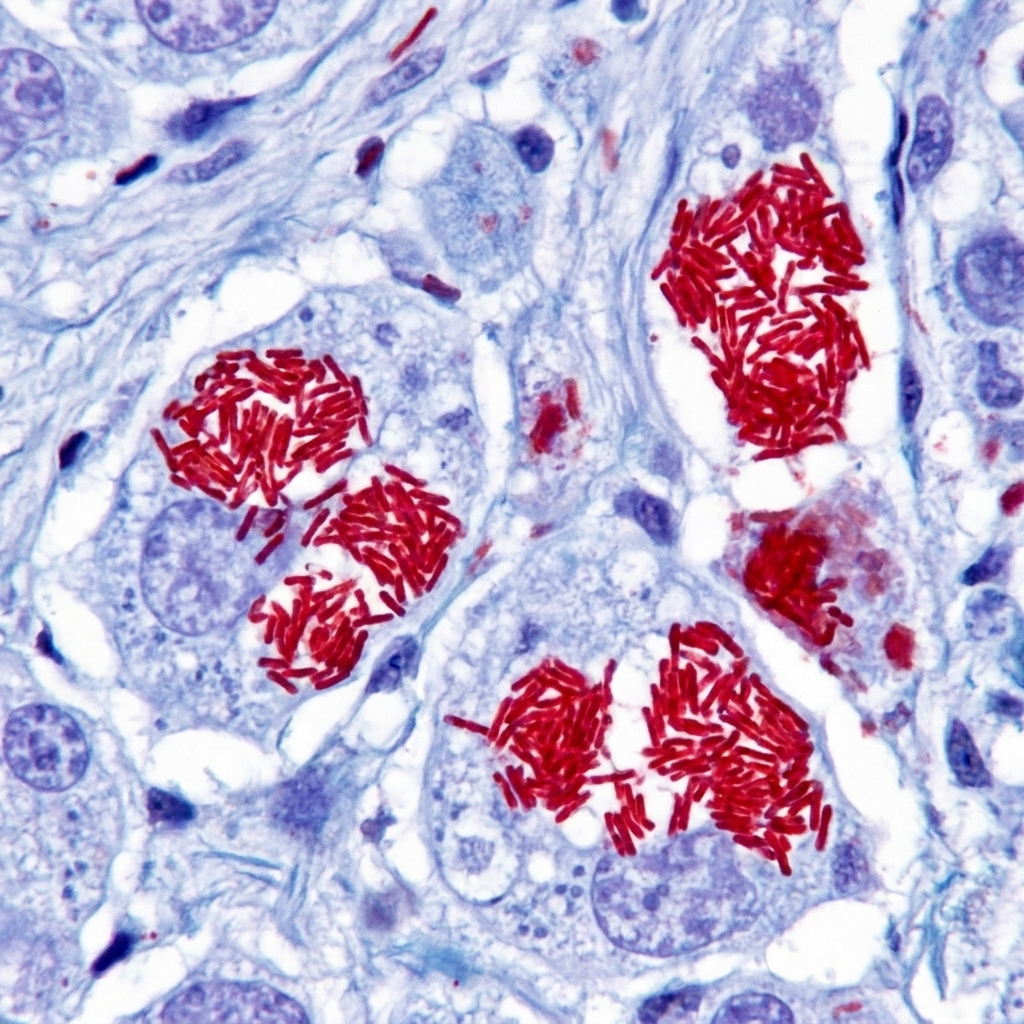
Mycobacterium leprae is a bacterium — specifically a rod-shaped (bacillus), acid-fast organism in the genus Mycobacterium, the same genus that contains Mycobacterium tuberculosis, the cause of tuberculosis. It is described as “acid-fast” because of a waxy, lipid-rich cell wall that resists ordinary staining and requires special techniques to reveal under the microscope, where the bacteria often appear in dense clumps called globi packed inside host cells.
It was identified in 1873 by the Norwegian physician Gerhard Armauer Hansen, making it the first bacterium ever shown to cause a disease in humans — a landmark in the history of medicine, and the reason leprosy is alternatively named after him. A second, closely related species, Mycobacterium lepromatosis, was recognized much more recently and can cause the same disease.
What makes M. leprae biologically distinctive is that it is an obligate intracellular pathogen. Unlike most environmental microbes — and unlike its free-living mycobacterial relatives — it cannot survive and reproduce on its own. It depends utterly on living inside the cells of a host, and to this day it has never been successfully grown in cell-free laboratory media. This single fact has hampered more than a century of research.
A genome in retreat: reductive evolution
The most remarkable feature of Mycobacterium leprae is what has happened to its genome — and this is the closest equivalent to the “life-stage transformation” that defines fungi and amoebae. Where those organisms change shape, M. leprae has changed its very genetic blueprint, through a dramatic process biologists call reductive evolution.
When researchers sequenced its genome in 2001 and compared it with that of M. tuberculosis, they found something extraordinary. M. leprae’s genome is much smaller — roughly 3.3 million base pairs against tuberculosis’s 4.4 million — but the shrinkage is only part of the story. Nearly half of the genome no longer works. It is filled with pseudogenes: former genes that have accumulated so many mutations they have fallen silent, like rooms in a house bricked up one by one. M. leprae carries the highest proportion of these dead genes of any known bacterium.
The consequences of this genetic decay explain the organism’s peculiar biology:
- It cannot be cultured, because it has lost the metabolic machinery to feed and maintain itself independently and must scavenge nutrients and building blocks from its host.
- It grows agonizingly slowly, with the longest doubling time of any known bacterium — on the order of nearly two weeks to divide once, compared with the roughly twenty minutes of common gut bacteria. This is why leprosy develops over years, not days.
- It depends completely on host cells, having discarded the self-sufficiency its free-living ancestors once had.
In a sense, M. leprae traded away its independence for a specialized life inside us, and the price was the slow collapse of much of its own genome.
The Trojan horse, reversed: surviving inside amoebae
The free-living amoebae are the classic “Trojan horses” of microbiology, sheltering bacteria that resist digestion. Mycobacterium leprae, despite being a host-dependent specialist, appears able to exploit this same relationship in the environment — and it may help solve one of leprosy’s enduring mysteries.
Because M. leprae cannot survive freely on its own, scientists have long puzzled over how it persists outside human bodies and how it might travel between hosts or linger in soil and water. Experimental work has shown that the leprosy bacillus can survive inside free-living amoebae and their cysts for weeks, protected within these environmentally hardy cells. This raises the possibility that amoebae act as a reservoir and even a vehicle for the bacterium in the environment — a Trojan horse that could help explain why leprosy maintains a stubbornly stable global presence despite decades of treatment efforts. The organism that cannot live alone may, in effect, borrow the durability of another microbe to bridge the gap between hosts.
How Mycobacterium leprae reaches human tissue
The transmission of Mycobacterium leprae remains, even now, not fully understood — a striking gap for such a historically important disease. But the broad outline is reasonably well established, and it is very different from the casual contagion of legend.
Route 1: The respiratory tract (prolonged close contact)
The leading view is that M. leprae spreads mainly through respiratory droplets — the bacteria are shed in large numbers from the nose and mouth of an untreated person with the more bacteria-rich form of the disease, and are inhaled by others. Critically, this is thought to require prolonged, close contact, not a passing encounter. Leprosy does not spread through brief touch, shared objects, or fleeting proximity. Most investigators believe the nasal mucosa is the main point of entry into the body.
A central and reassuring fact: most people are simply not susceptible. The overwhelming majority of humans exposed to M. leprae never develop disease, because their immune systems clear or contain it. Susceptibility appears to depend heavily on individual immune and genetic factors. And once a patient begins proper treatment, they typically stop being infectious within days.
Route 2: The nerves (the disease’s defining feature)
What sets M. leprae apart from nearly every other human pathogen is its unique tropism for the peripheral nerves. After entering the body, the bacterium targets the Schwann cells — the cells that wrap and insulate nerve fibers — and it is the only human pathogen known to invade these superficial peripheral nerves directly. It also colonizes the skin, the lining of the nose, and the eyes, and it favors the cooler regions of the body, which is why the skin, earlobes, hands, and feet are characteristically affected.
This nerve damage is the source of leprosy’s most feared consequences. As the affected nerves are injured, people lose sensation in their hands, feet, and face. The widely held image of leprosy causing body parts to “fall off” is a myth: the digits do not drop away. Instead, numb hands and feet no longer feel cuts, burns, and pressure, so unnoticed injuries accumulate, become infected, and lead over time to the wounds, deformities, and loss of tissue historically associated with the disease. The damage is a downstream consequence of lost sensation and untreated injury — not the bacterium directly devouring flesh.
The disease itself takes different forms depending on a person’s immune response, ranging from a limited form with few skin lesions and strong immune control (paucibacillary) to a more widespread form with many lesions and abundant bacteria (multibacillary).
A zoonotic route: armadillos
Mycobacterium leprae is unusual among human pathogens in having a documented animal reservoir: the nine-banded armadillo, which carries the bacterium naturally in parts of the southern United States and the Americas. Evidence indicates the infection can pass between armadillos and humans, and exposure to these animals has been linked to some cases in the southern US. Humans, however, remain the principal reservoir of significance worldwide.
Who is affected, and where
Leprosy is an ancient disease that persists today mainly in specific regions. Globally, it continues to produce on the order of a couple hundred thousand new cases each year, concentrated in parts of Asia, Africa, and South America. In the United States it is uncommon and tends to occur in a few areas such as Texas, Louisiana, Hawaii, and the US Virgin Islands. Documented risk factors include:
- Prolonged close contact with an untreated person who has the bacteria-rich form of the disease — household contacts face the highest risk.
- Living in poverty and in crowded conditions, which is closely tied to the disease’s geography.
- Individual susceptibility, shaped by immune and genetic factors that remain incompletely understood.
- In some regions, armadillo exposure.
The incubation period is extraordinarily long — typically several years and sometimes up to two decades — a direct reflection of how slowly the bacterium grows. This long, silent interval is one reason transmission is hard to trace and the disease hard to eliminate.
Crucially, leprosy is curable. A combination of antibiotics known as multidrug therapy, provided free of charge through the World Health Organization for decades, reliably kills the bacterium, and early treatment prevents the nerve damage and disability that cause lasting harm. Millions of people have been cured over the past few decades. The tragedy of modern leprosy is less the biology of the organism than the stigma that still surrounds it — prejudice and social exclusion that can delay diagnosis and inflict suffering well beyond the disease itself.
Practical, general perspective
Because leprosy is hard to catch, largely treatable, and surrounded by misunderstanding, the most useful “precautions” are as much about accurate knowledge as about behavior. The following are general points that follow from the biology of the organism, not medical recommendations:
- Leprosy does not spread through casual contact — handshakes, sharing meals, or brief proximity do not transmit it. There is no need to avoid or isolate people who have it, particularly once they are in treatment.
- The disease is curable, and early diagnosis is what prevents permanent nerve damage, so persistent skin patches with loss of sensation, numbness, or unexplained muscle weakness are worth evaluating by a healthcare professional.
- In regions where armadillos carry the bacterium, avoiding direct handling of the animals is a reasonable, low-cost precaution.
- Combating stigma — treating affected people with dignity and without fear — is itself a public-health measure, because fear of discrimination drives people away from the early diagnosis that prevents disability.
These are general, educational points drawn from the biology and epidemiology of the organism. They are not medical advice, and anyone with a specific health concern should consult a qualified healthcare professional.
Why it matters
Mycobacterium leprae sits at a rare crossroads of evolutionary biology, medical history, and social justice, and understanding it means holding several ideas together at once:
- Evolutionary biology — how a bacterium can specialize so completely for life inside a host that it sheds half of its own working genome, surrendering independence for intimacy in one of the most extreme examples of reductive evolution known.
- Microbial ecology — how an organism that cannot live on its own may still persist in the environment by hiding inside amoebae, and may move between hosts and even animal reservoirs in ways scientists are still uncovering.
- Host–pathogen biology and society — how a slow, hard-to-catch microbe with a singular talent for invading nerves produced a disease whose worst burden has often been not the infection itself but the centuries of fear and exclusion heaped upon those who carried it.
The takeaway is not fear of a legendary disease. It is a more nuanced lesson than the ones taught by the environmental amoebae and fungi: with Mycobacterium leprae, the gap between an organism’s actual danger and its reputation can be enormous, and that gap can do harm of its own. The leprosy bacillus is fragile, slow, and easily defeated by modern medicine, and most people are immune to it entirely. The suffering historically attached to it came as much from misunderstanding as from microbiology.
In a microbial world we are still learning to read accurately, Mycobacterium leprae stands as a reminder that how we understand a pathogen — and how we treat the people it affects — can matter just as much as the biology of the microbe itself.
Sources and further reading
- World Health Organization. Leprosy (Hansen’s Disease). who.int/news-room/fact-sheets/detail/leprosy
- Cole ST et al. “Massive gene decay in the leprosy bacillus.” Nature 409(6823):1007–1011. 2001.
- White C, Franco-Paredes C. “Leprosy in the 21st century.” Clinical Microbiology Reviews 28(1):80–94. 2015.
- Centers for Disease Control and Prevention. Hansen’s Disease (Leprosy). cdc.gov/leprosy