Educational disclaimer. This article is general biological reference. It is not medical advice, not a clinical guide, and does not describe diagnosis or treatment of human disease. If you or someone you know may have been exposed to contaminated water and develops symptoms, seek qualified medical attention immediately.
Naegleria fowleri is a single-celled organism that, for most of its life, behaves like an ordinary soil and freshwater amoeba — drifting through warm water, grazing on bacteria, and dividing when conditions allow. It is not a parasite by trade. It has no animal hosts in its life cycle, no specialized invasion mechanisms targeted at humans, and no need for a mammal to reproduce. And yet, in extremely rare circumstances, it ends up inside a person’s nasal passages and follows the olfactory nerve straight into the brain.
The contradiction at the heart of this organism is what makes it biologically remarkable. It is one of the most studied examples of a free-living protist that can opportunistically reach a vertebrate central nervous system without any evolutionary investment in doing so.
A heat-loving amoeba
N. fowleri belongs to the genus Naegleria, a group of small free-living amoeboflagellates classified within the Heterolobosea. Most Naegleria species are completely harmless to humans and exist in soil and water worldwide.
What makes N. fowleri unusual within its genus is thermophily. It thrives at temperatures most freshwater amoebae cannot tolerate — typically 25 to 46 °C (77 to 115 °F), with peak growth around 42 °C. This temperature window matches the warm fringes of summer lakes, hot springs, untreated industrial water systems, and inadequately chlorinated pools far better than it matches the open ocean or cold lakes. As a result, the organism is found mostly in:
- Warm freshwater lakes, ponds, and slow-moving rivers, particularly in summer.
- Naturally heated water bodies: hot springs and geothermal pools.
- Poorly treated swimming pools, splash pads, and water-play structures.
- Soil and sediment at the bottom of warm water bodies.
- Inadequately disinfected plumbing systems and water heaters in some regions.
N. fowleri has been documented on every continent except Antarctica, but cases of human illness cluster in warm-climate regions: the southern United States, Pakistan, India, Mexico, parts of Australia, and several countries in sub-Saharan Africa. Climate change appears to be slowly expanding the latitudes at which the organism can persist year-round.
Three forms, one organism
Like other members of its group, N. fowleri alternates between three morphologically distinct life stages:
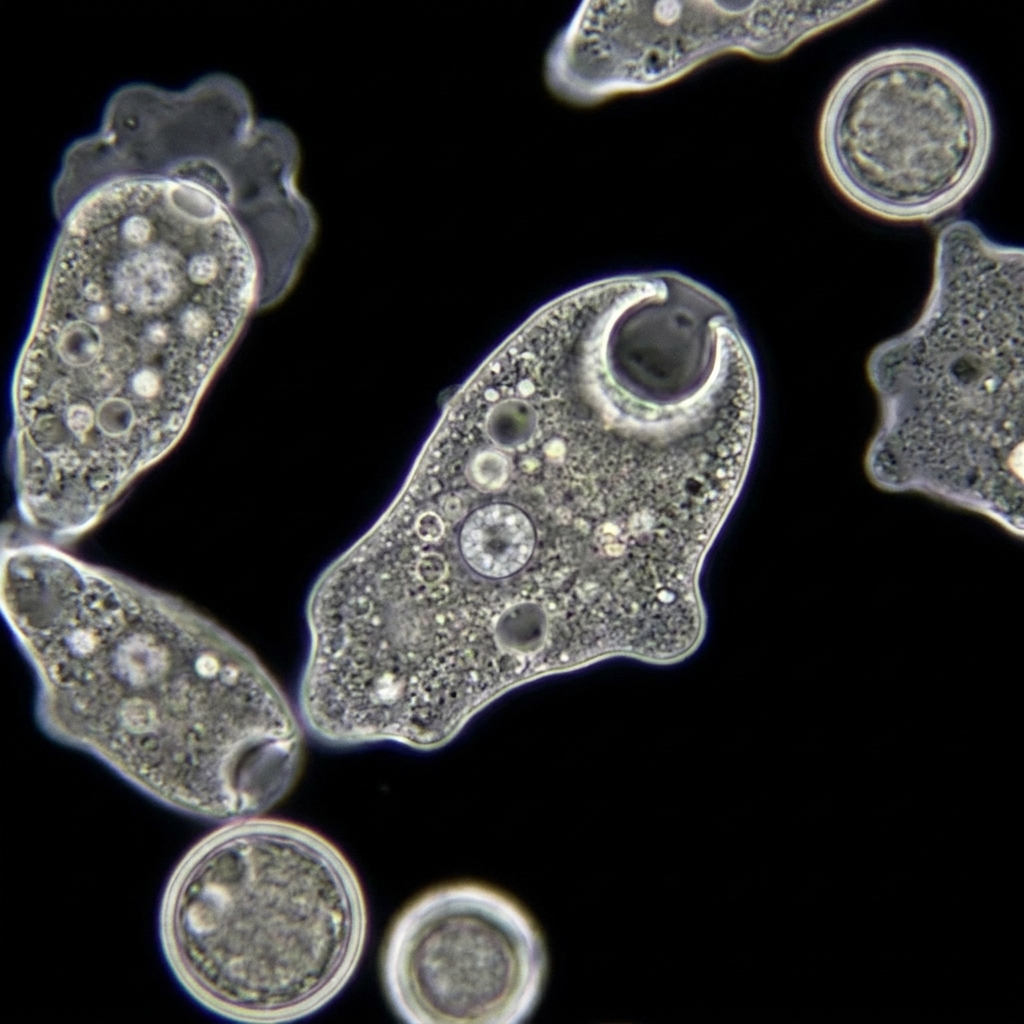
- Cyst — a small, round, double-walled resting form that the amoeba adopts when conditions turn unfavorable (cold, dry, low nutrients). Cysts can survive for long periods but cannot infect tissue. They are the dormant, dispersal-friendly stage.
- Trophozoite — the active feeding form. Roughly 10 to 35 micrometers across, it moves with broad lobopodial extensions and engulfs bacteria using surface structures sometimes called “food cups.” Trophozoites divide by binary fission and are the only form that can cause disease.
- Flagellate — a transient pear-shaped form with two anterior flagella, induced by sudden changes in water chemistry. The flagellate form does not feed or divide; it acts as a temporary swimming stage that converts back to the trophozoite within hours.
Only the trophozoite stage is implicated in human disease. Cysts and flagellates are not infectious by themselves, although a cyst can germinate into a trophozoite if conditions become favorable.
How a free-living amoeba ends up in a brain
N. fowleri does not naturally seek out vertebrate hosts. There is no chemical gradient inside a human that it follows on purpose. The route into the brain is, in evolutionary terms, an accident — but a specific and reproducible one.
It begins with water containing trophozoites entering a person’s nasal passages with force: while diving, swimming with the head submerged, splashing aggressively, or rinsing the nasal cavity with contaminated water. Drinking contaminated water does not cause infection. Swimming with the head above water does not transmit the organism. Casual skin contact does not transmit it. The exposure route is specifically through water being driven up the nose.
Once inside the nasal cavity, trophozoites attach to the olfactory epithelium — the specialized lining inside the upper part of the nose that contains the receptor neurons responsible for the sense of smell. From there, the amoeba migrates along the olfactory nerve fibers, crosses the cribriform plate (a thin, perforated bone separating the nasal cavity from the brain), and enters the olfactory bulbs at the base of the frontal lobe.
The migration is fast. In experimental animal models, N. fowleri trophozoites can reach the central nervous system within days of exposure. Once there, they feed on neural tissue using the same food-cup mechanism they use on bacteria in water, releasing enzymes and triggering a severe, rapidly progressive inflammatory response. The clinical syndrome that follows is called primary amoebic meningoencephalitis (PAM).
PAM is extremely rare. Worldwide, only a few hundred cases per year are reported across all countries combined, despite the fact that N. fowleri is present in many warm water bodies used by millions of swimmers. The exposure-to-infection ratio is, in other words, extraordinarily low. But when PAM does occur, it is one of the most rapidly progressive central nervous system infections in medicine.
This article does not describe the clinical course or management of PAM. That is a topic for medical professionals and qualified public-health resources, not for a popular-biology piece.
Why most people exposed to N. fowleri never get sick
Given how common warm freshwater swimming is, the rarity of PAM is itself an interesting biological question. Several factors are believed to contribute:
- Mucosal defenses. The nasal cavity has a layered mucous-and-cilia defense that captures and clears most microbes before they can reach the olfactory epithelium.
- Innate immunity. Macrophages, complement proteins, and antimicrobial peptides can kill N. fowleri trophozoites in laboratory conditions. Many incidental exposures are likely cleared invisibly.
- Low organism density. Even in lakes where N. fowleri is detectable, the concentration of trophozoites per liter of water is usually very low, and the dose required for infection appears to be relatively high.
- Mechanical factors. The cribriform plate’s thickness and its mucus coverage vary between individuals; some anatomical configurations may make crossing more difficult.
Investigators continue to study why a handful of exposures result in tragic outcomes while millions of similar exposures produce nothing detectable. Genetics, immune status, the precise volume and pressure of water entering the nose, and water temperature all appear to play roles.
Practical prevention
Public-health guidance for reducing risk centers on stopping warm freshwater from being forced into the nasal passages:
- Avoid jumping or diving into warm, still freshwater during peak summer temperatures when water levels are low.
- Hold the nose shut, use a nose clip, or keep the head above water in warm lakes, ponds, hot springs, and similar bodies of water.
- Avoid stirring up bottom sediment in warm water bodies, where N. fowleri concentrations are often higher.
- For nasal irrigation (e.g., neti pots, sinus rinses), use only distilled, sterile, or previously boiled-and-cooled water, following the directions provided by the manufacturer and the rinse-device’s care guidelines. Never use untreated tap water for nasal irrigation.
- Ensure swimming pools, splash pads, and similar facilities are operated and disinfected according to local public-health standards.
These are general lifestyle precautions. They are not a substitute for advice from local public-health authorities, who issue site-specific guidance in areas where N. fowleri has been detected.
A wider lesson in environmental microbiology
N. fowleri is a striking reminder that the line between “free-living” and “pathogenic” organisms is not as sharp as biology textbooks sometimes imply. Most of the time, this amoeba is a perfectly ordinary inhabitant of warm freshwater ecosystems, recycling bacteria and contributing to the microbial food web. It has no evolutionary “interest” in mammals. But because its feeding biology happens to work on neural tissue, and because the olfactory route bypasses many of the body’s usual defenses, an accidental encounter can produce devastating consequences.
The species also illustrates how climate change is reshaping infectious-disease ecology. As regions that were historically too cold for N. fowleri to persist begin to support warmer summer water temperatures, the geographic range in which exposure is even possible expands. Cases have been reported further north in the United States than was the case decades ago, and similar shifts are being documented in Europe and Asia.
Why it matters
Three big-picture takeaways are worth carrying away from Naegleria fowleri:
- A free-living organism can produce serious disease without being a “real” parasite — it does not need a host to complete its life cycle. The pathogenicity is, in a sense, a coincidence of its biology meeting a particular anatomical route in mammals.
- Anatomy can be a defensive structure. The cribriform plate is not designed to keep amoebae out, but in practice it does, almost always. The very rare cases where it fails are a reminder of how much routine biological infrastructure quietly protects us.
- Knowledge of ecology shapes prevention. Understanding where and how N. fowleri thrives — warm, still freshwater; nasal entry; rinse-water sources — converts a vague fear into specific, actionable precautions.
For most people, the practical relevance of N. fowleri is small: hold your nose when you jump into a warm lake in midsummer, and use safe water for nasal rinsing. For biologists, the organism is one of the clearest examples of how the boundary between an environment’s microbes and a host’s tissues can be crossed by chance, anatomy, and a tiny amount of warm water finding the wrong route into a body.
Sources and further reading
- Centers for Disease Control and Prevention. Naegleria fowleri — Primary Amebic Meningoencephalitis (PAM). cdc.gov/parasites/naegleria
- Visvesvara GS, Moura H, Schuster FL. “Pathogenic and opportunistic free-living amoebae: Acanthamoeba spp., Balamuthia mandrillaris, Naegleria fowleri, and Sappinia pedata.” FEMS Immunology and Medical Microbiology 50(1):1–26. 2007.
- Siddiqui R, Khan NA. “Primary amoebic meningoencephalitis caused by Naegleria fowleri: an old enemy presenting new challenges.” PLOS Neglected Tropical Diseases 8(8):e3017. 2014.
- Yoder JS et al. “Primary amebic meningoencephalitis deaths associated with sinus irrigation using contaminated tap water.” Clinical Infectious Diseases 55(9):e79–e85. 2012.