Educational disclaimer. This article is general biological reference only. It is not medical advice, not a clinical guide, and does not describe diagnosis or treatment of human disease. If you suspect any parasitic or liver condition, seek qualified medical attention promptly.
A child wades into a calm African lake to fetch water, cool off, or do laundry. The water looks clean. But drifting in it, invisible, are thousands of microscopic larvae that have spent the morning swimming up from infected snails, and within minutes some of them have bored painlessly through the child’s skin and entered the bloodstream. This is how one of the most widespread parasitic diseases on Earth begins — not with a bite or a tainted meal, but with simple contact with fresh water.
The culprit is Schistosoma mansoni, a blood fluke responsible for much of the world’s intestinal schistosomiasis (also called bilharzia or snail fever). It is, after malaria, among the most consequential parasitic diseases of humankind, infecting hundreds of millions of people. And its biology holds a profound and counterintuitive twist: the damage it does comes not from the worm itself, but from its eggs.
What kind of organism is Schistosoma mansoni?
Schistosoma mansoni is a trematode, or fluke — a type of parasitic flatworm, quite distinct from the roundworms like Loa loa. It belongs to a group of blood-dwelling flukes and is one of several Schistosoma species that infect humans, alongside S. haematobium (which affects the urinary tract) and S. japonicum. S. mansoni is the principal cause of intestinal and hepatic (liver) schistosomiasis.
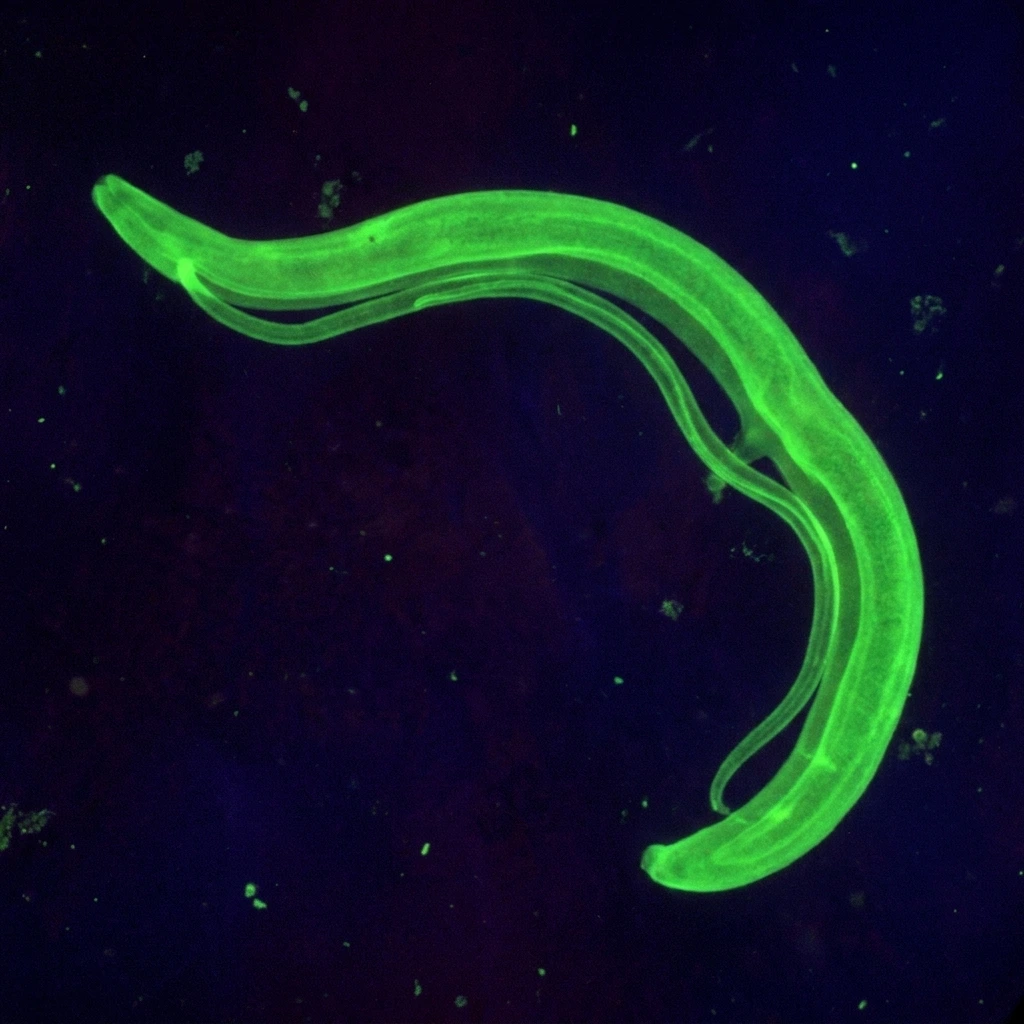
The adult worms are unusual among flukes in being separate sexes that live permanently paired together. The male is shorter and stouter, with a long groove running down his body called the gynecophoral canal; the female is longer and more slender and lies held within that groove, the two essentially locked in a lifelong embrace. United this way, the pair lives inside the small veins draining the human intestine, where the female produces hundreds of eggs every single day for years. The worms themselves can survive in a human host for many years.
Schistosoma mansoni is a true obligate parasite with one of the most elaborate life cycles in all of parasitology. Like Loa loa, it requires two hosts — but here the second host is not an insect. It is a freshwater snail.
Two hosts, many forms: a life cycle of transformations
Few organisms transform as many times as Schistosoma mansoni. Across its life it builds its body anew several times over, alternating between a human and a snail and passing through a series of distinct larval forms.
The egg and the miracidium (water)
The cycle turns when eggs leave an infected person in feces and reach fresh water. There each egg hatches into a tiny, ciliated, free-swimming larva called a miracidium. This larva does not feed; it lives on internal energy reserves and has only a short window — on the order of hours — to find and penetrate the right kind of snail before it dies. It swims actively, searching.
The snail and the sporocysts (asexual multiplication)
When a miracidium finds a freshwater snail of the genus Biomphalaria, it bores in and transforms into a sporocyst. Inside the snail, something remarkable happens: the parasite reproduces asexually, a sporocyst generating daughter sporocysts, which in turn generate enormous numbers of the next larval stage. A single miracidium that infects one snail can ultimately yield thousands of human-infective larvae — a vast clonal amplification at no cost of mating.
The cercaria (water again)
Those larvae, called cercariae, are released from the snail back into the water. Each is a microscopic swimmer with a distinctive forked tail. Cercariae are the form that infects people: when they contact human skin, they use enzymes and muscular boring to penetrate intact skin directly, shedding their tails as they enter. No wound, bite, or swallowing is required — just skin in contaminated water.
The schistosomulum and the adult (in humans)
Once inside, the larva — now a schistosomulum — remodels its surface and migrates through the bloodstream, traveling to the lungs and then to the liver’s blood supply, maturing over several weeks. The young worms pair up, male and female, and move to the small veins around the intestine, where they settle, feed on blood, and begin the relentless production of eggs that drives both the next generation and the disease.
Not a “Trojan horse” — but a master of immune disguise
The free-living amoebae are the classic “Trojan horses” of microbiology, hiding bacteria inside themselves. Schistosoma mansoni earns a different distinction: it is one of the most accomplished immune evaders in the parasitic world. The reason a blood fluke can live for years — sometimes decades — bathed directly in a host’s bloodstream, the most heavily patrolled tissue of the immune system, is that it has evolved an arsenal of tricks to avoid being destroyed.
The worm continuously remodels its outer surface, the tegument, and is thought to cloak itself in host-derived molecules, effectively disguising itself as “self” so the immune system overlooks it. It also releases molecules that dampen and manipulate the host’s immune responses. In a sense, Schistosoma does to the immune system what an amoeba does to a bacterium it shelters — it neutralizes a hostile environment from within — except here the parasite is hiding itself, in plain sight, inside the bloodstream. This mastery of immune evasion is one of the central reasons a vaccine against schistosomiasis has been so difficult to develop.
How Schistosoma mansoni harms the body: the paradox of the eggs
Here lies the most important and counterintuitive fact about schistosomiasis. The adult worms, living quietly in the veins and cloaked from the immune system, cause remarkably little direct harm. The disease is caused chiefly by the eggs — and specifically by the eggs that fail to escape the body.
Each day the female releases hundreds of eggs, many of which are meant to pass through the intestinal wall and leave in the feces to continue the cycle. But a large fraction of them never make it out. Some lodge in the wall of the intestine; many are swept backward by the blood flow and become trapped in the liver, and sometimes the spleen. Each trapped egg releases substances that provoke an intense immune reaction, and the body walls the egg off in a ball of inflammatory tissue called a granuloma.
Over years of continuous egg production, these granulomas accumulate, and the repeated inflammation drives scarring (fibrosis) of the liver — a pattern known as periportal fibrosis. As the scar tissue builds, it can obstruct the great vein carrying blood through the liver, raising the pressure in that system (portal hypertension). The downstream consequences can be severe: enlargement of the liver and spleen, fluid accumulation, and the swelling of fragile veins in the esophagus that can, in the worst cases, rupture and bleed dangerously. The clinical picture is the cumulative product of countless tiny immune battles fought around microscopic eggs, not of the worm gnawing at tissue.
This is why schistosomiasis is fundamentally a disease of chronic, repeated, and intense infection. A light, brief infection may cause little; years of heavy exposure in an endemic community are what produce the gravest outcomes, often building silently over a long time.
Schistosomiasis is not contagious from person to person. It spreads only through the freshwater cycle involving the snail. A person cannot catch it directly from someone who has it.
Who is affected, and where
Schistosomiasis is one of the most important neglected tropical diseases on the planet. Estimates indicate that over 250 million people are infected worldwide, with hundreds of millions more living at risk, and the overwhelming majority of cases — more than 90% — occur in sub-Saharan Africa, where S. mansoni is widespread. The disease is closely tied to poverty and to the absence of safe water and sanitation. Several patterns define who is at risk:
- Contact with contaminated fresh water for daily life — bathing, swimming, fishing, farming (especially irrigated agriculture), laundry, and fetching water — is the fundamental risk. The parasite cannot be avoided where life depends on infested lakes, rivers, ponds, and irrigation canals.
- Children are often the most heavily infected, both because of frequent water contact and because immunity builds slowly over years of exposure; school-aged children are a primary target of control programs.
- Inadequate sanitation, which allows eggs in human waste to reach water and continue the cycle, sustains transmission.
- The presence of the right Biomphalaria snails in local water bodies is a geographic prerequisite, which is why transmission is intensely local and patchy.
For decades the principal control strategy has been mass drug administration of an effective, safe, and inexpensive medicine, delivered through community and school programs, alongside efforts to improve water, sanitation, and hygiene and to control snails. These campaigns have substantially reduced heavy infections and severe disease in many regions, and the World Health Organization has set goals to eliminate schistosomiasis as a public-health problem. But re-infection is constant where exposure continues, and the disease remains stubbornly entrenched.
Practical, general prevention
Because Schistosoma mansoni spreads through contact with contaminated fresh water, prevention centers on that contact. The following are general, common-sense points that follow from the parasite’s biology — not medical recommendations:
- In endemic regions, avoid swimming, wading, or bathing in untreated fresh water — lakes, ponds, slow rivers, and irrigation canals — where the snail-borne larvae may be present. Salt water and properly chlorinated pools do not transmit the parasite.
- Water for bathing or washing can be made safer by heating it or by letting it stand in a snail-free container for a day or more before use, since the infective larvae are short-lived.
- Improving sanitation and avoiding contamination of water with human waste interrupts the cycle at its source — a community-level measure as much as a personal one.
- Anyone who has had freshwater exposure in an endemic region and develops unexplained symptoms — or who simply has had significant exposure — should seek evaluation from a qualified healthcare professional with experience in tropical disease, as effective treatment exists and early treatment helps prevent long-term damage.
These are general, educational points drawn from the biology of the organism. They are not medical advice, and anyone with a specific health concern should consult a qualified healthcare professional, ideally one experienced in tropical and parasitic diseases.
Why it matters
Schistosoma mansoni sits at a powerful intersection of parasitology, immunology, and global health inequality, and understanding it means thinking on several levels at once:
- Parasite biology — how a single fluke can rebuild its body through a chain of distinct larval forms, multiply itself thousands of times over inside a snail, and bore unaided through human skin from a swimmer’s brief contact with calm water.
- Immunology — how a worm can survive for years inside the bloodstream by disguising itself as part of its host and quietly manipulating the immune system, and why that same mastery has frustrated every attempt to build a vaccine.
- Disease and society — how the true harm comes not from the parasite directly but from the host’s own inflammatory response to trapped eggs, and how this slow, cumulative damage falls overwhelmingly on the poorest communities, where contact with infested water is unavoidable.
The takeaway is not fear of all fresh water. It is a layered lesson, different from those taught by the environmental microbes: with Schistosoma mansoni, the agent of disease and the source of suffering can be separated by a surprising distance — a worm that barely harms you directly, eggs that turn your own immune system against your liver, and a transmission cycle bound tightly to poverty and the absence of clean water. The parasite is a marvel of biological engineering; the disease it causes is, in large part, a disease of inequity.
In a world where a single barefoot step into a quiet lake can carry lifelong consequences, Schistosoma mansoni stands as a reminder that some of the planet’s most devastating organisms are also among its most ingenious — and that defeating them is as much a matter of clean water and fair access to medicine as of biology.
Sources and further reading
- World Health Organization. Schistosomiasis. who.int/news-room/fact-sheets/detail/schistosomiasis
- Colley DG et al. “Human schistosomiasis.” The Lancet 383(9936):2253–2264. 2014.
- Centers for Disease Control and Prevention. Schistosomiasis. cdc.gov/parasites/schistosomiasis
- McManus DP et al. “Schistosomiasis.” Nature Reviews Disease Primers 4:13. 2018.