Educational disclaimer. This article is general biological reference only. It is not medical advice, not a clinical guide, and does not describe diagnosis or treatment of human disease. If you suspect any wound infection or serious illness, seek qualified medical attention promptly.
Vibrio vulnificus lives in the warm, brackish water where rivers meet the sea — estuaries, coastal lagoons, salt marshes, and the shallow margins of bays from the Gulf of Mexico to both coasts of the United States and warm shorelines around the world. It is a natural part of these waters, not a sign of pollution or filth; the sea can look perfectly clean and still be full of it. It is especially abundant in oysters and other shellfish, which concentrate the bacterium as they filter seawater, and during warm months nearly every oyster from some areas carries it.
Most encounters with Vibrio vulnificus are harmless. But under the right circumstances it becomes one of the deadliest bacteria a person can meet — capable of causing a bloodstream infection that kills more than half its victims, sometimes within a day or two, and of destroying flesh so fast it has earned a place in news stories under the lurid label “flesh-eating bacteria.”
What kind of organism is Vibrio vulnificus?
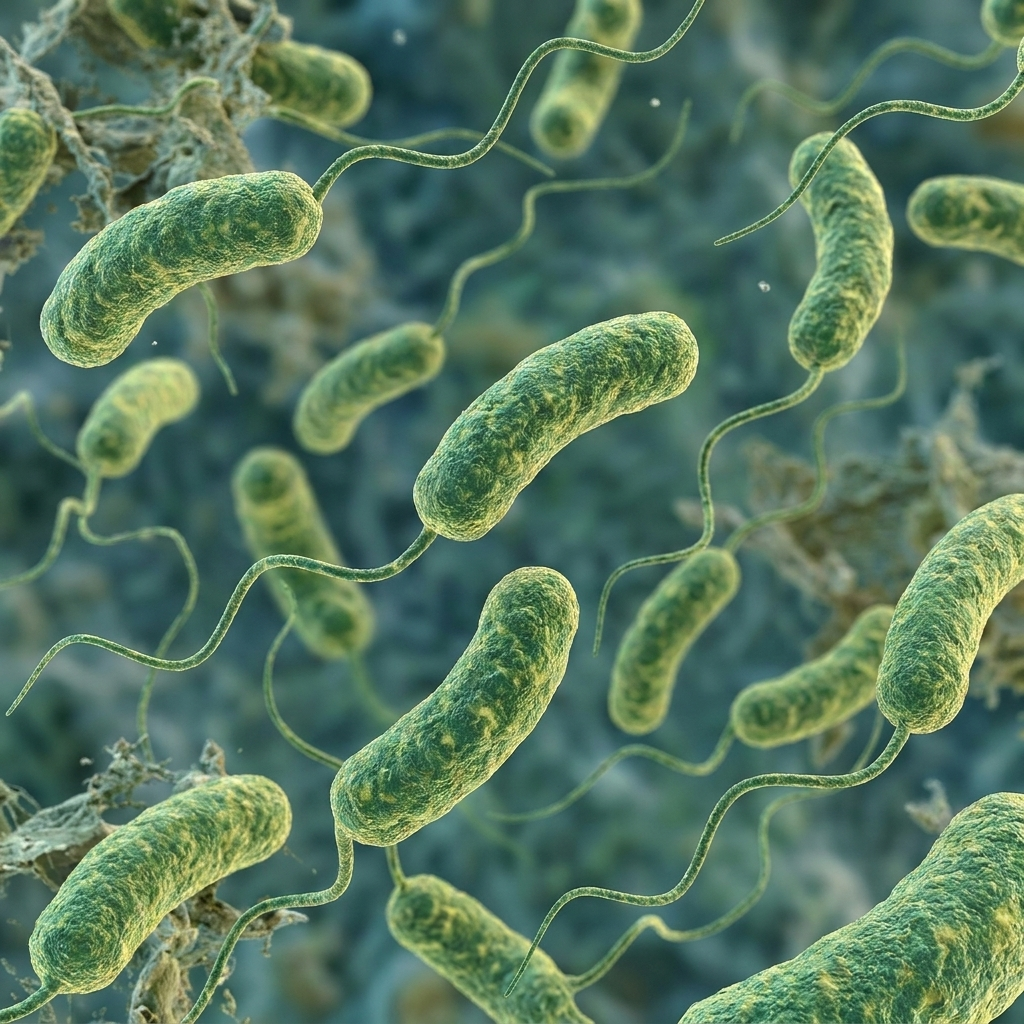
Vibrio vulnificus is a bacterium — not a fungus, parasite, or amoeba. It is a Gram-negative, curved, rod-shaped, motile cell belonging to the family Vibrionaceae, the same family that contains Vibrio cholerae, the cause of cholera. It swims using a single whip-like flagellum and was first recognized as a distinct human pathogen in 1979.
It is what microbiologists call an obligate halophile — it requires salt to live, though not very much. It thrives best in water of moderate salinity, in the brackish zone between fresh and fully marine, and it strongly prefers warmth. Researchers have sorted the species into three “biotypes,” of which biotype 1 causes most human disease worldwide, while others are mainly associated with diseased eels or with a regional outbreak strain. For everyday purposes, biotype 1 is the one that matters for human health.
Like the environmental fungi and amoebae, Vibrio vulnificus needs no human host. It is a free-living marine organism with an ecological job to do — breaking down organic matter and recycling nutrients in coastal ecosystems. Human infection is, from the bacterium’s perspective, an accidental dead end.
One cell, two survival states
A bacterium does not have the dramatic life-stage transformations of a fungus or amoeba, but Vibrio vulnificus does shift between two important physiological states depending on the temperature of the water — and that switch is central to its biology and its seasonality.
The active state
In warm water, Vibrio vulnificus is metabolically active, growing and dividing rapidly. It multiplies readily above roughly 13 °C (55 °F) and flourishes in warmer water still, with growth favored by water temperatures comfortably above 20 °C. This is why infections cluster in the warm months and in warm regions, and why the bacterium becomes far more abundant in summer seas and in shellfish harvested from warm water. If caught seafood is not chilled promptly, the bacteria inside it can multiply quickly before the food is ever eaten.
The dormant state (viable but not culturable)
When the water turns cold — below about 13 °C — Vibrio vulnificus does not simply die. Instead it enters a curious survival mode known as the viable-but-not-culturable (VBNC) state. In this condition the cells shrink, slow their metabolism almost to a halt, and can no longer be grown on ordinary laboratory media — yet they remain alive. When the water warms again, they can revive and resume growing. This dormancy lets the bacterium persist through unfavorable seasons hidden in sediment and water, ready to rebound when conditions improve, much as a fungal spore waits out hard times.
The bacterium also produces a capsule of polysaccharide around itself, which helps it resist the host immune system and is one of several virulence factors — alongside tissue-degrading enzymes and iron-scavenging systems — that make the difference between a harmless water microbe and an aggressive pathogen.
Not a “Trojan horse” — a creature of chitin and warming seas
The free-living amoebae are famous as “Trojan horses” that shelter bacteria; Vibrio vulnificus plays a different ecological role. It is intimately tied to the marine food web through chitin, the tough material that forms the shells of crabs, shrimp, and the countless tiny zooplankton drifting in the sea. Vibrio species are skilled at attaching to and breaking down chitin, and they ride through coastal waters clinging to plankton and shellfish, using chitin both as food and as a surface to colonize. This is why oysters, which filter enormous volumes of plankton-rich water, become such efficient concentrators of the bacterium.
This ecology also explains why Vibrio vulnificus has been nicknamed the “microbial barometer of climate change.” Because its abundance and range are governed so tightly by water temperature and salinity, warming oceans and shifting coastlines are expanding where and when it thrives. The bacterium has been increasingly reported in waters where it was historically rare, including farther north than before. Where an amoeba’s danger comes from what it carries inside, Vibrio vulnificus’s growing menace comes from a changing environment widening its reach.
How Vibrio vulnificus reaches human tissue
Vibrio vulnificus is not adapted to infect people, and the great majority of exposures cause no harm. When disease does occur, it arrives by two main routes that produce strikingly different illnesses, plus a milder third.
Route 1: Through the gut (eating raw shellfish)
The classic route is eating raw or undercooked shellfish, above all raw oysters harvested from warm water. The bacteria, concentrated in the shellfish, are swallowed and can cross from the intestine into the bloodstream. In vulnerable people this leads to primary sepsis — a fulminant bloodstream infection with fever, chills, plummeting blood pressure, and the rapid appearance of blistering, hemorrhagic skin lesions. This is the most lethal form of the disease, with reported mortality exceeding 50%, and it can progress with frightening speed. Vibrio vulnificus is responsible for the great majority of seafood-associated deaths in the United States, and the fatality rate among its foodborne cases is the highest of any foodborne pathogen.
Route 2: Through the skin (wound infection)
The second route is direct: an open wound, cut, or scrape exposed to warm seawater or brackish water, or injured while handling raw seafood — a fish spine, an oyster shell, a crab claw. The bacteria enter through the broken skin and can cause a rapidly spreading soft-tissue infection. In severe cases this becomes necrotizing fasciitis, in which the infection races through the tissue layers, destroying skin, fat, and muscle, sometimes requiring urgent surgery and occasionally amputation to control. Wound infections, too, can spill into the bloodstream and turn lethal. This is the route most relevant to swimmers, waders, fishers, and seafood handlers — and it can strike even previously healthy people.
Route 3: The intestine (gastroenteritis)
Less dramatically, ingesting the bacterium can sometimes produce a self-limiting gastrointestinal illness — vomiting, diarrhea, abdominal pain — without invading the bloodstream. This milder presentation is the most survivable, though it can precede or accompany more serious disease.
A crucial point: Vibrio vulnificus infection is not contagious. It does not spread from person to person. Every case comes from the environment — from water or seafood.
Who is affected, and where
The single most important factor determining who suffers serious Vibrio vulnificus disease is the health of the person exposed, especially the liver. By far the strongest risk factor for severe, fatal infection is chronic liver disease, particularly alcohol-associated cirrhosis. The biological reason is revealing: damaged livers are linked to elevated levels of iron in the blood, and Vibrio vulnificus grows explosively when iron is plentiful, while cirrhosis also blunts the immune defenses that would otherwise contain it.
Other documented risk factors for severe disease include:
- Diabetes.
- Immunosuppression, including HIV/AIDS, cancer, and immune-suppressing medications.
- Hemochromatosis and other conditions of iron overload.
- Other chronic illnesses that weaken the body’s defenses.
Geographically, infections concentrate in warm coastal regions and in the warm season. In the United States, the Gulf Coast has historically borne the heaviest burden, with cases also along the Atlantic and Pacific coasts, and the range appears to be creeping northward as waters warm. Importantly, while severe disease is far more common in people with underlying conditions, healthy people are not immune — wound infections in particular can affect anyone unlucky enough to expose a fresh injury to the wrong water at the wrong time. Vibrio vulnificus infection is rare overall, but its severity makes it disproportionately important.
Practical, general precautions
Because Vibrio vulnificus is a natural part of warm coastal waters, it cannot be eliminated, and most people who enjoy the coast are never harmed. The following are general, common-sense behaviors that follow from how the bacterium reaches people — and they matter most for those with liver disease or weakened immune systems — and are not medical recommendations:
- People with liver disease, diabetes, or weakened immune systems may wish to avoid eating raw or undercooked oysters and other shellfish; thorough cooking kills the bacterium.
- Keep open wounds, cuts, scrapes, and fresh tattoos or piercings out of warm seawater and brackish water; cover them with a waterproof bandage if exposure cannot be avoided.
- Wear protective gloves when handling or shucking raw shellfish, and protective footwear when wading where shells and marine debris can cause cuts.
- Refrigerate fresh seafood promptly, since the bacteria multiply quickly in unchilled shellfish.
- Wash any wound exposed to seawater or raw seafood promptly with soap and clean water, and seek prompt medical attention for a wound that becomes rapidly red, swollen, painful, or develops blisters after coastal exposure — Vibrio vulnificus infections can progress very fast.
These are behavioral precautions drawn from the biology of the organism. They are not medical advice, and anyone with a specific health concern — particularly anyone with liver disease or a compromised immune system — should consult a qualified healthcare professional.
Why it matters
Vibrio vulnificus sits at the intersection of marine ecology, climate science, and public health, and understanding it means thinking on several levels at once:
- Environmental microbiology — how a salt-loving bacterium tuned to warm, brackish water rides the chitin of plankton and shellfish through coastal ecosystems, surviving cold seasons in a dormant, uncultivable state.
- Climate science — how an organism so tightly governed by water temperature and salinity becomes a living indicator of warming seas, expanding its range and season as the climate shifts.
- Host–pathogen biology — how a harmless marine recycler turns lethal mainly when it meets a vulnerable host, exploiting the excess iron and weakened defenses of a damaged liver to multiply unchecked.
The takeaway is not fear of the ocean or of oysters. It is the same biologically humbling lesson the environmental fungi and amoebae teach, applied to a marine bacterium: how common an organism is in the environment and how dangerous it is to a given person are different measurements, and the gap between them is bridged largely by the vulnerability of the host and the warmth of the water. Vibrio vulnificus is a natural, abundant part of warm coastal seas, and for most people it passes by without consequence. The rare catastrophic cases arise from an unlucky collision — a raw oyster eaten by someone with a fragile liver, a fresh cut dipped in warm water — that lets an ordinary sea microbe slip somewhere it was never meant to be.
In a marine world teeming with mostly harmless microbial life, Vibrio vulnificus is a sobering reminder that the boundary between a clean-looking sea and a serious human infection can be as thin as a single swallowed oyster or an open scratch in warm water.
Sources and further reading
- Centers for Disease Control and Prevention. Vibrio vulnificus. cdc.gov/vibrio/vibrio-vulnificus
- Baker-Austin C, Oliver JD. “Vibrio vulnificus: new insights into ecology and virulence.” Environmental Microbiology 20(2):423–430. 2018.
- Jones MK, Oliver JD. “Vibrio vulnificus: disease and pathogenesis.” Infection and Immunity 77(5):1723–1733. 2009.
- Dechet AM et al. “Nonfoodborne Vibrio infections: an important cause of morbidity and mortality in the United States, 1997–2006.” Clinical Infectious Diseases 46(7):970–976. 2008.