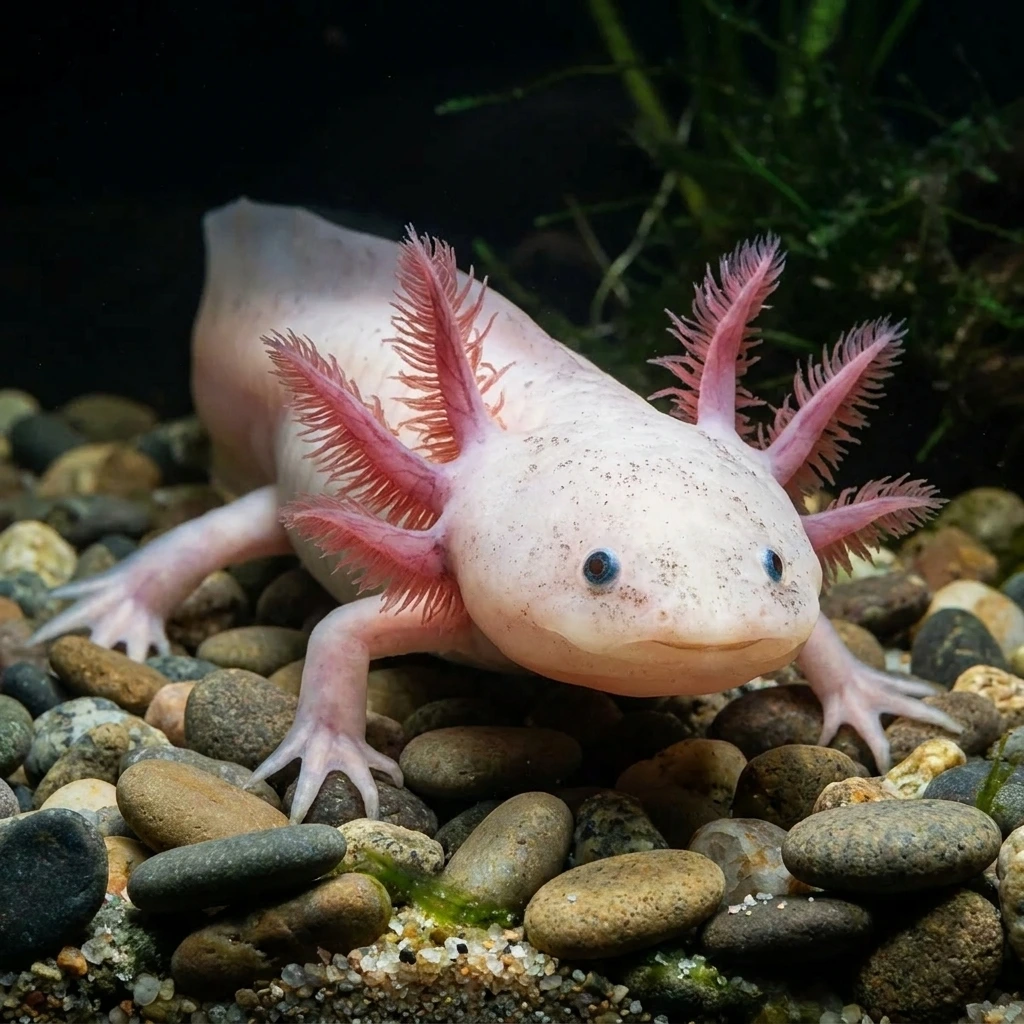
If you cut off an axolotl’s leg cleanly above the knee, a new leg will grow back in roughly two months. The new leg will have the right number of bones, the right muscles in the right places, the right nerves, and skin that matches the surrounding tissue. There will be no scar.
This is unusual. Most mammals — humans included — close wounds by laying down dense, disorganized collagen, producing scar tissue that is functionally inferior to the original. Axolotls (Ambystoma mexicanum), a paedomorphic salamander native to a single lake system near Mexico City, do not scar at all. Their tissue heals by rebuilding the original architecture from scratch. Understanding how is one of the most active questions in regenerative biology.
The blastema: a temporary stem-cell factory
After a clean amputation, an axolotl’s wound closes within hours as a single layer of skin cells migrates across the cut and forms a wound epidermis. Within a day or two, this epidermis thickens into a specialized signaling tissue called the apical epithelial cap, which broadcasts molecular instructions to the tissues underneath.
Underneath the cap, cells in the surrounding tissue dedifferentiate. Mature muscle cells, cartilage cells, and connective tissue cells loosen their identities, switch their gene expression patterns, and begin to behave like stem cells. These dedifferentiated cells form a mound at the amputation site called the blastema.
Crucially, the cells in the blastema retain a kind of positional memory. A muscle cell that dedifferentiates does not produce just any tissue — its descendants tend to recreate muscle. The blastema then expands, organizes, and gradually rebuilds the missing limb in roughly the same order it grew during embryonic development.
Why scarring doesn’t happen
In mammals, severe injury triggers an aggressive inflammatory response that recruits fibroblasts to produce collagen quickly. The collagen plugs the wound but disrupts the local environment in ways that prevent more delicate tissue from regrowing.
Axolotls have a strikingly different inflammatory profile. Macrophages — immune cells that normally drive both healing and scarring — play a much more nuanced role. Studies by James Godwin and colleagues showed that if you deplete macrophages in an axolotl, regeneration fails entirely: the wound scars over instead. Some axolotl macrophages actively suppress the scar-forming signals that dominate mammalian healing while still cleaning up debris and recruiting blastema-forming cells.
The result is a molecular environment that favors rebuilding over patching.
A genome built for redundancy
The axolotl has one of the largest genomes ever fully sequenced — roughly 32 billion base pairs, about ten times the size of the human genome. Much of this length is repetitive sequence rather than new gene content, but the genome also contains expanded gene families relevant to development. Several genes that humans express only during embryogenesis stay accessible and re-activatable in axolotl adults.
For example, Tig1 (TIG1/RARRES1), identified in 2024 work as a “patterning hub,” appears to help blastema cells re-read positional information so they regrow the correct part of the limb in the correct orientation. Other key genes involved include members of the Wnt and FGF signaling families, both ancient pathways used in embryonic limb patterning.
It is not that axolotls have radically novel regeneration genes. They mostly have the same toolkit mammals do, kept in active reach, paired with a different immune environment.
What can axolotls actually regrow?
Limbs are the most famous example, but they are not the only one. Axolotls can also regenerate:
- Portions of the heart, replacing damaged muscle with new contractile tissue rather than fibrous scar.
- Sections of the spinal cord — including nerve tracts that mammals cannot rebuild after injury.
- Parts of the brain, including transplanted tissue from the same species.
- Eye tissues, including parts of the retina.
- Jaws, tail, and gill structures, repeatedly.
Each of these tissues has its own variant of the blastema process, but they share the same general logic: clean wound closure, dedifferentiation, positional re-specification, regrowth.
Limits and the species’ fragile future
Axolotl regeneration is not unlimited. Very old animals regenerate more slowly. Heavily diseased or chronically infected tissue may scar in axolotls too. And, intriguingly, when axolotls undergo metamorphosis — which they normally skip but can be induced into with hormones — their regenerative ability declines to roughly the level of other salamanders. Whatever maintains their full regenerative powers seems linked to their paedomorphic, larva-like adult state.
The species itself is critically endangered in the wild. Pollution and the introduction of non-native fish into Lake Xochimilco have reduced wild axolotl populations to a few hundred individuals at most. Almost all axolotls in research labs, pet stores, and home tanks are descendants of a small captive population that has been bred for over a century. Conservation efforts are ongoing in Mexico, but the wild population may already be functionally extinct.
Why it matters
The axolotl is the closest living natural experiment we have for full regenerative healing in a vertebrate. Every gene, every signaling pathway, and every immune-cell role identified in axolotl regeneration is a candidate for translation into human medicine. If even a fraction of the axolotl’s wound-environment chemistry could be replicated in human tissue, it might dramatically improve outcomes after heart attacks, spinal cord injuries, severe burns, and amputations.
Researchers do not expect humans to grow back limbs anytime soon. The blastema requires a specific developmental context that adult mammalian cells have long left behind. But targeted interventions — local immune modulation, controlled dedifferentiation of specific cell types, or temporary reactivation of embryonic patterning genes — are now realistic research goals largely because the axolotl proved they could work in a vertebrate.
The animal sitting in a tank with feathery gills and a permanent half-smile is, biologically, a guide to one of the most ambitious questions in modern medicine: why does our species heal with scars when at least one of our distant cousins doesn’t have to?
Sources and further reading
- Tanaka EM. “The molecular and cellular choreography of appendage regeneration.” Cell 165(7):1598–1608. 2016.
- Nowoshilow S et al. “The axolotl genome and the evolution of key tissue formation regulators.” Nature 554:50–55. 2018.
- Ambystoma Genetic Stock Center, University of Kentucky. ambystoma.uky.edu
- Seifert AW, Murawala P, Tanaka EM. “Making regeneration work.” Current Biology 27(11):R421–R423. 2017.