Educational disclaimer. This article is general biological reference. It is not medical advice, not a clinical guide, and does not describe the diagnosis or treatment of any human condition. All content is drawn from published scientific literature.
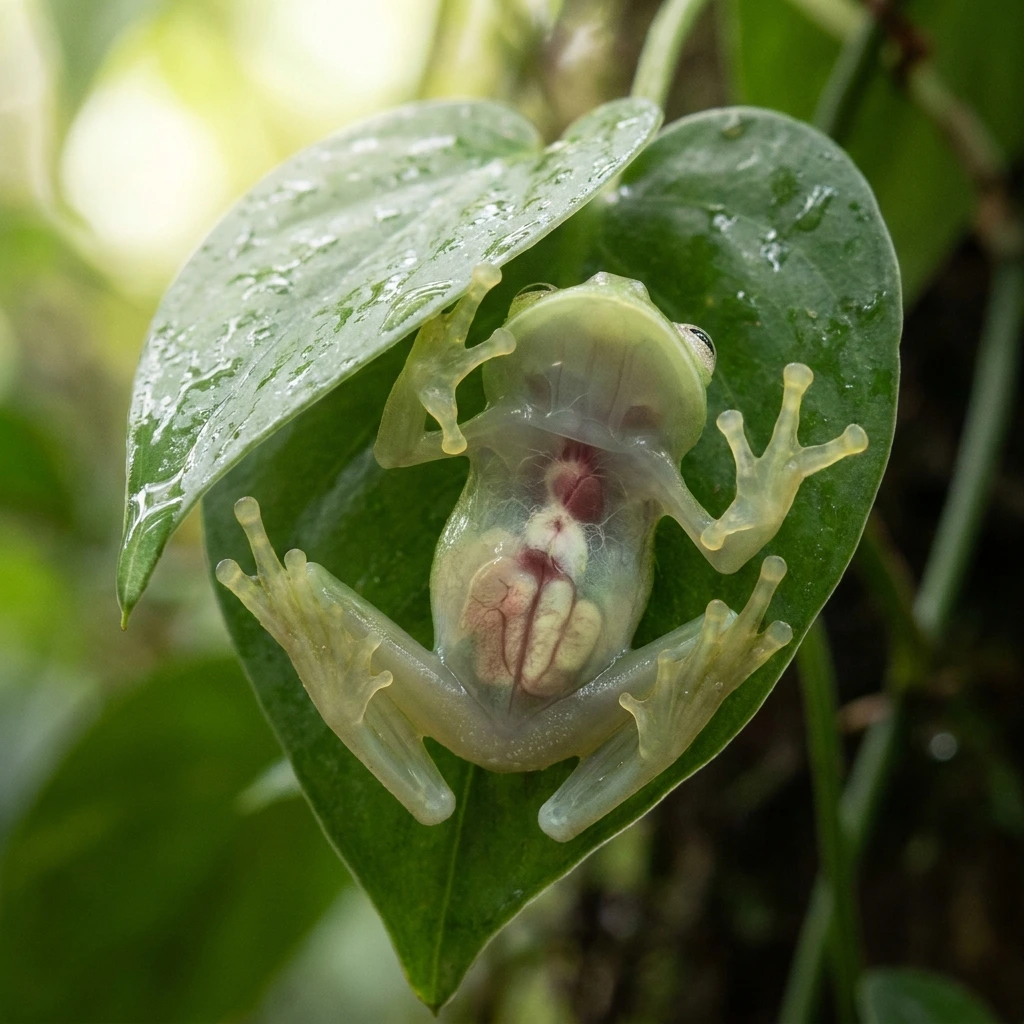
Glass frogs belong to the family Centrolenidae, a group of about 160 species found in the rainforests of Central and South America. What makes them immediately recognizable is their skin: the ventral surface — the underside — is largely transparent. When a glass frog rests on a leaf, you can see its heart beating, its liver positioned in the upper abdomen, its digestive tract, and the outline of its muscles through the skin, all without surgical intervention or special lighting.
This is unusual among vertebrates. Transparency in animals generally works through structural modifications that reduce or eliminate light absorption and scattering — thin tissues, absent pigmentation, low cell density. In most vertebrates, blood alone prevents transparency: hemoglobin, the oxygen-carrying protein in red blood cells, absorbs visible light strongly, giving blood its red color. A transparent vertebrate with functional blood circulation should not be possible, because the blood moving through capillaries would block light transmission.
Glass frogs manage it anyway. A 2022 study published in Science by Carlos Taboada and colleagues, using non-invasive photoacoustic imaging and direct observation of living frogs, revealed how.
The liver as a blood reservoir
When a glass frog is resting — which it does during the day, sitting motionless on a leaf — it sequesters approximately 89% of its circulating red blood cells into the liver, which acts as a dense, reflective storage organ. The spleen also holds a fraction. The effect on the bloodstream is dramatic: with most red blood cells removed from circulation, the blood remaining in peripheral capillaries is nearly clear, dominated by plasma and white blood cells. Light absorption by hemoglobin in the skin’s capillary network drops by roughly 65%, and the ventral skin becomes nearly transparent.
The liver itself is not transparent — it appears as a bright, opaque, pale-green or yellow mass visible through the belly skin. But its reflective opacity is less visually disruptive than the diffuse red coloration that fully circulating blood would produce across the entire ventral surface. The overall effect is that a resting glass frog on a leaf is substantially harder to detect than it would be with a uniformly red-tinged underside.
When the frog becomes active — at night, when it hunts, calls, or breeds — the sequestered red blood cells are released back into circulation within minutes, and the frog’s hemoglobin levels return to normal functional levels for oxygen transport. The transparency is dynamic, not permanent.
Why transparency is not normally viable in vertebrates
The challenge of building a transparent vertebrate is not just cosmetic. Blood is functional. Red blood cells deliver oxygen to tissues; a vertebrate that sequesters 89% of them continuously would be severely hypoxic. Glass frogs avoid this problem by being active at night (when they are opaque and oxygen demands are met by full circulation) and transparent only during daytime rest (when metabolic demands are lower and brief periods of relative hypoxia are tolerable).
There is also the problem of clotting. In most animals, removing red blood cells from circulation and concentrating them in a single organ would risk clot formation as cells pack together at high density. Glass frogs appear to have evolved a protective mechanism against clotting during sequestration — potentially involving an antiaggregatory compound in the liver microenvironment, though the precise biochemistry of this is still being characterized.
The Taboada et al. study noted that the ability to rapidly and reversibly sequester red blood cells in the liver had not previously been documented in any vertebrate, making glass frogs a unique case of active, controlled transparency in the vertebrate lineage.
Dorsal camouflage: the other side of the strategy
Glass frogs are not transparent from above. Their dorsal skin — the top surface — is typically bright green, sometimes with small yellow, white, or black spots, and is opaque. This dorsal coloring matches the surface of green leaves closely. From above, where most avian predators would encounter the frog, it is camouflaged by conventional background-matching.
The transparency is a ventral camouflage strategy: seen from below (against the transmitted light coming through a leaf), a transparent underside leaves almost no shadow or silhouette. The frog essentially blends with the leaf from below by transmitting light through itself rather than reflecting it back. Predators viewing the frog from underneath — fish in streams below overhanging vegetation, or certain spiders — would find a near-invisible animal where a normally opaque frog would be clearly outlined.
This dual-surface strategy — opaque green from above, transparent from below — provides simultaneous camouflage against threats from two opposing directions.
Eggs and the glass frog life cycle
Glass frogs lay their eggs on leaves or rocks overhanging streams, not in water. Males typically guard the eggs, keeping them moist by pressing their ventral surface against the clutch and periodically urinating on them. The eggs develop directly into tadpoles, which hatch and drop into the water below when they are sufficiently developed.
Some glass frog species have eggs with their own form of transparency. The embryo and its surrounding fluid are visible through the egg membrane, making the developing frog visible long before hatching. In several species, the embryo can escape early from the egg membrane if threatened — a behavior called trauma-induced hatching — using an enzyme to dissolve the membrane from within when vibrations or physical disturbance are detected. This is the embryo detecting a predator and initiating early (but viable) hatching as an escape response.
What glass frogs tell us about animal transparency
Glass frogs represent one of the few documented cases of dynamic, functionally reversible transparency in a vertebrate, achieved not by eliminating blood but by temporarily removing it from the tissue that would otherwise be visible. The mechanism is biochemically sophisticated, ecologically functional, and apparently unique.
Research on glass frog transparency is not only zoological curiosity. Understanding how these frogs prevent clotting during red blood cell sequestration at high cellular density could provide insight relevant to biomedical research on stored blood, thrombosis prevention, and the physiology of organs that experience high-concentration red cell exposure. When biology solves a problem elegantly, the solution tends to be worth examining beyond the animal that invented it.
Sources and further reading
- Taboada C et al. “Glassfrogs conceal blood in their liver to maximize transparency.” Science 378(6626):1340–1345. 2022.
- AmphibiaWeb. Centrolenidae — Glass Frogs. amphibiaweb.org. University of California, Berkeley.
- Delia J, Warkentin KM. “Biological variation in embryo development rate and its effects on embryonic and hatchling phenotypes.” Evolutionary Ecology 30:745–764. 2016.