Educational disclaimer. This article is general biological reference. It is not medical advice, not a clinical guide, and does not describe the diagnosis or treatment of any human condition. If you are bitten by any large lizard or wild animal, seek emergency medical care immediately.
For most of the 20th century, the standard explanation for why Komodo dragon bites are so often fatal to large prey — water buffalo, deer, pigs, humans — was sepsis. The conventional story held that the dragon’s mouth harbored such a dense and diverse community of bacteria from scavenged carrion that a single bite would introduce a lethal infection. The prey animal would escape, weaken, and collapse over days, and the dragon would follow patiently and scavenge the carcass.
This explanation is straightforward, memorable, and largely incorrect.
A 2009 study by herpetologist Bryan Fry and colleagues at the University of Melbourne, published in PNAS, demonstrated using MRI imaging, venom gland dissection, and protein analysis that Komodo dragons (Varanus komodoensis) possess functional venom glands in their lower jaws producing anticoagulant and hypotensive compounds. The bacteria story had been intuitive but underexamined. The venom mechanism changed how biologists understand not just Komodo dragons, but the evolutionary history of venom in lizards and snakes broadly.
The venom glands and what they produce
The Komodo dragon’s venom glands are located in the lower jaw, between the teeth. They are not the compact, duct-connected structures seen in vipers or cobras — they are more diffuse, with multiple small compartments. The venom seeps into the spaces between the teeth and is introduced into wounds through capillary action rather than active injection.
Analysis of gland secretions identified compounds including anticoagulants that prevent blood from clotting, agents that cause vasodilation (widening of blood vessels) and a drop in blood pressure, and compounds that promote prolonged bleeding from wounds. The combined effect on a prey animal is that a bite wound continues to bleed heavily, blood pressure drops, and the animal goes into hypovolemic shock — not infection. The process is faster and more reliably fatal than waiting for bacteria to establish a systemic infection.
The dragon’s bite itself is also mechanically damaging. Adult Komodo dragons are large — males can reach 3 meters in length and weigh 70 kilograms — and their serrated, laterally compressed teeth tear rather than puncture, creating large wounds optimized for blood loss. Observations of prey animals after bites show rapid collapse consistent with vascular shock rather than delayed bacterial septicemia.
The Fry study’s broader implication
Fry’s team did not stop at Komodo dragons. They went on to examine venom glands across the Toxicofera — the large clade of squamate reptiles (lizards and snakes) that includes monitors, iguanas, and all snakes — and found evidence of venom glands in many species previously considered non-venomous. Their conclusion was that venom glands evolved once, early in the Toxicofera lineage, and that most snakes elaborated venom delivery while most lizards retained only rudimentary glands.
This reframing made venom not a rare, specialized novelty in reptiles but an ancestral trait that was lost or down-regulated in most lineages and amplified in others. It also means that “non-venomous lizard” is not a clean biological category for many species — it describes a degree of elaboration rather than the simple presence or absence of venom glands.
Hunting strategy: patience and precision
Komodo dragons are ambush predators with a wide prey range. They eat deer, goats, pigs, and water buffalo, and will eat almost any animal matter available to them, including carrion and eggs. Their hunting strategy involves lying in wait near game trails, making a rapid strike at passing animals, and then withdrawing.
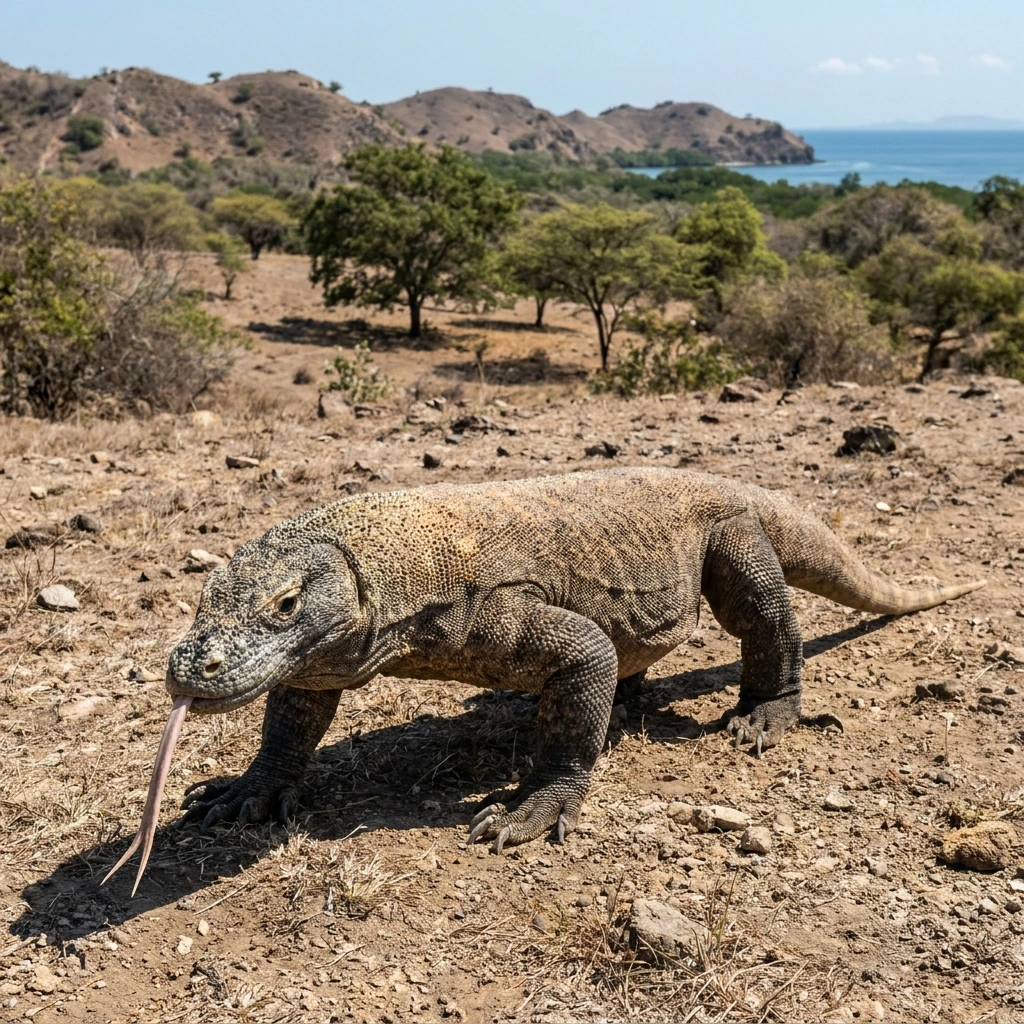
In the case of large prey like water buffalo, the dragon does not immediately kill the animal. The initial bite introduces venom and causes a wound, and the dragon disengages. Over the following hours, the prey’s blood pressure drops, the wound continues to bleed, and the animal weakens. The dragon tracks it by scent, using its deeply forked tongue to sample airborne and ground chemical signals and process them in the Jacobson’s organ (vomeronasal organ) in the roof of its mouth. This chemosensory system is sensitive enough to detect trace amounts of blood or decomposition from over a kilometer away, depending on wind conditions.
Parthenogenesis: reproducing without males
Komodo dragons can reproduce sexually, but females have been documented reproducing through parthenogenesis — producing offspring from unfertilized eggs — in captivity and possibly in the wild. This was first confirmed at Chester Zoo and London Zoo in 2006 when females who had had no contact with males produced viable offspring.
Genetic analysis confirmed the offspring were produced without sperm contribution. The chromosomal mechanism in Komodo dragons (and other varanid lizards) means that parthenogenetically-produced offspring are typically male. This has led to speculation that parthenogenesis in isolated females — such as one stranded without males — could allow a female to establish a colony by producing sons that she then mates with. The ecological plausibility of this scenario is contested, but the genetic mechanism is documented.
Conservation status and range
Komodo dragons are Endangered according to the IUCN Red List, with a total wild population estimated at between 1,300 and 2,100 adults. They exist naturally only on four Indonesian islands: Komodo, Rinca, Gili Motang, and Flores. Most of this habitat is within Komodo National Park, a UNESCO World Heritage Site since 1991.
The primary threats are habitat loss, reduction of prey populations through human hunting pressure, and low genetic diversity within an already limited island range. Climate projections suggest that rising sea levels may reduce the available land area of Komodo and Rinca islands significantly by 2100, with direct implications for the species’ long-term viability in the wild.
The Komodo dragon is not a biological curiosity confined to prehistory. It is a living predator that has been continuously refined over millions of years, producing a combination of ambush technique, chemical sensing, and venom delivery that makes it the apex predator of the ecosystems it inhabits — even though those ecosystems now fit on a handful of small Indonesian islands.
Sources and further reading
- Fry BG et al. “A central role for venom in predation by Varanus komodoensis (Komodo Dragon) and the extinct giant Varanus (Megalania) priscus.” Proceedings of the National Academy of Sciences 106(22):8969–8974. 2009.
- Montgomery JM et al. “The bacteriology of Komodo dragon (Varanus komodoensis) and the existence of a ‘toxic oral bacteria’ hypothesis.” PLoS ONE 7(9):e43405. 2012.
- International Union for Conservation of Nature. Varanus komodoensis. IUCN Red List, 2021. iucnredlist.org