Educational disclaimer. This article is general biological reference. It is not medical advice, not a clinical guide, and does not describe the diagnosis or treatment of any human condition. All content is drawn from published scientific literature.
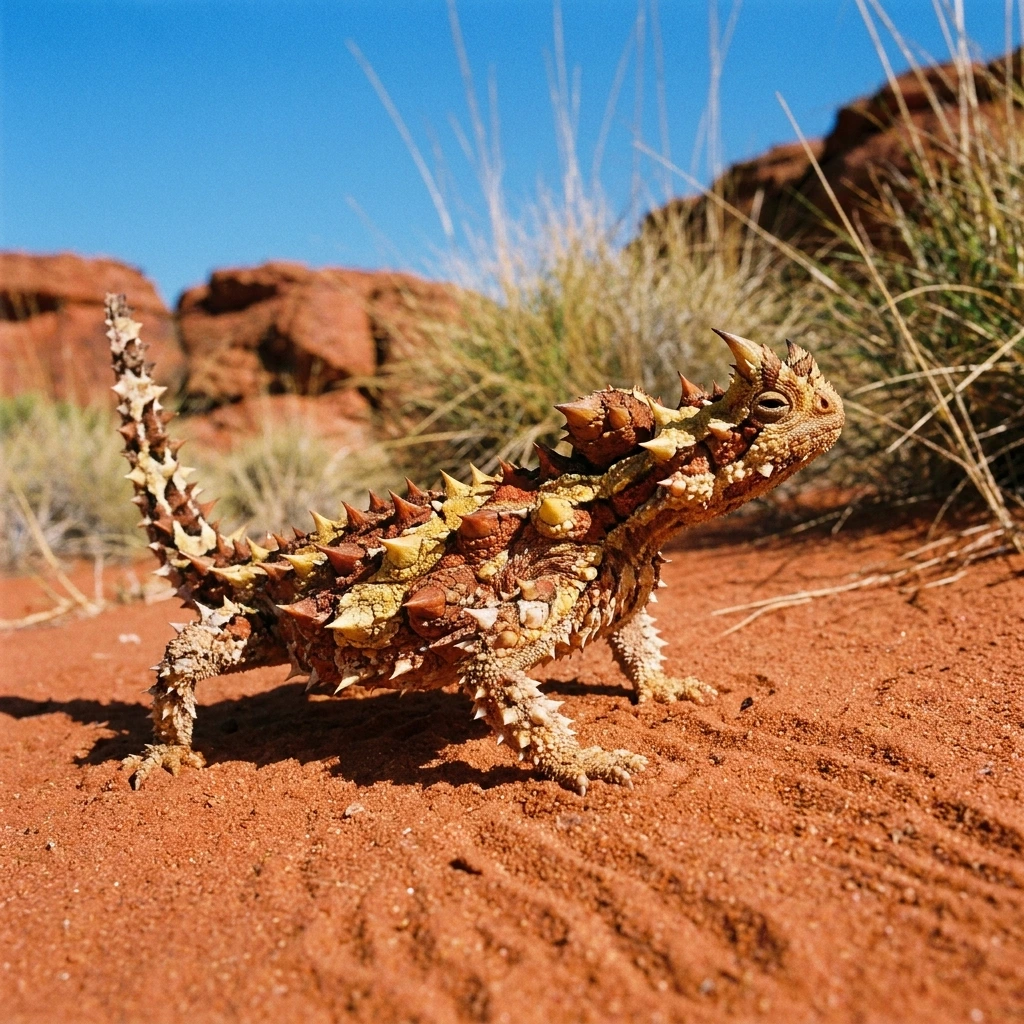
In the arid scrubland of central and western Australia, water is the scarcest resource. Rainfall is infrequent, temperatures are extreme, and open drinking sources are largely absent for months at a time. The thorny devil (Moloch horridus), a small agamid lizard covered in sharp conical spines, solves this problem through a mechanism that has no equivalent in any other vertebrate: it collects water through its skin and delivers it passively to its mouth without any muscular action on the lizard’s part.
Wet sand, morning fog, dew, or light rain contacts the lizard’s skin anywhere on its body. The water moves — through a network of microscopic channels between the scales — to the corner of the lizard’s mouth, where it is swallowed. The lizard does not need to find a puddle, lower its head to drink, or do anything except stand where moisture is present.
How the channels work
The thorny devil’s scales are arranged in a pattern that creates tiny, tightly spaced inter-scale channels. The geometry of these channels — their width, cross-sectional shape, and surface chemistry — causes water to move through them by capillary action: the same physical process that causes water to climb the inside of a narrow tube, or that pulls fluid through the wick of a candle.
In a capillary system, water moves spontaneously against gravity if the tube is narrow enough and the surface is hydrophilic (water-attracting). The thorny devil’s inter-scale channels satisfy both conditions. Water introduced anywhere on the skin surface enters these channels and is directed toward the head by the cumulative geometry of the scale mosaic, which channels water toward a collection point at the mouth corners where it can be swallowed.
This was confirmed experimentally by Werner and Schmitt in a 1994 study and further characterized by Comanns and colleagues in 2015 using micro-CT imaging and colored dye tracers, which allowed visualization of the exact flow paths water takes across and through the scaled surface. The channels form an interconnected hygroscopic network across the entire body surface.
The key constraint is that the system is passive — it operates without muscle contractions, without any energy expenditure by the lizard, and without any active pumping. It functions under the same thermodynamic principles as a paper towel absorbing liquid from a counter.
Standing in wet sand is enough
Thorny devils can collect water not only from rain or fog but from damp sand. When the lizard stands on wet or moist substrate after a rain event, the capillary network pulls water from the sand directly through the ventral scales — the underside of the lizard is in contact with the substrate and acts as an intake surface. The same channels that collect water from above (fog, rain) continue to transport it to the mouth whether the water source is above or below.
This is ecologically significant because in Australian desert environments, precipitation often occurs at night or in the early morning, followed by rapid evaporation. The ground retains moisture longer than the air. A lizard that can harvest water from damp substrate — a resource available for hours after dew has evaporated from surfaces — has access to water long after conventional drinking behaviors would be ineffective.
The false head and other defenses
The thorny devil’s spines are not its only defensive feature. On the back of its neck sits a prominent knob of tissue — a false head or dorsal boss — that resembles a knobbed head from certain angles. When threatened by a predator, the thorny devil tucks its actual head downward between its front legs, presenting the false boss as an apparent head instead.
The adaptive value is straightforward: a predator seizing the false head encounters a mouthful of spiny, hard tissue rather than the vulnerable real head. Birds, large lizards, and snakes are the primary predators of thorny devils, and all are likely to make strike-for-head attempts.
The combination of spines (which make the lizard difficult to swallow whole), cryptic coloration (the thorny devil’s ochre, brown, and tan patterning matches the sandy substrate closely), and the false head gives it a layered set of defensive strategies operating before, during, and after a predator’s initial attack.
A specialist diet
Despite its dramatic appearance, the thorny devil is an extreme dietary specialist. It feeds almost exclusively on small black ants (primarily Iridomyrmex species), lapping them up individually with a sticky tongue at rates of up to 45 ants per minute. A single meal may involve consuming several thousand ants.
The specialization has several consequences. The lizard’s jaw musculature, tooth morphology, and digestive chemistry are all optimized for small, ant-sized prey with a chitinous exoskeleton. It does not attempt to eat larger insects, spiders, or other lizards. This restricts its habitat to areas where appropriate ant species are reliably available, which constrains its range more tightly than its water requirements alone.
Engineering applications
The thorny devil’s skin geometry has attracted the interest of materials engineers and biomimetics researchers. The passive transport of water through capillary channels cut at specific angles and widths is directly applicable to several engineering problems: passive microfluidic devices (which move liquids through circuits without pumps), fog-collection surfaces for arid regions, and self-wetting heat exchangers.
Several research groups have fabricated biomimetic surfaces modeled on thorny devil scale geometry — using laser cutting, photolithography, or 3D printing — and have demonstrated directional water transport matching or approaching the efficiency of the biological original. The thorny devil’s skin thus became a blueprint before engineers fully understood the mechanism, and the mechanism, once understood, is proving applicable to problems the lizard has never encountered.
Why it matters beyond the animal
The thorny devil illustrates a principle that appears repeatedly in the biology of extreme environments: problems that seem to require active energy expenditure can sometimes be solved passively if the geometry is right. The lizard doesn’t pump water. It doesn’t chase water. It built its skin to collect water while standing still.
For a lizard living in a desert where every calorie of metabolic expenditure matters and where behavioral thermoregulation already consumes a large fraction of daily activity budgets, a passive water-collection system is not a minor refinement. It is a solution to a central survival problem that requires no behavior at all.
Sources and further reading
- Bentley PJ, Blumer WF. “Uptake of water by the lizard Moloch horridus.” Nature 194(4829):699–700. 1962.
- Comanns P et al. “Moisture harvesting and water transport through specialized micro-structures on the integument of the Australian thorny devil (Moloch horridus).” Beilstein Journal of Nanotechnology 2:204–214. 2011.
- Australian Museum. Thorny Devil, Moloch horridus. australian.museum